
Outsourcing in the Philippines

small business owner

When and How to Outsource for your Small Business

Most entrepreneurs and small business owners have enormous talents but oftentimes they think they can do it all. This mindset can really hinder the growth of the business. Through outsourcing, they will have more time to focus on their core competencies to generate income. 

Business owners and entrepreneurs have long seen outsourcing as a strategy used by big businesses or large corporations, but technology has made this incredible resource more accessible to startups and other small businesses. For many startups, outsourcing has made a powerful impact not only on their growth but also on their efficiency, productivity and bottom lines. 

More and more businesses in the SME category are outsourcing or utilising offshore teams to do repetitive day-to-day back-office tasks because of technology. The advancing technology allowed professionals to be able to work from anywhere in the world. Couple that with the availability of extremely qualified and talented professionals. Whether it’s a virtual executive assistant, digital marketing professional, graphic designer, bookkeeper or web developer, there’s a large pool of these talents in countries like the Philippines. The utilisation of offshore staffing helps small businesses save on overhead costs. It removed the burden of paying overhead associated with payroll taxes and expenses such as health insurance and salary, as well as the office space constrictions that growing a company in-house can present.

When to outsource

Taking the first steps toward outsourcing can be a daunting task and extremely time-consuming. But figuring out how to build a more sustainable business with help from outside professionals can offer increased productivity, efficiency and economies of scale.  According to David Walsh, an entrepreneur and author of Source Control, “Progressive entrepreneurs realise the unstoppable power of outsourcing to handle aspects of their business that are essential but simply don’t make sense for them to deal with personally.”

The right time to outsource is different for every company. Some businesses have in-house employees to handle daily activities but may need outside help to tackle new projects that are beyond their capabilities and capacities. It’s when you and your current staff are unable to manage the daily business of your company and do it satisfactorily, it may be the right time to consider outsourcing. For entrepreneurs, the realisation may come when you had no time left in your day to pursue the growth of your business. If you want your business to thrive, you have to let go of some control and start delegating. 

According to Tonya Thomas, president of The Small Office Assistant, it’s recommended that startups and very small businesses start outsourcing from the very beginning. She suggested starting out with a virtual assistant and a bookkeeper and growing the team from there. 

What to outsource

Almost any task can be outsourced these days with many outsourcing and offshore staffing firms in countries like the Philippines offering access to a large pool of talented and qualified English-speaking professionals. But just because you can outsource a task or a project doesn’t mean you should. 

Business owners should take a hard look at their business and determine their strengths and values. Startups and small businesses especially must identify their core competencies and capabilities. 

Here are two general categories of the types of tasks that are best outsourced: 

  • Highly repetitive tasks. Some examples are data-entry, accounts payable, website tasks such as moderating comments, blog writing, content creation, SEO and social media tasks.
  • Specialised knowledge. An example is IT support for your network or accounting system. 

Related: Here are 4 tasks that entrepreneurs should consider outsourcing.

Finding the Right Outsourcing Provider

Although technology makes it a lot easier to find capable, reliable outsource providers, the selection process is still extremely important. There’s no better place to start than your own network; ask other entrepreneurs or your accountant, lawyer, or banker if they can recommend a provider that offers the services you need. Online networks like LinkedIn and Facebook make it easy to grow your personal networks and to ask for recommendations.

Others are also able to locate outsource providers through brokers like Outsource Accelerator. They are the leading Business Process Outsourcing (BPO) marketplace, advisory & operator for businesses across the globe. They connect startups, entrepreneurs and business owners of small-to-medium sized companies with the top outsourcing providers in the Philippines while helping them learn about, engage and integrate outsourcing into their businesses.

Whether you use a personal referral, a web-based broker or marketplace, or a consultant, the key to choosing the right provider is to know exactly what you’re business needs are.

Focusing on identifying your performance metrics for each task that you want to outsource is critical. There are some outsourcing providers that focus on speed at the expense of quality or vice versa. This is fine as long as there is a good match between what the small business wants and what the provider specialises in. In the Philippines, there are BPOs that specialise in customer service support for big companies like Slack, Google, AT&T, Skype to name a few who require a larger call centre operation. Others specialise in assisting the SME market like Dynamic Business Outsourcing Solutions (DBOS). DBOS’ business model allows full flexibility to scale up and down from 1 staff to 50+ which is perfect for startups and expanding businesses. Many small businesses don’t realise these massive differences among outsourcing providers and select the wrong ones. It’s essential to have an open and transparent conversation with potential partners regarding these key performance metrics.

Making it Work for your Small Business

Your work does not end yet once you’ve found a provider. You need to put in some extra time creating a specific contract that outlines exactly all the key performance indicators. You need to ensure that your provider focuses on what is most important to you rather than their own preferences or assumptions of what you want. 

Set your expectations and the steps included in the job as clearly as possible. Never assume that your provider is thinking what you’re thinking. And even when you clearly set your expectations, there will always be a learning curve on the provider’s side so just be patient. The provider will get better, and you will soon have the freedom to focus on more important tasks. 

Finally, your last responsibility to become a successful outsourcer is to relinquish some control and allow your new offshore team to do the job you’ve hired them to do. A measure of trust is required to be successful at outsourcing. Remember that the whole point of outsourcing is to save your valuable management time and attention. You also have to realise that removing yourself from low-level operations is the smartest investment you can make for the long-term success of your business.

Determining the Costs vs. the Benefits

The costs of allowing you to get away from the day-to-day tasks and build a better business depend on the type of work that you’re buying. You also have to consider the skill level of the employees you’re planning to hire and the location of your provider.

In the Philippines, outsourcing companies like DBOS offer a flat structure monthly fee which covers all the dedicated staffing solutions:

  • Staff’s salary package
  • Staff’s workstation
  • Electricity and internet access
  • HR support
  • IT support
  • Admin support
  • Orientation
  • Payroll processing
  • Benefits management
  • Performance monitoring and evaluation
  • Engagement and recognition programs
  • Meeting and boardroom access
  • Access to pantry and supplies

This type of fee structure allows businesses to save between $20,000 to $40,000 per employee annually. 

It cannot be any more true that you get what you pay for wherever you go in the world. Regardless of location, you always have to pay someone what they are worth. Leveraging the currency differences though can often work in your favour. 

Overcoming the Challenges

Outsourcing does not guarantee success every time. While it yields great advantages for a startup or small business, there are always challenges. 

  • Language and timezone barriers. Making sure that your own communication is clear can help overcome confusion for non-native English speakers. Time zones, on the other hand, create more opportunity than an inconvenience. You can extend your productive hours by assigning tasks over to your offshore team during your workday and wake up to find it complete and ready for you.
  • Security risks. There is always some level of security risks involved when handing over tasks to an outsourced provider. You need to ensure that you’re not risking any employee personal information and customer data. Choose a provider that allows clients to maintain their intellectual property and full process and data control. Or provide them with only the absolute minimum data necessary for them to do the job. Otherwise, for general sense, always review your provider’s security policy and practices.

Earning the Benefits of Small Business Outsourcing

Despite the risks, outsourcing offers small business owners great advantages. It’s an affordable and proven strategy for growing your business without letting it consume all your time. Outsourcing can bring back your focus on your core competencies and allows you to spend your time setting new goals and finding ways to fulfil them. 

timezone

Outsourcing to the Philippines: Managing the Timezone Differences

Majority of Philippine outsourcing companies offer to work almost the same office hours as their clients. They will work according to your timezone, whatever it may be. This is one of the many attractive propositions to clients located in Australia and New Zealand.

A normal and comfortable work shift in the Philippines would-be 7:00 AM to 4:00 PM. Without the dreaded Metro Manila traffic and with ample preparation, Filipino staff could comfortably come in as early as 6:00 AM and stay late until 5:00 PM. Sometimes, to avoid the rush hour, some employees choose to stay even a lot later. 

More and more Australian and New Zealand businesses choose to outsource to the Philippines, instead of other known outsourcing destinations. 

The timezone gap between the Philippines and these countries are minimal which allows a more real-time communication and interaction between the onshore manager and their Filipino staff. This is extremely important in building a good working relationship, better collaboration and making your Filipino staff feel like they are part of the team. 

Filipinos are also very family-oriented so working a day-shift allows them not only to live a healthier life but also spend more time with their families and friends.

But this doesn’t mean that companies in Europe and North America are in the disadvantage. Many of the BPO companies now have higher flexibility in providing services in different timezones. 

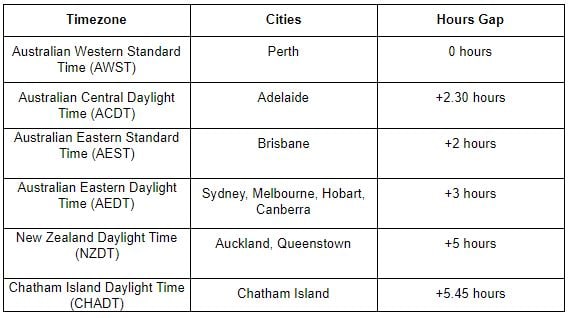
Here’s a quick overview of the time differences between the Philippines and some of the key cities in AU and NZ:

timezone-table

In Australia, New South Wales, Victoria, South Australia, Tasmania, and the Australian Capital Territory observe Daylight Saving Time (DST). Whilst Queensland, the Northern Territory and Western Australia do not observe DST.

Daylight Saving Time starts when the local standard time is about to reach Sunday, 4 October, 02:00:00. The clocks are turned forward 1 hour to Sunday, 4 October, 03:00:00 local daylight time instead. It ends when the local daylight time is about to reach Sunday, 5 April, 03:00:00. The clocks are turned backward 1 hour to Sunday, 5 April, 02:00:00 local standard time instead.

During DST, the clocks on the Chatham Islands are also turned forward 1 hour from UTC+12:45 to UTC+13:45. It starts on the last Sunday of September and ends the first Sunday of April, the same as mainland New Zealand.

Here at DBOS, not only that we personalise and make offshore staffing an affordable option for startups and expanding businesses, but we also make collaboration and communication with our Australian and New Zealand partners very simple. 

Our remote management system provides our clients with full control and visibility to their Philippine-based operations using their chosen tool and system. This addresses the pain points when working on a different timezone and with a geographically separated team. 

As labour costs in Australia and New Zealand continue to rise, startups and expanding companies find the low wages and minimal timezone gap in the Philippines attractive and practical. In fact, the Philippines has overtaken India as the leading call centre country. This subsector added around 10% in the country’s economy in 2015. The expansion of the BPO industry to other provincial regions such as Cebu and Davao was also a key factor for the country’s continuous growth. You can learn more about the best outsourcing locations in the Philippines on one of our previous blogs. 

graphic-designer

Why You Should Outsource Your Graphic Designer in the Philippines?

Having a well-designed graphics is one of the best ways to help your business stand out in the market these days. But without the time and the right resources to hire a graphic designer locally, this could be a daunting task for you and your business. 

Using design tools that offer ready-made templates don’t resolve the problem either. Not only that these tools can be pricey, but you’re also sharing the designs and images with thousands of other people. It can also be extremely time-consuming having to choose from hundreds of different templates. This is why many businesses of all scales across the globe are now choosing to outsource their graphic design activities to countries that offer graphic design services with lower labour cost such as the Philippines. And doing so allow their businesses to divert important resources and time towards their core-competencies. 

Why choose outsourced graphic designer in the Philippines?

The significant cost-savings has always been one of the main reasons why many choose to outsource their graphic designs in the Philippines. But it doesn’t mean that the quality of work is compromised by the reduced cost. Most of the time, you’ll get the same quality as the local resource, sometimes even better.  The Philippines has one of the most talented graphic designers in the world. In fact, in 2015 a Filipino woman graphic designer was recognised for her work. Lucille Tenazas’ body of work makes you think it was made by some renowned Brazilian or European designer. She was chosen as one of America’s best 40 design innovators. She has then conquered America, is respected in Europe and still conquering the world. 

In the Philippines, on top of the exceptional skills and natural talents, designers are extremely proficient and adaptable to design trends and new technologies being used in the graphic design industry. And of course, Filipinos are known for their strong grasp of the English language so swift communication is almost guaranteed. 

There are a lot of compelling arguments that set the Philippines apart from other outsourcing destinations. We trimmed it down into six main arguments.

Filipinos are excellent English communicators 

The Philippines has a 94% literacy rate and 70% of the population are fluent in English making it one of the largest English-speaking countries in the world. No one in Southeast Asia speaks English more fluently and naturally than the Philippines. The influence of the Americans and Spanish colonisation continue to be evident. From the educational system which follows that of the United States, up to the movies and tv shows that they watch and enjoy.

Filipinos have global influences

The Philippines has diversified cultural influences. Most of these influences are results of the previous colonisation, originating mainly from the culture of Spain and the United States. Having been exposed to those cultures, Filipinos often look up to influences from different parts of the world when it comes to their creative ideas. A global competitive edge that Filipinos continue to be known for globally.

Lower labour costs

In the Philippines, the rates are significantly lower than in Australia or New Zealand so you’re guaranteed to get great quality of work at a much lower cost. You can save up to 70% annually on wage costs per employee in the Philippines.  

Filipinos are multi-talented

The Philippines housed some of the most talented and dynamic workforces in the world. Young employees nowadays are incredibly versatile, especially in the marketing and design industry. They are required to learn multiple skillsets which have become a great attracting factor for employers locally and abroad. For SMEs and startup who don’t have the resources yet to hire a team, hiring a graphic designer who can also do some web development or a writer who can also do SEO will be a great asset.

Filipinos are easy to deal with

Filipinos are known for their friendliness and hospitality. Where ever you go, you will be greeted with warm smiles and hellos. It’s no different in the workplace. Filipino workers are one of the most fun and joyful people to work with. They are naturally patient, calm and understanding, so communicating with them is an easy task. 

Filipinos spend the most time online worldwide

According to reports, the Filipinos spend the most time online on social media worldwide. They beat Thailand for most time spent online for the 4th consecutive year. The Philippines also tops the world in terms of internet usage in front of a laptop or desktop computer. They clock in 5 hours and 4 minutes daily which is way above the global average of 3 hours and 28 minutes. This makes the hiring process a lot easier as you can tap a large pool of talents online. Reaching them is also a breeze because they are always online. 

Outsourcing some of your workforces regardless of the industry you are in or the size of your company comes with heaps of benefits. The significant cost savings alone can not only help your bottom line but also free up funds and time for growth and expansion. With the large pool of talents in the Philippines, you’re guaranteed to find the right employee or team for your business. Certainly, hiring an outsourced graphic designer in the Philippines will be one of the best business decisions you’ll ever make. 


bpo-marketplace

Back-Office Outsourcing: How to Remain on Top of a Competitive Marketplace

When a company wants to stay on top or improve their competitive position in a highly competitive market, they typically look to doing something internally to transform their position whether it’s learning a new technology, developing an innovative process, or even adopt a new business model.

These traditional strategies for enhancing competitiveness are sound but not the only option. More and more organisations turn to outsourcing to improve the competitive landscape, reposition their companies, or restore how they do business.

Thus, small and medium-sized enterprises (SMEs) are trying to find the most suitable offshore back-office provider that will help them achieve success.

With all the tasks available for outsourcing, and a lot of choices, finding the most equipped provider for your service is not as easy as it sounds. So, to keep up with the competition, most importantly with the industry giants, outsourcing providers have become very aggressive.

The demand for back-office outsourcing services

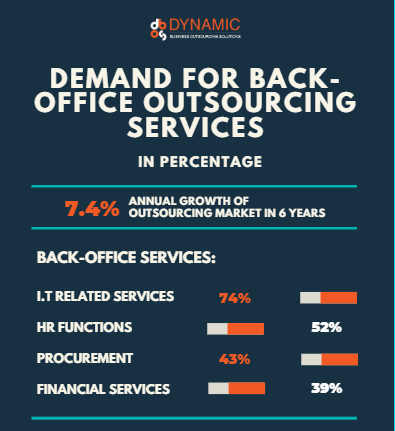
On a recent study, it is said that the outsourcing market is expected to see an annual growth rate of 7.4% in the next 6 years. Partially, this is because businesses are looking at becoming more global, complex, and digital to keep up with the trend. So, the initial step is to adopt the latest developments and work on better strategies to properly outsource.

marketplace

Along with the demand for call centre agents, other popular services today include back-office outsourcing services. Based on the latest data, 74% of companies outsource IT-related services, 52% on HR functions, 43% procurement, and 39% on financial services.

But first, how well do we know back-office outsourcing?

What is back-office outsourcing?

Back-office outsourcing is the process of delegating non-customer facing operations to a third-party supplier. The most common back-office services outsourced by companies are administrative tasks that require a certain level of skill.

Most startup entrepreneurs venture in fields that they are good at. However, to make the business running, there are other positions that must be occupied too. Some of which include; HR, payroll, accounting, marketing, and other support tasks.

Some companies try to do these tasks themselves but eventually didn’t get the results that they wanted. Most of the time, they ended using up all their time and fail in focusing on their core competency.

Why do businesses choose to outsource?

Both small and big companies have been outsourcing for a long time. Their number one reason remains to be for cost-savings. But, there are a lot more reasons to consider aside it. With outsourcing, businesses are not only expected to save a huge heap of money but also gain more time to focus on their main goal. Other entrepreneurs also take this time to make sure that they use their free hand in creating better strategies to expand their businesses.

Most of the time, there are telltale signs that prompt you to outsource, especially when you need it most, watch out for those.

Conclusion

Given the overwhelming advantages of outsourcing, back-office outsourcing is becoming increasingly strategic and even a game-changer.

Back-office outsourcing is changing how business is done. It is a powerful way to improve business focus, achieve better resource utilisation and allows the business to gain a competitive edge in the industry.

Now, we here at DBOS believes that if it is not your cream of the crop, then you should delegate it to the experts. And as an outsourcing company in the Philippines that holds a reputation for providing the best services to all our clients, we make sure to pick only the best talents. Our main goal, to help our clients grow their businesses while saving up to 70% on their labour costs.

Want to know more? Contact DBOS today and get a free consultation with our CEO/Founder.

locations

Top 4 Best Outsourcing Locations in the Philippines

Over the years, the Philippines continuously make headlines and breakthroughs in the world of outsourcing. In 2010, the country was then declared as the world’s BPO capital with 525,000 employees in call centres and $8.9 billion in revenue. After a year, numerous BPO companies started to open up their businesses in strategic locations inside and outside the Metro. That specific year started the progressively exciting year for the outsourcing industry.

With numerous contenders on the business processing outsourcing industry around the world, the Philippines soared high and has reached its peak in 2015. Formerly known as “the sick man of Asia”, the country immediately rose as the “tiger economy of Asia”, with outsourcing as its most income-generating industry.

However, not all foreign investors were impressed by this feat and some were even clouded by second thoughts. But then, a massive number of startup companies suddenly started to take risks and experience the perks of outsourcing their services to the Philippines.

PEZA special economic zones

Now, not just anywhere in the Philippines is a great location to outsource. There are strategic business districts in the country called PEZA Special Economic Zones. And out of all the industries under these economic zones, the BPO industry has benefited the most from it.

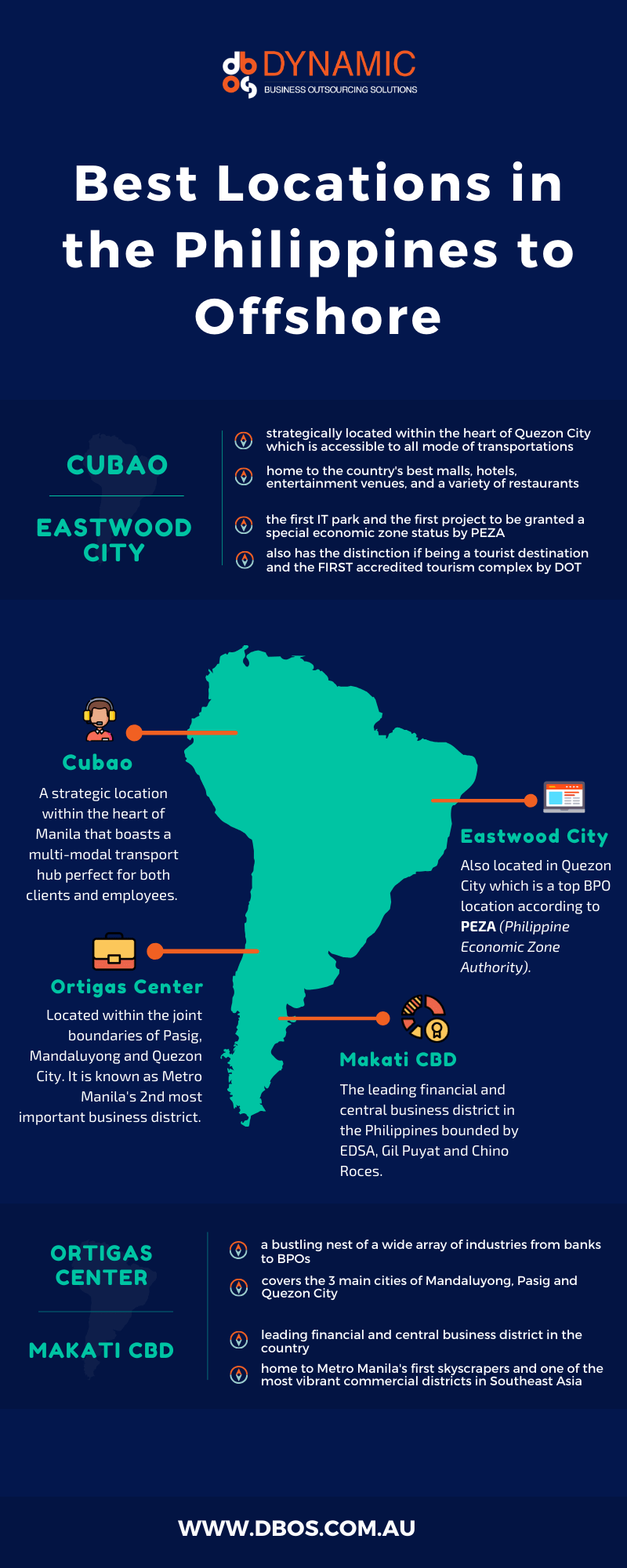
To date, there are 379 operating economic zones in the country which is mostly comprised of IT parks and centers. Most of them are located in Metro Manila, specifically in Eastwood, Cubao Quezon City, Makati, and Ortigas.

locations

To build more of these economic zones, currently, there are 139 under development, 99 of which are IT parks and centres.

If you would notice, the first PEZA economic zones are all strategically located in places most accessible to the general public. This is also because most career-driven individuals move into the Metro as there are better opportunities than in provinces on the country. However, as more people move to the capital, it has become highly congested. To veer away from the already overpopulated Manila, more IT parks and centres are being built outside the capital. This move attracts more companies to invest in the country while boosting the economy, as well as tourism.

4 Best Locations in the Philippines to Outsource

Aside from the numerous benefits that companies can get from starting their BPO businesses in the Philippines, there are PEZA incentives. But to get those privileges, entrepreneurs should be familiar with the strategically-located economic zones that PEZA approves. Here are some in the Metro:

Cubao, Quezon City

locations-cubao
Photo from ASYA Design.

Locations highly matter for businesses, especially for the BPO industry. Not only it is a great advantage for clients and customers, but also the employees.

Cubao has been a famous BPO hub since the peak of outsourcing because of its accessible location that entices great clients and talents. Since then, BPO companies in the area have been randomly popping up everywhere. And to continuously meet the ever-increasing demand of PEZA-accredited corporate offices, The Spark Place was built. Following the long line of BPO companies in the building, it also serves as home to DBOS for 5 years.

Nonetheless, there are only a few certified zones in the area. Some of which also includes the Araneta Center Cyberpark which has 2 towers with 33 floors of office space each.

Eastwood City

locations-eastwood

Eastwood City is a special case among all strategic locations for outsourcing in the Philippines. It is the first IT park and the first project to be granted special economic zone status by PEZA. Although technically, Eastwood City in Libis is still a part of Quezon City.

In addition to that, Eastwood is not just a business district, it is also a residential community that allows clients from keeping their home close to their business. With this, it has become a top dollar-earner in the Philippines over a couple of years. Accessibility wise, the ride from Eastwood to Cubao only takes a couple of minutes. If you live in Eastwood, there is a possibility that you might never move out because everything that you need is within its 18.5 hectares. High-end malls, entertainment complex, sports hub, and many more are provided in that location alone. These attractive features are the biggest reason why DBOS choose this location to build another office that will be launched this year.

Ortigas Center

locations-ortigas

Ortigas Center is located within the joint of Pasig, Mandaluyong and Quezon City. It is a central business area that is highly considered as the second most important business district that after Makati. Like other business districts in the Metro, it is home to many shopping malls, office spaces, and condominiums. Established for a very long time, Ortigas Center has been the headquarters for one of the largest and most diversified conglomerates in the country. It is also where one of the largest malls in the nation – SM Megamall is located.

The transportation to and from Ortigas Center is very easy as it is surrounded by the streets of Ortigas Avenue, EDSA, C-5 Road, and Shaw Boulevard. However, traffic is very bad in this area.

Makati CBD

locations-makati

As the leading financial district in the country, Makati is where the Manila skyscrapers are found. The country’s tallest office building is also in this area and is known as one of the most vibrant commercial districts in Southeast Asia. More than a hundred multinational companies listed in Forbes Global 2000 have also built their regional headquarters in the CBD.

Years ago, working in Makati was a prestigious achievement for job-hunting people. But as time changes, the Makati area has become one of the worst traffic-congested places, especially during rush hours. And although opportunities are there, talents are backing out because their travel time to and from work almost takes half a day.

Conclusion

If you choose to outsource in the Philippines, find a company that value things like travel time, locations-wise, accessibility to both clients and employees, as well as other factors that can affect on how your business will be impacted directly or indirectly.

With DBOS, you don’t have to worry about things like such. Our head office is strategically located in a PEZA-certified building – Spark Place Cubao and our upcoming office will open its doors in Eastwood – two of the most accessible business districts in the Metro. As we highly value the convenience of both our staff and clients, we only offer dayshift schedules. On top of that, we made sure to get the right talent as we help them save up to 70% on their labour costs.

Want to know more about our services? Contact DBOS today and get a free consultation with our CEO/Founder!

HR

8 Fundamental Benefits of Embracing Big Data in HR

The HR department in any organisation is pivotal. It plays one of the most important roles in a business because it handles strategic planning, company image, acquiring the right talents, and hiring. With all the tasks that HR personnel should do, the introduction of using big data has become a huge breakthrough in running the department.

What is Big Data?

According to SAS, the term “big data” refers to the data that is so large, fast or complex that it’s difficult to process using traditional methods. The idea was there for a very long time, but this concept gained momentum in the early 2000s.

Doug Laney, an industry analyst, enunciated the importance of big data as the three (3) V’s.

1. Volume: In businesses, data could be collected from a variety of sources including transactions, smart devices, videos, documents, and so much more. In previous years, storing big volume data takes up a lot of space on external hard drives and backups on other storage devices. Nowadays, there are affordable online platforms that could ensure security for any volume of data.

2. Velocity: The data streams that businesses acquire comes at an unprecedented speed and must be handled in a timely manner.

3. Variety: There are a huge variety of data. Whether structured or unstructured text documents, databases, emails, videos, audios, graphics, and others, the big data sure can handle it all.

Why is Big Data Important?

In today’s innovative world, using big data has become highly important. Initially, it doesn’t just focus on how much data you have, but what you can do with it. While all of those could be overwhelming to analyze and manage, big data enable cost reductions, time reductions, new product development, optimized offerings, and smart decision making.

While all those important aspects of acquiring big data alone is a huge feat, let us also find out what’s in it for the HR department.

HR

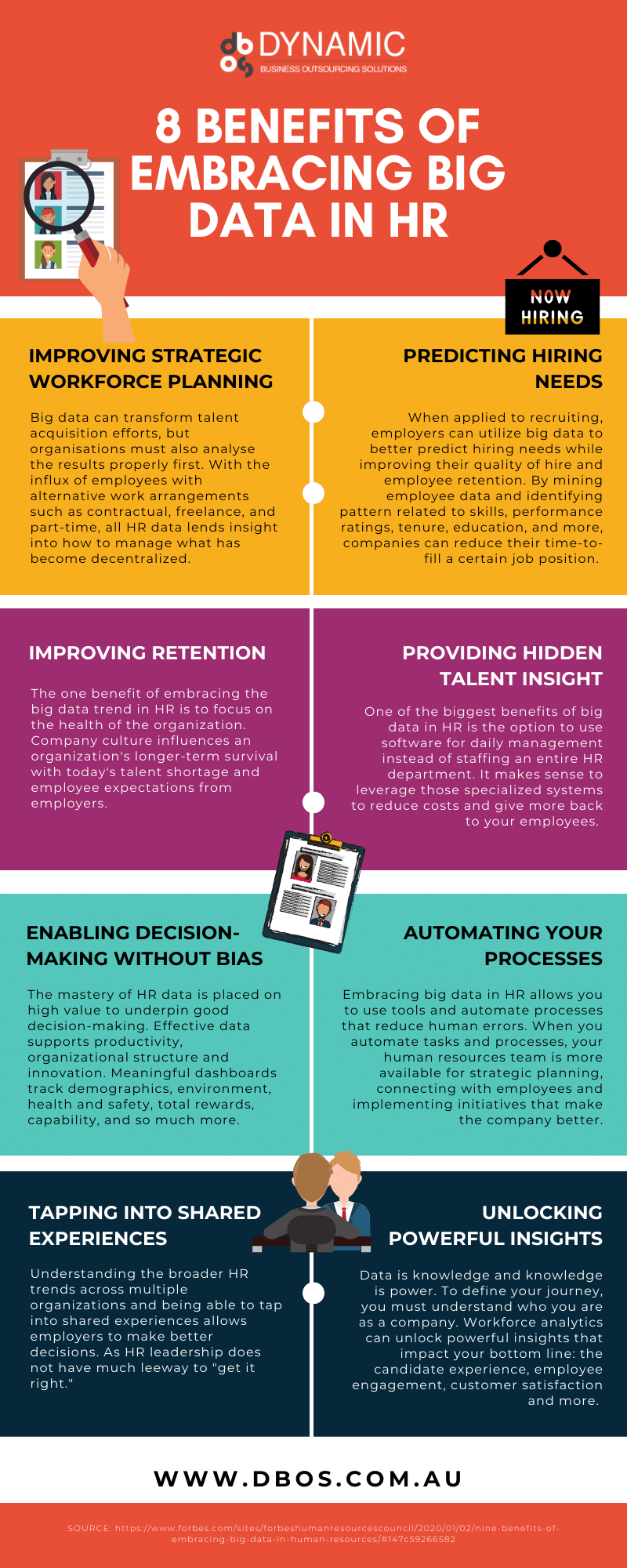
8 Benefits of Embracing Big Data in HR

Traditionally, the HR department is one of the busiest and most cluttered places in an office setting. Papers piled up on desks and file cabinets lined up everywhere are just normal during this time. Sorting all those files take up a lot of energy, manpower, and time. However, technological advances came fast and most businesses became reliant on outsourcing.

Moving forward, a lot of advanced years came by and the usage of online storage became a hit. Companies are suddenly going paperless and fewer people are needed to run a department while most are utilised for other roles.

Suddenly, HR outsourcing in the Philippines became famous and even the smallest entrepreneurs use this practice. To learn more about the usage of big data in human resources, check out these benefits:

1. Improving strategic workforce planning

Big data has the ability to sort all candidates by their specific skill sets, work arrangement options, work experience and other categories. This help businesses tap into a very precise talent pool and immediately exclude other candidates that do not pass the qualifications. By doing this, the HR department can save more time to look at a broader talent pool.

2. Predicting hiring needs

One very specific benefit of big data in HR is that it helps employers improve their quality of hire. It also strengthens employee retention and better predicts hiring needs. By mining employee data and identifying their pattern of skills, performance, education, professional experience, and more, then hiring the right talent would be so much easier.

3. Improving retention

According to a relevant HR study, the company culture hugely affects employee retention. With big data, HR can now immediately identify if a candidate and their personality align with the company values and goals. For an organisation’s long-term survival, employee retention is the key.

4. Providing hidden talent insight

The use of big data in HR lessens the actual number of staff needed in the department. So, instead of employing a whole HR department, the company can actually cut the number and have them do other things that will help with their career growth. Now, this is where hidden talents could be discovered.

5. Enabling decision-making without bias

By implementing big data in HR, decision-making would be quicker and simpler. There won’t be any issues of being biased, because all of it will be based on actual numbers. And so, the HR people will be able to accurately track the demographics and performance of each and every employee.

6. Automating your processes

Embracing the use of big data in HR allows you to use tools to automate your processes. On the other hand, your human resources team will be more available for strategic planning, reaching out to employees, and finding more ways to engage and support them.

7. Tapping into shared experiences

Being exposed to HR trends in other industries allows employers and their staff to get better ideas. It will also aid the HR leaders to create strategies that would best fit the organization they belong to. This drives new big data analytics and AI-powered solutions onto the market.

8. Unlocking powerful ideas

As analysing data can give you other points of view to focus on, it can also unravel more ideas that could later turn into an opportunity that will change the way companies handle their HR.

Conclusion

The implementation of big data in most companies is an advanced move that will help the business reach, understand, and target their supposed audience. On the other hand, the HR department is indeed a huge beneficiary of big data.

So if you’re thinking about working with an outsourcing provider who shares your goals and aspirations, check out DBOS and get to save up to 70% on your labour costs!

Contact us today and get a free consultation with our CEO/Founder.