
Customer Support Service Outsourcing

customer-service-agent

Essential Customer Service Outsourcing Trends for 2022 and Beyond

The customer service outsourcing landscape is constantly evolving. And since the pandemic lockdowns have drastically changed how we work, it’s more important than ever to keep abreast of global trends. With this knowledge, organisations can adapt quickly if and when the next disruption arrives.

Robotic Process Automation (RPA) and autonomous Artificial Intelligence (A.I.)

While A.I. has been a trendy topic in customer service outsourcing for quite a while, RPA is slowly but surely following in its footsteps. RPA is a technology that allows software bots to mimic human actions to complete specific tasks such as data entry and simple complaint resolution.

RPA reduces the customer service staff’s workload and minimises the risks of human error. In an industry where even the slightest mistake can cause considerable work disruptions, having an RPA is a highly desirable feature for businesses looking for customer service outsourcing partners.

Chatbots and Niche Talent Acquisition

One of the products of A.I. technology is the now ubiquitous chatbot. They’re computer programs designed to simulate human conversation and are on almost every platform these days. They are becoming increasingly popular in customer service outsourcing because they can handle simple customer queries quickly and efficiently.

However, customers can easily pick up on whether they’re talking to bots or a real person and prefer the latter. This is why customer service outsourcing providers are now turning to niche talent acquisition to find customer service reps with the right skill set in working with A.I. bots to find custom solutions to complaints.

Rising Demand for Tighter Cybersecurity Systems

It’s no secret that the customer service outsourcing industry has been hit hard by data breaches in recent years, leading to a massive rise in demand for customer service providers that can offer tighter cybersecurity systems.

Data breaches often occur because customer service reps have access to sensitive customer data, such as credit card numbers and contact information. This data can then be sold on the black market or used to commit identity theft.

To protect their customers, customer service outsourcing providers are now investing in advanced cybersecurity systems, such as two-factor authentication and encryption. They are also conducting regular training sessions for their staff on identifying and preventing potential cyber threats.

Shift to Omnichannel Customer Service

Customers are everywhere, making it challenging to keep up with customer service tasks across multiple platforms. To help manage these challenges, omnichannel customer service has become the new standard. It’s a customer service strategy that utilises multiple channels, such as phone, email, live chat, and social media to provide customer support.

The goal of omnichannel customer service is to provide a seamless customer experience regardless of the channel that the customer is using. Going omnichannel for customer service has become essential because customers now expect to be able to reach customer service reps through multiple channels, and they get frustrated when they have to repeat their query numerous times.

Utilising Data Analytics to Personalise Customer Service

Data analytics has been a boon for customer service outsourcing providers for a long time now. It allows them to see customer behaviour patterns and trends, which helps them to provide a more personalised customer experience.

For example, organisations can use data analytics to identify customer pain points and develop solutions to these issues. They can also be used to create targeted marketing campaigns and upsell/cross-sell products and services.

It’s quite apparent that data analytics will only become more prevalent in the industry as it provides customer service providers with a competitive edge.

As the world slowly learns how to resume work in a world where a pandemic can disrupt everything, customer service outsourcing providers need to be on the lookout for new trends to offer their clients the best possible service. These are some of the most important global market trends in the industry that providers should be aware of.

What other customer service outsourcing trends do you think we’ll see in the coming months?

customer service outsourcing

Top 5 Reasons Why You Should Invest in Improving Your Customer Service

Consumers today are always drawn to businesses that offer above-average customer service. Your customers’ needs are crucial throughout the buyer’s journey, and for long term success in your industry, it’s vital to prioritise customer service.

Good customer service not only grows your business but gives customers confidence that you will always be available to solve their problems. Consumers now have many options and won’t want to stay with a company that doesn’t provide the service they seek. So if you are wondering why you should make more investments in your customer service, here are five reasons:

  • Get More Referrals

Happy customers will always be willing to spread the word to their family, friends, and work colleagues. Think about the last time you had a positive experience with a brand, how excited were you to tell others. It’s natural to share your positive brand experience because you want others to commit to a trusted brand. Word of mouth marketing doesn’t require spending money on advertising. As long as you give your customers the right reason, they have the potential to be your biggest supporters.

  • Retain More Customers

It costs more to attract a new customer than to keep existing ones and this shows it’s more cost-efficient to retain customers than to get a new one. In fact, only a 5% increase in your retention rate can cause an increase in profit by at least 25%. The reason is that repeat customers are more likely to spend more with your brand. Excellent customer service is crucial to building these kinds of loyal relationships.

  • Boost Brand Image and Reputation

While you may have an idea of what your brand should represent, there could be a disconnect between what you want your brand to represent and how customers view it. Customers will typically judge and make assumptions about your brand based on your social media, advertisements, and other content from your brand.

However, your customer service team connects to your customers, and it can be difficult to establish direct communication without them. This is why your customer service team is crucial to building your brand image. They are your customer’s front line of support and if done properly, customers will trust you and see how much you value them. Keep in mind that every successful business is built on trust.

  • Customers Aren’t Hindered by Price

A survey reveals that up to 85% of consumers will pay 25% more for a better customer service experience. This indicates the importance of customer service so much that some customers are willing to pay more just to interact with a business that does it well.

Many companies today are prioritising customer service and any company that doesn’t won’t survive. One experience can be the deciding factor for a customer and if it’s negative, that could send them right into the arms of your competitor. But if you give your customers a positive experience, that could make them loyal to you for life.

  • Your Business Will Grow

The major reason for investing in your customer service is to grow your business. However, every business, whether it is a small startup or a large company needs to have professionals to handle customer problems and a great way to do is through customer service outsourcing.

By outsourcing your customer service, you will get access to experts that can handle both small or major issues efficiently. This also allows your management to devote more time to other aspects of the company and use human capital better. If you want to run an organisation that is effective and successful, you don’t want to have your resources spread too thin. Hiring an outside team of customer service professionals will ensure your customers get what they need when they need it and through the mediums they need it. 

Related article: 8 Pointers to Fuel Customer Service Growth in 2020 and Beyond

Conclusion

Out of every 100 businesses, only 5 last up to the 10-year mark- a 95% failure rate. If you are serious about achieving success with your business, you have to focus on what is most important: your customers. Without them, your business would cease to exist. The importance of customer service to any business cannot be overemphasised. This is why you should ensure your customers can effectively communicate with your business. If you give your customers the service they seek and deserve, they will always remain loyal to you.

sales-organisation

How to Pandemic-Proof Your Sales Organisation For 2021

After the pandemic hit in 2020, many sales organisations began to face never-before-seen challenges with supply chain problems, strained customer reach, and a global recession that all but nearly eliminated in-person sales. Thankfully, things started to improve in 2021 with sales organisations having to change the way they think if they would restore revenue and income growth to pre-pandemic levels and beyond. The situation has provided many opportunities to create new strategies to overcome these difficult issues and keep you always be ready. Here are some ways to do this:

  1. Redefine Sales Strategy

Rethinking the role of the sales team is the first thing to do in restructuring your organisation’s approach due to the pandemic. Ask questions about your organisation and seek answers to move from there. Decide on where your organisation should focus its energy and effort on. Ensure that your reps are coached better on the sales process and advancing opportunities rather than spending time on reporting what is not really important. Doing this will set a clear line of sight between your objectives, your priority markets, your competitive advantages, and the right way your sales organisation should execute. 

  1. Redesign Your Sales Experience

Customer experience is a top priority for many companies, and that is why they invest thousands of dollars into it. If done right, it could be the reason customers stay with a company. The pandemic altered customer buying habits, which means changing your sales experience as well. Sales processes have historically been about sharing information about a company’s capabilities with prospects and clients. But now, sales experience is much more than just price, brand, and service. You need to add value in the form of insight and expertise. Although, this might mean redesigning the sales experience from one customer to the other, however, it is guaranteed to create more value and win more business.

  1. Embrace The Advantages Of Virtual Selling

One of the things the pandemic has done is cause most communication to shift to videoconferencing and now that most organisations have had plenty of experience with virtual sales calls, no doubt the advantages have been fully recognised and it has become easier for sales teams to bring stakeholders from wherever they are to meet shortly with prospects or to bring in experts on different subjects for more value-driven sales cycles. The virtual environment can help your sales team build the support needed for making key decisions, especially in the early stages of the sales process.

  1. Outsource Customer Support 

Round the clock customer support can transform your company’s profit while improving customer experience at the same time. And at no time is this more crucial to sustaining a sales business than in a pandemic. However, setting this up for your organisation will cost a significant amount of money, time, and effort, which makes outsourced customer support the way to go. Handling this crucial part of the business process to experts can help to build brand responsiveness, ease resolutions to customer problems and inquiries, and allow you to implement the tech that makes the customer’s journey smoother. 

Customer support can be outsourced onshore or offshore, but offshore outsourcing offers the advantage of reducing operation and labour costs while extending marketing reach as well. It also makes it easy for your organisation to handle calls and messages from different time zones so that when you and your staff are asleep, professionals from across the globe continue to speak to customers and provide the attention they demand and deserve. But be careful with how you do this as cheap does not translate to efficiency all the time. In fact, this might cost you more in the long run if you hire a call centre that doesn’t meet your business needs or have the right technology to fulfil those needs.

Related article: How To Run Your Business Differently in a Pandemic

Conclusion

The pandemic has caused sales organisations to find new ways to survive and thrive in an unfamiliar world. This requires a change of ways to ensure the organisation can adapt and be stronger now and further into a post-pandemic world. By implementing the right strategy and tactics, your organisation can stand out completely from the competition.

technology vs human experience

Why Technology Can’t Replace the Human Experience

There are growing concerns and fear that technological advancements like AI, robot machines, and more will replace the role of humans in the workplace. So, to prevent this, employees need to upskill and reskill to remain relevant in the market.

But will technology overcome humans? Technology may be good, but it is not going to replace human experience, values, and judgement any time soon, and here are some reasons why.

  1. Speed Is Not Intellect

One of the thought processes driving the belief that technology will overtake human intelligence comes from the visible and predicted increase in computing capabilities. However, speed does not necessarily equate to human intelligence and intuitiveness.

Humans created technology, which means human intelligence supersedes that of the products of its technology like robots. For example, advanced tech can decide things much faster than humans. Let’s say you want to fill a Google questionnaire, your answer will be recorded faster compared to if it was traditional checks. But this is where their processing ability stops. Only humans can take further process on the answer in your questionnaire.

Technology may provide the intelligence needed to make decisions based on knowledge against a set of objectives, however, it’s the desire and ability to choose those criteria based on a value set learned from experience and empathy that differentiates humans from technology.  

  1. Values Are Not Data But Experience

We make choices based on preferences. But with automation technology, choices are based on data and systems. It’s futile to describe the human world through a logical combination of data, programs, and atomic facts.

For example, a human being’s values may be contradictory. While you love eating meat, you don’t like the slaughtering part. This value system cannot be recreated through technology. Technology can only complement humans, but it cannot wholly replace the human value.

  1. Technology Lacks Understanding of Irrational Thought

Building on the last point, technology operates on mindless logic. While it is logical, humans don’t always work like that. So using a rational entity to do the work of an irrational one is asking for trouble.

For example, chatbots, which have become prevalent today. They are programmed to answer questions by following a set of pre-programmed clues. That’s good but when people interact with chatbots, sometimes they want that emotional understanding and connection over logical and rational answers. They want empathy, and understanding of their feelings and that they are justified to feel in a certain way.

The smartest AI is incapable of doing that, and even if they do, it is impossible to be so convincing as it can be with a human. From a customer satisfaction perspective, it may not be the best idea to completely replace humans with AI technology.

This is why many companies who want to establish tangible connections with customers but cannot provide in-house human customer service forgo chatbots and go the offshore customer support route and are better for it.

  1. Judgments Come From Values, Not Artificial Life

A wholly artificial company will provide artificial experiences, which creates artificial values. As earlier discussed, technology bases decisions on data and these decisions made are not the same with judgements.

On the contrary, human judgments are based on values and values come from our experiences. However, technology is yet to experience the life of a human and humanity. For example, humans have been suffering through the recent pandemic and economic recession. This made people to start improving on themselves and creating more business values.

AI tech, on the other hand, has no experience of the past or the present and cannot factor all of that into its decision-making process. If technology does produce robots and machines with human-like behaviours, this may endanger the human race, which once again points to the futility of such tech.

5. Technology Cannot Solve Problems Creatively

One of the special things about humans is the ability to think and provide creative solutions to problems. This imaginative capability is not something robots have, which means they are incapable of anything requiring creative thinking though. Of course, it can be argued that robots are fantastic at dull, repetitive tasks.

In fact, they are better at this than any human, since one of the most desired skills in mass production is machine-level consistency and the lack of feelings of tiredness or boredom. However, humans make up for this in creativity and this is not something that can be programmed into logic-based boards.

Technology advances relentlessly forward, and it would be unwise to argue otherwise. Some things remain significant, and people-to-people interaction and communication will continue to be one of them. Just because the tech is available and convenient, doesn’t mean it’s the best option in every situation.

outsourcing-trends-2021

Best Practices and Trends in Outsourcing for 2021

The year 2020 shook the business world to its foundations and showed how highly volatile the environment is with a change possible at any moment. However, preparing and coping with a global pandemic has taught us resilience, responsiveness, and most of all, adaptability.

One area that has been most impacted is the outsourcing industry. New trends are emerging and shaping how partnerships between clients and vendors exist. How can businesses thrive in the face of change? Let’s take a look at what’s in store in outsourcing in 2021.

Emerging Trends in Outsourcing for 2021

  1. Rise of KPO

Knowledge process outsourcing (KPO) deals with specialised knowledge and problem-solving outsourcing. Some KPO services include data analysis, financial consultancy, research and development, etc.

With the growing sophistication and adoption of advanced technology by various industries, KPO will become more valuable in outsourcing services. Companies seeking to fill the gap for highly-skilled professionals or expand use it to their requirements while ensuring costs are kept low.

  1. Robotic Process Automation

2021 will witness further incursion of Artificial Intelligence (AI) and other emerging technologies into outsourcing. Robotic process automation or intelligent automation is the novel technology that is already proving to offset workloads for outsourcing providers and boosting business services delivery.

  1. Social Media As a Customer Service

One trend that 2021 will see is growing social media adoption as a customer service channel. Due to the pandemic of 2020, social media apps and platforms have seen a skyrocket in global penetration rate. With more customers taking to social media platforms, this has created a better opportunity of interacting with clients where they are, boosting customer experience and raising satisfaction in general.

  1. Staff Upskilling

With menial and repetitive tasks taken over by automation, staff have to focus on more specialised knowledge. By upskilling, outsourcing staff can enhance knowledge and capabilities, which elevate and expand their service scope and delivery.

  1. Cloud Computing

A game-changer for many industries, cloud computing has provided greater storage access and increase processing power to users on-demand. Outsourcing providers can use a pay-per-usage model to offer their IT infrastructure to their clients ready to pay for a server, storage, and networking needs. Most businesses today are already using or considering using cloud services.

Outsourcing Best Practices For 2021

  1. Set Well-Defined Objectives And Goals For Outsourcing

Determine if you need to outsource your business, what aspects need outsourcing, and what best fits your needs and objectives. With well-defined expectations, both parties can ensure that the service rendered is according to the objectives stated.

  1. Strengthen Management Relations

How well a company and its outsourcing provider work together will help forge successful partnerships. Through mutual respect and commitment to terms agreed upon, project leaders and managers can improve their relationship. This healthy relationship can be the catalyst for business growth in the long run.

  1. Ensure Data Security And Regulatory Requirements Compliance

A huge priority will be keeping customer sensitive information safe, more so due to the involvement of a third-party. Businesses have to review all the data security requirements before committing to any agreements. Besides minimising the risk of data breaches, other things to consider are regulatory requirements and compliance with existing laws.

  1. Improve Conflict Management Processes

Conflict management processes should be created to effectively resolve disputes, which are expected when people work together. This will improve team relations and overall work performance. This conflict management process includes a hierarchy of escalation and principle negotiation for better representation.

To wrap up

The outsourcing industry like most industries is adapting its services to accommodate the rapid changes in technology and the evolving needs of businesses in 2021. With all of these exciting changes that will boost in-house staff communication and contribute to better services and growth, there has never been a better time for customer service outsourcing in the Philippines.

customer service growth

8 Pointers to Fuel Customer Service Growth in 2020 and Beyond

Today’s customer service growth goes beyond the traditional approach that we are extremely familiar with. As we have entered the age where many different channels of communication are made available, more effective customer support is expected to be implemented.

Customer service agents nowadays have full access to e-mail, live chat, social media, text messages and more. So companies that want to boost their sales and improve reputation has been conceptualizing the future of customer service growth.

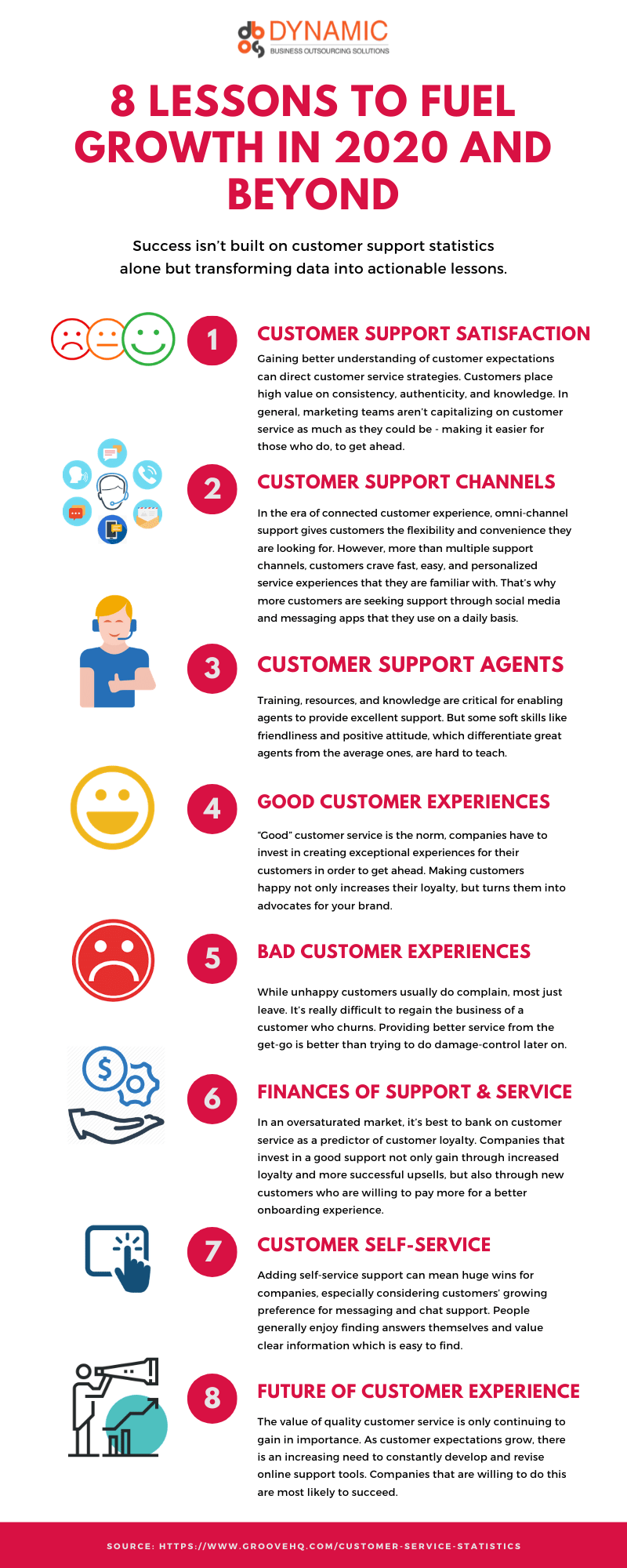
See the infographic below and know the 8 lessons about customer service outsourcing to fuel growth in 2020 and beyond.

customer service growth

Customer support satisfaction

As customers highly value consistency, authenticity, and knowledge, gaining a better understanding of their expectations can boost their satisfaction. Ensuring it is the utmost priority of most businesses today. Check out our previous blog on how to improve the quality of your customer support services.

Customer support channels

The digital age enables customers to experience the omnichannel support that provides easier and faster service. This includes the use of social media platforms such as Facebook, Twitter and Instagram which they use on a daily basis.

Customer support agents

More than the know-how and professional experience, attitude is also a very important factor in picking the right customer support agents. While skills are learned and practised, friendliness, confidence, and a positive attitude are hard to teach. To be a great customer support agent, you have to have both.

Good customer experiences

Providing good customer service is what all companies aim to achieve, and so as their competitors. But, how would you get ahead of them? Making your customers happy is one thing, but providing a service that creates a huge impact on them could turn them into advocates.

Bad customer experiences

Unhappy customers only either complain or silently leave. And when they do, it’ll be hard to win their favour again. So it is always better to focus on providing a great service from the get-go to avoid the need for damage-control after.

Finances of support and service

According to a PWC survey, 86% of consumers are willing to pay up to 25% more for better customer experience. That means companies who invest in good customer support agents and was able to retain them has more chances of successful upsells and gain more new customers.

Customer self-service

Most customers nowadays enjoy discovering and exploring the answers themselves as they are also learning in the process. In the next years to come, the customers’ preference for chat support and messaging will only keep on growing. So adding self-service support can mean huge wins for your business in the future.

Future of Customer Experience

As technology continues to evolve, the quality of customer service also remains developing. The trends are changing and customer expectations keep on growing. Companies that continuously seek the trend and is never afraid of changes are most likely to go far in the business.

Located in the Philippines, DBOS is an Australian-owned offshore staffing company that caters to back-office services, digital marketing, IT outsourcing, and customer service outsourcing. Reduce your wage costs up to 70% and get a free consultation with our very own CEO/Founder!