Outsourcing in the Philippines

The Cost of Outsourcing To the Philippines: How much will it cost you?

If there’s one benefit to outsourcing in the Philippines, it’s the low cost of labour. Outsourcing to the Philippines can save you up to 70% on your labour costs compared to hiring in-house staff in developed nations. 

However, there are other costs to consider when outsourcing to the Philippines, such as the cost of doing business in the country. In this blog post, we’ll look at all the costs you need to consider when outsourcing to the Philippines, so you can make an informed decision about whether it’s the right choice for your business. 

Cost of Labour 

One of the biggest costs of outsourcing to the Philippines is salaries. The average salary for a Filipino worker is around $250 per month. However, this number can vary greatly depending on the type of work you need to do, and the workers’ skillset. For example, if you are looking for a web developer, the average salary would be closer to $400 per month. 

The cost of living in the Philippines is also relatively low, so you don’t need to worry about your workers not being able to live on their salaries. In fact, many Filipino workers are able to save a large portion of their salary each month. 

Operational Expenses 

Another cost that you need to consider when outsourcing in the Philippines is the cost to operate. When you outsource to the Philippines, you will need to set up an office for your workers. The cost of renting an office in the Philippines is relatively low which can hover around $14 – $34 depending on the location. 

There are 3 main CBDs located in Manila – Ortigas, Makati, and Bonifacio Global City (BGC). These cities provide the best infrastructure and amenities that an outsourcing company could ever need such as high-speed fibre-optic internet, power, and water.  

In Ortigas, the average price for standard office space is $22 per square meter. In Makati, the cost is a bit higher at $32 per square meter. And in BGC, the cost is on the higher end at $34 per square meter.  

Furthermore, companies must also consider the utility rates in the Philippines. The average cost of electricity in the Philippines is $0.16 per kWh. The average cost of water is $0.01 per cubic meter, and the average cost for the internet is $50 per month. 

While you’re not directly going to pay for these costs, they’ll surely play a factor in your negotiations with offshore outsourcing companies in the Philippines. 

Government-Mandated Obligations 

There are also a few government-related factors that may affect the overall costs of outsourcing in the Philippines such as 13th Month Pay, Night Differential, Social Security, and Insurance. 

13th Month Pay 

In the Philippines, all workers are entitled to a 13th-month pay. This is an additional month’s worth of salary given to workers on top of their regular 12 months’ salary. The 13th Month’s Pay must be given to all workers regardless of position or length of service. 

Night Differential 

Another government-mandated benefit that workers are entitled to in the Philippines is Night Differential. This is an additional hourly rate that workers receive for working at night. The Night Differential rate is usually 10% of the worker’s regular hourly rate.  

Social Security and Insurance 

Like in most countries, Filipino employees are also entitled to social security (SSS) PhilHealth (Health Insurance), and Pag-IBIG (Savings Fund). It’s the employer’s responsibility to enrol all their workers in these programs and make contributions on their behalf. 

The cost of social security is usually around 12% of an employee’s salary with 8% being shouldered by employers while the employee’s shoulders rest. The cost of health insurance, on the other hand, is around 3% of the employee’s salary while Pag-ibig contribution sits at around 2% per year per employee. 

Related Article: The Philippines’ Labour Code And Holidays: How They Affect Offshore Labour In Western Countries

Final Thoughts: The Cost of Outsourcing to the Philippines: How Much Will It Cost You? 

While setting up and maintaining a team of outsourced labour in the Philippines may look costly, it’s important to remember that you’re still saving a lot of money in the long run because of the low cost of labour. Outsourcing your work to the Philippines will undoubtedly help your business save on costs while still maintaining high-quality output. 

Accounting Tasks You Can Outsource to Philippine Offshore Staffing Companies

The Philippines has become a popular destination for outsourcing accounting and bookkeeping tasks. This is because of the country’s highly skilled and English-speaking workforce and low labour costs. But, if you’re like most companies, you’re probably wondering which specific accounting tasks the talented Filipino workers can help you with. 

Here are just a few of the accounting functions that offshore staffing companies in the Philippines can assist you with: 

Accounts payable and receivable 

Basic bookkeeping has always been one of the first tasks companies outsource. This is because it’s a time-consuming and detail-oriented task that doesn’t require a lot of strategic thinking. And thanks to the internet, it’s easier than ever for companies to outsource accounting functions to another country. 

It’s an uncomplicated assignment that can be taught even to employees without an accounting degree or background. So, you can set up relatively quickly with a new staff and still be able to expect high-quality work. 

Payroll processing 

Payroll processing is another accounting function often outsourced to Filipino workers. This includes tasks such as calculating employee salaries, issuing paychecks, and withholdings taxes.  

What makes outsourcing even more accessible is that plenty of cloud-based Enterprise Resource Planning (ERP) tools are developed specifically to streamline payroll processing. This translates to easy integration with your existing workflow tools and services. 

Financial planning and analysis 

Financial planning is also often offloaded to offshore staffing firms in the Philippines. The country’s workforce is just brimming with talent, and they’re usually able to provide insightful analysis and observations that can help improve your company’s financial planning. 

It’s also more suitable to outsource this particular task now as the technologies and infrastructure for financial data collection and analysis, such as data visualisation and investor communication tools, have taken a giant leap in recent years. Nowadays, it’s much easier to interpret, process, and present the necessary data to government regulators and investors.   

Tax compliance  

Preparing tax statements is another resource-consuming accounting task that can be easily outsourced to Philippine offshore staffing firms. While CPAs in the country are trained in Philippine tax laws, professionals in the BPO industries are also equipped with expertise in developed nations’ tax systems. So, they can easily handle tax return filing for companies based in the US, UK, and other Western countries. This ensures compliance with the latest tax regulations while freeing your in-house accounting staff to focus on other tasks. 

Controller functions 

Even critical controller functions could be offloaded to Philippine outsourcing companies. This is especially true for companies trying to scale or expand their operations. 

Outsourcing controller functions can give you access to a team of professionals who can help you develop and implement the necessary policies and procedures for company expansions. They can also help establish an internal control system to safeguard assets and ensure compliance with local and international accounting standards. 

Final Thoughts: Accounting Tasks You Can Outsource to Philippine Offshore Staffing Companies 

So, there you have it. These are just some of the many accounting tasks that can be easily outsourced to Philippine offshore staffing firms. If you’re looking to cut down on costs and free up your in-house staff’s time, then outsourcing is definitely something you should consider. 

Top 5 Tasks Commonly Offloaded to Outsourced Staff

Offloading specific tasks to outsourced staff can be a great way to scale your business. It doesn’t simply help reduce overhead costs for more staff; it also enables you to focus on the core business. So, if you’re considering passing on some of your workloads to an offshore team, here are the top five tasks you can outsource:  

  1. Data entry – Data entry is one of the most commonly outsourced tasks. This is because it is relatively simple and does not require a lot of training. Furthermore, data-entry tasks are often time-consuming, especially if you have a large amount of data to input. Outsourcing this task can free your time to focus on more critical tasks.  
  1. Customer service – While there’s no denying that customer service is one of the pillars of any business and that you’d be best served if you can keep it in-house, the task can be incredibly demanding, especially during peak season. Most companies hire outsourced staff to handle customer service during these times. It helps that most staffing companies have a dedicated and, more importantly, seasoned team of customer service professionals ready to go at a moment’s notice. They’re easy to train and can be a tremendous asset during these times.  
  1. Research – The world is filled with talented researchers, and outsourcing this task can save you time. Many research-based jobs, such as market research, data analysis, and even primary research, can be outsourced. All of these tasks can be time-consuming and focus-draining. Outsourcing this task is a great way to get accurate and up-to-date information without doing all the legwork yourself. Make sure to give your outsourced staff detailed instructions, and you’ll be all set.  
  1. Graphic design – Having access to a global talent pool for graphic design professionals can help find that fresh pair of eyes for your project. So, this task is also a favourite for offshore staffing. However, it’s important to remember that not all graphic designers available actually have the basics down to pat. So, for these tasks, organisations need to be slightly more discriminating regarding credentials and talent.  

Related Article: 5 Reasons To Outsource Your Graphic Designer In The Philippines [Infographic]

  1. Web development – While web developers used to be highly technical, requiring in-depth coding knowledge, that is no longer the case. With the advent of user-friendly content management systems (CMSs), web development has become much more accessible. Outsourcing this task can be a great way to save time and money, especially if you don’t already have the in-house expertise. Please coordinate your in-house and offshore web developers, as the slightest miscommunication can cause massive delays.  

There are plenty of other tasks that can be easily handed over to outsourced staff. Bookkeeping, for example, is an age-old task that can be easily learned and performed by someone without prior experience. The important thing is to carefully consider what tasks are best suited for outsourcing before deciding to do so. Outsourcing the wrong task can lead to subpar results. But when done right, it can be an extremely effective way to improve your business. So, what are some of the tasks that you would consider outsourcing? 

outsourcing philippines

6 Frequently Asked Questions About Outsourcing Offshore

Every business seeks to be profitable while keeping expenses as low as possible. But with profit comes tax, upgrade of office equipment investments in real estate and other worthy ventures that ensure money goes back to the local economy and creates more jobs. 

However, when business owners refuse to adapt their models, profit dries up, tax and wages are no longer paid, and some even go into government benefits, which takes money out of the economy. And this is happening every day across Australia. Businesses that hold onto past models and misconceptions are bound to fail today. 

This article seeks to put an end to those misconceptions and wrong beliefs that hold people back. So let’s get started.

1. Are Jobs Being Taken Out of Australia?

Some people think that by outsourcing jobs overseas that they are stealing jobs in Australia. But this is not true. 

The truth is that everybody wins!

If a business gives a job to someone in another country, as the business grows and expands output and productivity, it can hire more hands among locals as not all jobs can be outsourced. 

Within a short while, more jobs have been created in Australia and the business pays tax and spends more money. The offshore professional wins, the business wins, and the local community wins.

2. What Can They Do?

There are endless tasks that offshore virtual staff can do. Businesses are only limited by their imagination. Here are some of the simple but time-consuming tasks that can be outsourced:

  • Deal with customer enquiries and clear out junk mail.
  • Contact people when emails bounce or return to the sender to ensure data is current.
  • Update website with content, optimise new pages for search engines and reply to blog comments.
  • Post to social media and monitoring of feedback.
  • Generate marketing reports on website analytics for smarter decision-making.
  • Typing minutes from meetings, creating presentation slides, doing research and sourcing images.

Related article: 4 Tasks That Entrepreneurs Should Consider Outsourcing

3. Is It Taking Advantage of Overseas Workers?

Overseas workers prefer working for Australian clients. Since the time difference between the Philippines and Australia is minimal, they can work during the day and get paid more, most of the time even more than working for clients that require workers to work at night. Working in day shift allows them to have a better work-life balance and spend more quality time with their families. 

The fact that they can earn more working for international clients motivates them greatly which increase their productivity and build loyalty to your business.

So again, this is providing a great employment opportunity at a higher rate than what is obtained working for a local employer.

4. Is It Possible To Find Good People?

Just like in every human endeavour, there are great people and there are bad ones. 

When it comes to finding the best people (And by the best people, we mean people who are highly skilled, have a degree or even double degree, speak excellent English and great work ethics), all it takes is some effort to search for the right outsourcing partner and the willingness to pay a little more than everyone else. 

Having said that, people are only as good as the system they follow, so it is crucial that new hires are trained and inducted properly into the company processes.

5. What About Business Data Security?

This may be a little tricky but it’s not any riskier than hiring local staff. All it takes here is following proper employee contact practice and if needed a non-disclosure agreement. However, this is more of an obstacle and not entirely a solution but is pure common sense. 

When it comes to the main work, they’ll only be granted access to the core folders and systems required for their job. Cloud-based file-sharing systems are the best bet and if they need access to special tools, password management tools like LastPass or RoboForm are great for this. With vital information, they can only be allowed to view them but not to delete or export data until they are tested and proven.

Given the importance of data security, a better option is to find an outsourcing partner that can help protect your data. This is why outsourcing companies like Dynamic Business Outsourcing Solutions (DBOS) have made a significant investment in infrastructure and connectivity as these are paramount in delivering a high-functioning offshore team.

DBOS placed high importance on privacy and security. Our facilities and systems are equipped with both logical and physical security. Most importantly, DBOS observes the provisions set out in the Privacy Act to protect our Client’s intellectual properties. 

6. Is Managing Offshore Staff Difficult?

Any serious business willing to make money must take staff management seriously and it is not any different when it comes to offshore staffing. It is important to have the right tools and maintain consistent communication as best practice.

Here are some great tools for offshore staff as well as in-house staff:

  • Gmail, Google Drive and other Google tools
  • Asana or Trello for project management
  • Skype or Zoom for face-to-face communication through video
  • Voxer for sending memos on the fly
  • TimeDoctor or Toggl for time tracking on projects

Conclusion

Outsourcing doesn’t have to be the way it has always been seen. Rather than thinking that it steals Australian jobs, businesses should see it as a great way to create more jobs in the country. Business people who are ready to join the shifting tide can take the plunge now or wait to be the last man standing, which might be an undesirable position to be in the future.

graphic designer philippines

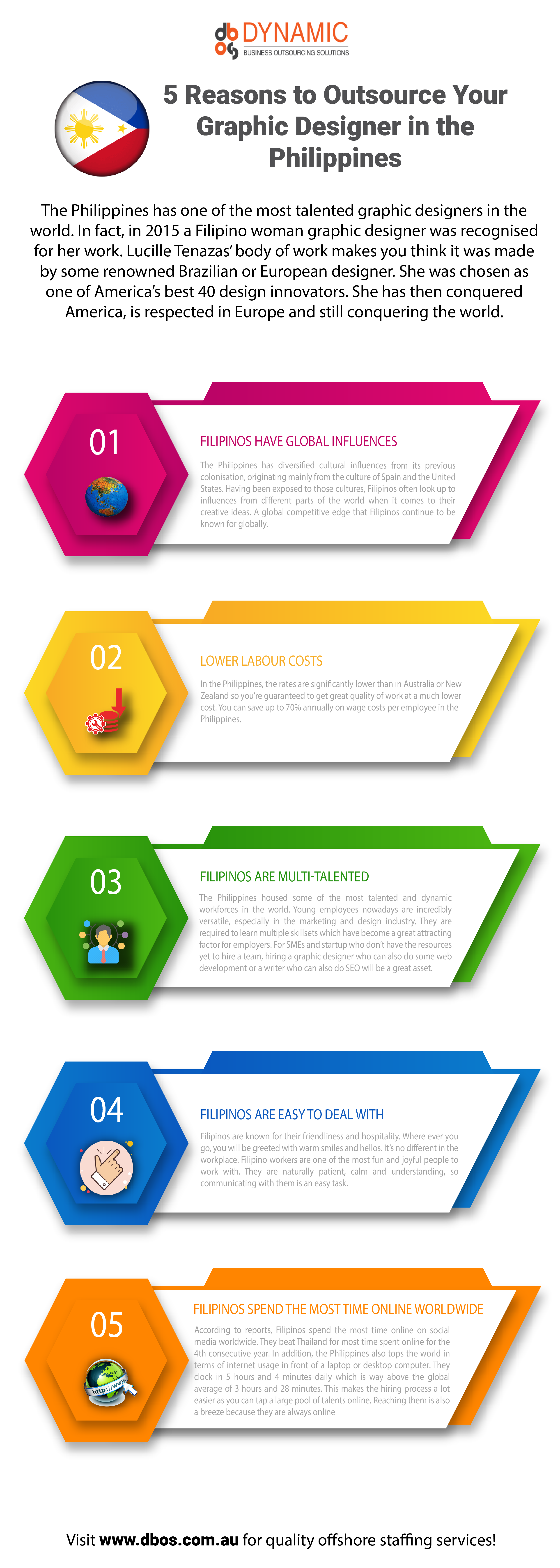
5 Reasons to Outsource Your Graphic Designer in the Philippines [Infographic]

graphic designer philippines

Filipino graphic designers have exceptional skills and talents. On top of that, they are proficient and adaptable to all the latest design trends and technologies.

Outsourcing some of your non-core tasks regardless of your company size comes with tons of benefits. Your core activities are what drive your business, so it’s only ideal to prioritise them. By outsourcing non-core tasks like graphic design, you’ll have more time to focus on the more essential parts of your business.

One of the most apparent benefits of outsourcing your graphic designer in the Philippines is financial saving. The significant cost savings alone of hiring offshore employees can help free up funds and valuable time for your company’s growth. The business also becomes a lot leaner. There are fewer people to manage, less office space required and fewer problems to solve.

Top Talents

How to Attract Top Talents to Your Small Business Online

Finding the right employees for your small business can be frustrating as the job market is full of unqualified job seekers. To distinguish your business and make it stand out in a competitive marketplace, you need the right team of professionals. To do this, you have to show what makes your company unique and what opportunities it offers them. Let’s take a look at some of the ways you can attract top talent to your small business.

  1. Make Company Culture A Top Priority

Focusing on company culture is one of the best ways to get top talents looking the way of your company. An environment that is enjoyable and encourages collaboration and connection is one that people always want to be a part of. However, being a people-first organisation means setting boundaries when it comes to personal privacy.

  1. Show Opportunity for Fast Growth

Small businesses don’t get embroiled in the shenanigans of office politics and bureaucratic processes that can easily stifle the growth of new employees. Smaller companies allow employees more room to handle different projects, flexibility to learn while doing so, and a leadership team that is always on hand to support them. If you are looking for top performers, show them that your small businesses can be the launchpad for the fast growth they seek.

  1. Truly Know Who You Are Hiring

If you want to attract and retain the top talent to your business, then you have to care about who you hire. You want to ensure that your company provides the place for them to fulfil their goals as they support the fulfilment of your organisation’s goals as well. When you can help them to be successful, they will do the same in return.

  1. Offer Relevant Perks

Another great way you can attract the best professionals to your small business online is by offering perks as part of your irresistible job offer. There are plenty of traditional work perks that can attract a diverse and talented applicant pool. In addition to good company culture, companies that offer work-life balance and comprehensive health insurance packages appeal to a broad range of candidates.

  1. Create A Community

Host a monthly meet-up about an engaging topic that can attract top talents around your area. You can create an intellectual community that discusses topics of interest, and get top talents engaged with your company.

  1. Spread the Good News Through Social Media

If you have great reviews on job sites about your company culture, then go ahead and share to attract prospective employees. Social media offers a great channel to spread the joy of working at a company that cares about its employees.

  1. Leverage Innovation, Access And Strategy

Smaller companies can quickly pivot and encourage innovation faster than a larger organisation can. Attract top talents that would otherwise be stifled in regular, traditional roles by showcasing your commitment to innovative thought processes, openness to sharing, and propensity to act on new ideas.

  1. Master How to Tell Your Story

When a prospective employee first enters your website to read about your company, what do they see? Is it just a bunch of information that talks about your company’s brand story in an interesting and engaging way? This may just be more important than compensation and benefits, however, you have to be competitive here. Show how passionate you are about what matters to you the most and this will attract people whose values resonate with yours.

  1. Hire HR Outsourcing Services

HR outsourcing is today considered one of the best ways of attracting top talents to an organisation. By working in collaboration with the right service provider, you can have several HR processes (i.e. payroll processing, onboarding, regulatory compliance training, employee engagement, etc.) taken out of your hands. However, in choosing the right HR outsourcing service, you need to go for a company that has the expertise and experience in your field. 

Related article: When and How to Outsource for your Small Business