
Human Resources

HR

8 Fundamental Benefits of Embracing Big Data in HR

The HR department in any organisation is pivotal. It plays one of the most important roles in a business because it handles strategic planning, company image, acquiring the right talents, and hiring. With all the tasks that HR personnel should do, the introduction of using big data has become a huge breakthrough in running the department.

What is Big Data?

According to SAS, the term “big data” refers to the data that is so large, fast or complex that it’s difficult to process using traditional methods. The idea was there for a very long time, but this concept gained momentum in the early 2000s.

Doug Laney, an industry analyst, enunciated the importance of big data as the three (3) V’s.

1. Volume: In businesses, data could be collected from a variety of sources including transactions, smart devices, videos, documents, and so much more. In previous years, storing big volume data takes up a lot of space on external hard drives and backups on other storage devices. Nowadays, there are affordable online platforms that could ensure security for any volume of data.

2. Velocity: The data streams that businesses acquire comes at an unprecedented speed and must be handled in a timely manner.

3. Variety: There are a huge variety of data. Whether structured or unstructured text documents, databases, emails, videos, audios, graphics, and others, the big data sure can handle it all.

Why is Big Data Important?

In today’s innovative world, using big data has become highly important. Initially, it doesn’t just focus on how much data you have, but what you can do with it. While all of those could be overwhelming to analyze and manage, big data enable cost reductions, time reductions, new product development, optimized offerings, and smart decision making.

While all those important aspects of acquiring big data alone is a huge feat, let us also find out what’s in it for the HR department.
HR

8 Benefits of Embracing Big Data in HR

Traditionally, the HR department is one of the busiest and most cluttered places in an office setting. Papers piled up on desks and file cabinets lined up everywhere are just normal during this time. Sorting all those files take up a lot of energy, manpower, and time. However, technological advances came fast and most businesses became reliant on outsourcing.

Moving forward, a lot of advanced years came by and the usage of online storage became a hit. Companies are suddenly going paperless and fewer people are needed to run a department while most are utilised for other roles.

Suddenly, HR outsourcing in the Philippines became famous and even the smallest entrepreneurs use this practice. To learn more about the usage of big data in human resources, check out these benefits:

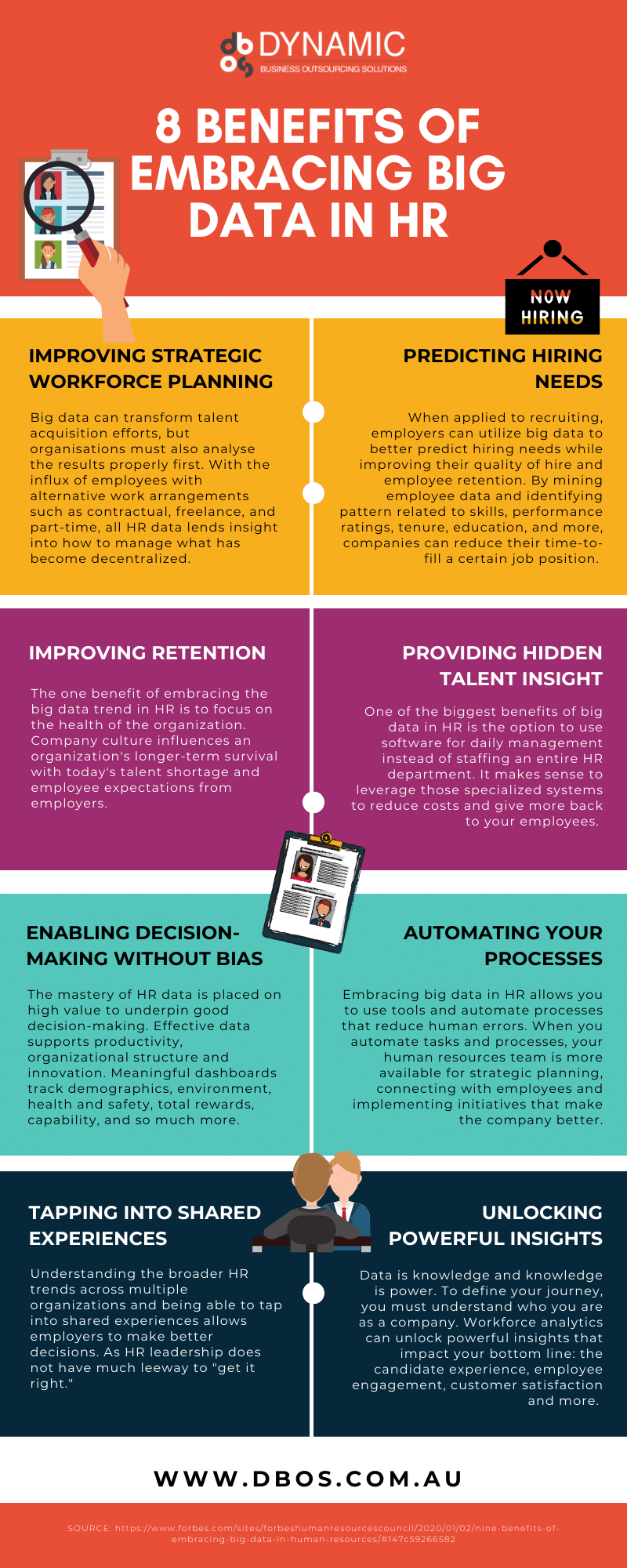
1. Improving strategic workforce planning

Big data has the ability to sort all candidates by their specific skill sets, work arrangement options, work experience and other categories. This help businesses tap into a very precise talent pool and immediately exclude other candidates that do not pass the qualifications. By doing this, the HR department can save more time to look at a broader talent pool.

2. Predicting hiring needs

One very specific benefit of big data in HR is that it helps employers improve their quality of hire. It also strengthens employee retention and better predicts hiring needs. By mining employee data and identifying their pattern of skills, performance, education, professional experience, and more, then hiring the right talent would be so much easier.

3. Improving retention

According to a relevant HR study, the company culture hugely affects employee retention. With big data, HR can now immediately identify if a candidate and their personality align with the company values and goals. For an organisation’s long-term survival, employee retention is the key.

4. Providing hidden talent insight

The use of big data in HR lessens the actual number of staff needed in the department. So, instead of employing a whole HR department, the company can actually cut the number and have them do other things that will help with their career growth. Now, this is where hidden talents could be discovered.

5. Enabling decision-making without bias

By implementing big data in HR, decision-making would be quicker and simpler. There won’t be any issues of being biased, because all of it will be based on actual numbers. And so, the HR people will be able to accurately track the demographics and performance of each and every employee.

6. Automating your processes

Embracing the use of big data in HR allows you to use tools to automate your processes. On the other hand, your human resources team will be more available for strategic planning, reaching out to employees, and finding more ways to engage and support them.

7. Tapping into shared experiences

Being exposed to HR trends in other industries allows employers and their staff to get better ideas. It will also aid the HR leaders to create strategies that would best fit the organization they belong to. This drives new big data analytics and AI-powered solutions onto the market.

8. Unlocking powerful ideas

As analysing data can give you other points of view to focus on, it can also unravel more ideas that could later turn into an opportunity that will change the way companies handle their HR.

Conclusion

The implementation of big data in most companies is an advanced move that will help the business reach, understand, and target their supposed audience. On the other hand, the HR department is indeed a huge beneficiary of big data.

So if you’re thinking about working with an outsourcing provider who shares your goals and aspirations, check out DBOS and get to save up to 70% on your labour costs!

Contact us today and get a free consultation with our CEO/Founder.

employee performance reviews

5 Tips to Help Improve Employee Performance Reviews

Employee performance reviews are a vital part of helping the staff create a clearer goal for themselves which also serves as motivation to do better. While it is done differently from every organisation, the goal of boosting employee performance remains as the main priority.

Meanwhile, more than just informing the staff of their level of productivity, employee performance reviews are also a good way to build rapport and loyalty within the organisation. Not only it is good for the company, but also for the individuals concerned.

Now, every employee contributes to the success or failure of a business. That is why improving the efficiency of the workforce and boosting the quality of services that they provide is necessary.

So, whether you’re a manager or a regular staff, it is highly important to keep track of your performance. Knowing your strengths and weaknesses earlier is better so you can do something to focus on your strengths. And to  further help improve every employee performance review, read these tips:

employee performance reviews


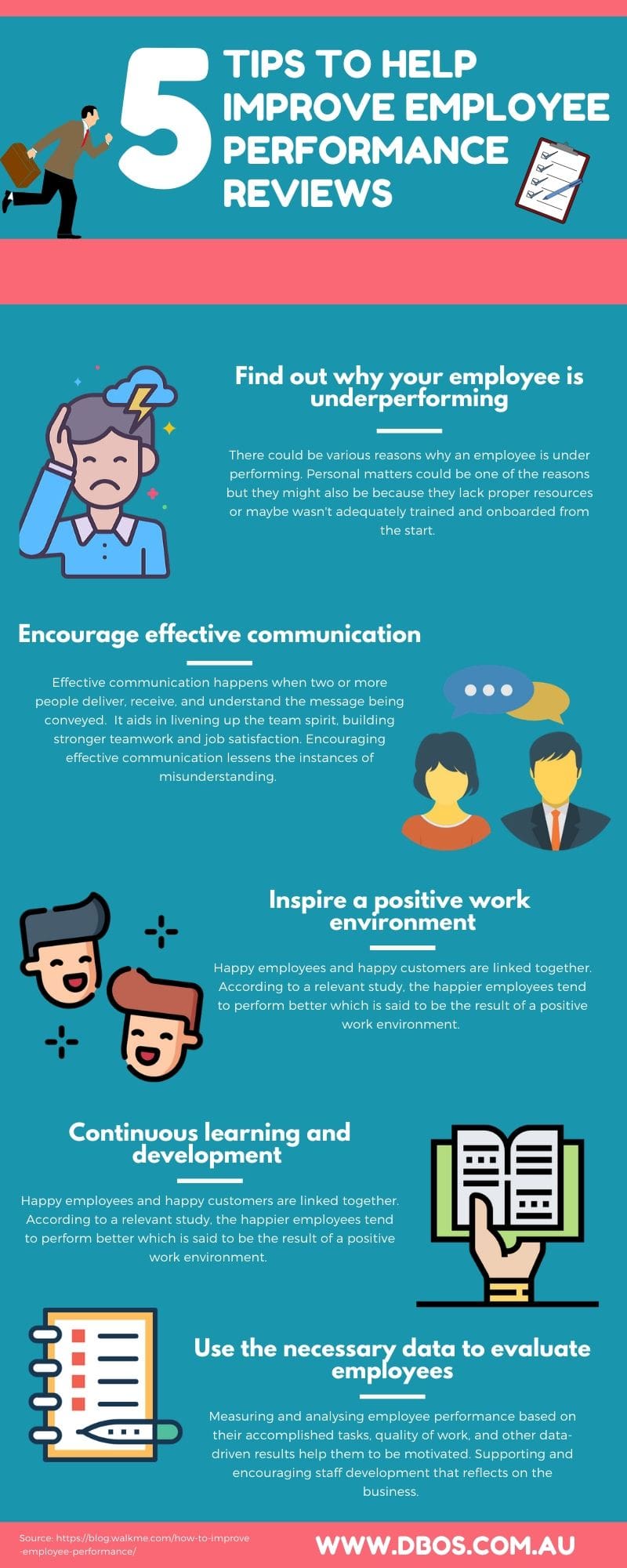
1. Find out why an employee is underperforming

Merely knowing and thoroughly understanding the employee’s issues are extremely different. So gathering proper information and enough data as to why they are underperforming would be the best foot forward. And instead of making numerous assumptions, it is better to exert any effort in finding out why. This way, it would be best tackled and addressed accordingly with the people involved.

2. Encourage effective communication

Effective communication happens when two or more people deliver, receive, and understand the message being conveyed successfully. It holds an integral part in creating a clear and concise discourse between people. At work, it aids in livening up the team spirit, building stronger teamwork and job satisfaction.

On the other hand, effective communication gives way to clearly deliver employee performance reviews and lessen the instances of misunderstanding. Also, the team members should be encouraged to communicate their ideas, as well as their deadlines, progress, and things that they believe is affecting their performance.

3. Inspire a positive work environment

Relevant studies prove that happy employees and happy customers are linked together. Happier employees tend to perform better which is said to be the result of a positive work environment. On a bigger scale, the employee’s happiness does not come from being paid a huge amount, nor getting tons of incentives. It is more of the feeling that they are valued for their role, appreciated, trusted, and encouraged to do more. And that is entirely for the HR people to handle.

However, there is only a significantly small number of companies all over the world that highly prioritises employee well-being. Unlike in the Philippines, an impressive number of HR-focused outsourcing companies have been established that gives high regards to the overall employee welfare.

4. Continuous learning and development

Just like how an employee was given a lot of attention during onboarding, they should be continuously provided with ongoing training. This way, the employees would highly feel that the company is very much concerned about developing their skills to further improve their performances too.

5. Use the necessary data to evaluate employees

Measuring and analysing employee performance based on their accomplished tasks, quality of work, and other data-driven results help them to be motivated. Concrete data that shows their strength and weaknesses both empower the employees. It gives them a higher level of motivation and conviction in improving their performance. So supporting and encouraging staff development will, later on, reflect on the business.

Conclusion

Employee performance reviews have provided better results than most ways that the HR people have used before. For example, rather than subjectively calling out an employee and telling them a piece of your mind regarding their performance, showing them the data is more credible.

Now, cultivating a healthy environment and promoting open communication gives the employees more room to work towards the company shared goals. And definitely, it is a good way for them to grow and succeed individually.

So if you want a professional’s viewpoint on how to help your employees further improve their performance and create high performing, productive workplaces, there is an excellent free culture IQ assessment tool which provides an in-depth, personalised report covering your areas of strength, opportunities for improvement and recommendations tailored for you to build a productive and enjoyable business.

dbos-offshore-staffing

The Link Between Happy Employees and Happy Customers

The secret’s been revealed about thriving businesses, and that mostly revolves with efforts in keeping the clients happy. But, did you know that happy employees play a crucial role in maintaining a customer’s happiness too?

For businesses, the most important people are no other than their customers. Without them, there is no source of revenue and the business will most likely fail. But, do you also honour the argument for other companies that employees should come first?

Business 101: Customer is King

On a case to case basis, there are businesses who can sustain their processes without hiring employees. Say, for example, websites that run on auto-pilot or have evergreen content where employees are not needed to maintain the page. Thus, giving their sole attention to no one but the customers.

No matter how large or small a business is, customers are still those who drive a company to success. Truth be told, customers have never been more powerful than they are these days. They can now give instant feedback on review sites and social media platforms which is where most people rely on nowadays. Meanwhile, paying attention to what your customers have to say can definitely leave a positive impact on your business. That is also why providing good customer service is critical to any kind of business.

However, getting customers is not the only goal for businesses. Nurturing the relationship with each one of them to make last long, as well as attracting new ones is the best win-win situation. But how do you nurture a business to customer relationship?

Here are a few tips on how to build long-term relationships with your customers:

  • Engage them.
  • Allow them to experience your brand.
  • Understand their relationship with your brand.
  • Explore their social media influence.
  • Provide value.
  • Make them feel special.
  • Respond to every concern.

Why Companies Should Keep their Employees Happy

When you talk about businesses that are fueled by employees, you are pointing at companies who have direct contact with customers. And while it should be a pre-requisite to keep both their customers and employees satisfied, some still doesn’t know its impact on their business.

Employees make a company functioning with their skills and ideas. They are those who keep the business moving. In industries like outsourcing and offshore staffing, employees are as important as clients and they should also be well-taken care of.

Ultimately, an employee’s attitude also reflects on their productivity and quality of work. To make sure that they are still happy with their work, here are the things that you should do:

  • Promote a good work-life balance.
  • Make them a part of the bigger picture.
  • Take time to know your employees personally.
  • Celebrate their wins and achievements.
  • Provide benefits and rewards.
  • Appreciate their extra efforts.
  • Trust your employees.
  • Set clear goals.
  • Recognise their progress.

In this competitive market where finding good and highly-skilled employees are hard, learn to appreciate your high-performing talents. Recent research on HR outsourcing and employee engagement has produced pieces of evidence that link the satisfaction of employees to their productivity. It highlighted the huge difference that happy employees bring in any organisation and on themselves.

Happy employees = happy customers

Naturally, when employees are happy and satisfied, they become eager to do more. Going the extra mile is second nature as they strive hard to achieve the company’s shared goals. They are able to produce greater and more innovative ideas that can satisfy the customers. In the end, it will create a ripple effect.  So when the company owners take care of their employee’s welfare, in return, they will take care of the business.

Now, if you want to be a happy employee that is encouraged and supported, then browse on our career opportunities today and be a part of DBOS!

professional behaviour

12 Professional Behaviour Tips in the Workplace

Every workplace environment has a different ethos. But no matter how distinctive it is from one another, companies would agree that an employee’s professional behaviour makes all the difference. More than dressing appropriately for work, one’s attitude and approach in the workplace can help improve their chance of success.

Many organisations nowadays have set a formal code of conduct for employees to follow. Failure to do so can bring negative consequences to the person involved. To avoid those, we come up with 12 tips on how to professionally behave at work.

Check out our infographic below!

professional behaviour

12 professional behaviours

  • Honesty
    Being honest is a highly important attribute for employees in all fields. When you’re honest, people will trust you more.
  • Respect
    Always remember that respect is earned. If you’re a leader and your people have seen you respect other people regardless of hierarchy or status, the more they will respect you.
  • Meetings
    Never be late for any kind of meeting and don’t show up unprepared. Don’t talk when somebody else is talking and ask questions only when necessary.
  • Communication
    Be mindful of how you talk to your colleagues and most especially to your boss. Make sure that you send the right message by watching the tone of your words in written emails and letters.
  • Time management
    Avoid arriving late for work and make sure to follow the break schedules. Practise allocating the right time to finish your workload for the day before going home.
  • Integrity 
    Act ethically and do the right thing at all times. Don’t hesitate to report misconduct and other violations of the company policy.
  • Safety 
    Even at work, be mindful of your safety. Know the company safety policy and actively participate in safety drills. Report hazards immediately.
  • Dress code
    In some companies, a strict dress code is observed. So if your company is implementing one, make sure to follow.
  • Accountability
    Take responsibility for all your actions and decisions. Avoid the blame-game to escape on your obligations and pin on to someone else.
  • Corporate goals
    Learn about the company’s mission vision and know your role in upholding all those.
  • Teamwork
    Work well together with your team and set aside the differences to achieve your shared goals. Maintain a good relationship with your members at all times and avoid talking behind each other’s back.
  • Commitment 
    Be dedicated to your role in the organisation you belong to. Do not hesitate to go the extra mile to achieve your goal and the company’s goal. Remember that if you work hard, there will be no other way but up.

Takeaway

Displaying professional behaviour at all times reflects your true character outside work. If you’re in the outsourcing industry, you have to mingle with different characteristics every single day. At times it’ll be hard, however, your behaviour should stay the same. But if you’re seeking a welcoming working environment, why not check out DBOS?

Aside from being one of the fastest-growing Australian-owned offshore staffing companies in the Philippines, we take pride in our employee engagement programs that focus on the well-being and career advancement of our employees. Browse on our career opportunities and be a part of our growing family!

employee-motivation

Why Leaders Need to Embrace Employee Motivation

While all too focused on the income-generating aspects of their company, some employers tend to forget the welfare of their best asset – the employees. At times, some companies sadly fail to understand the importance of employee motivation. Although not everyone does.

But, what is employee motivation and how does it affects a business?

By definition, employee motivation is the level of energy, commitment, and creativity that company workers bring to their jobs. If the employees are motivated, they become passionate about their job and actively works to achieve the organization’s goal. On the other hand, employees who lack motivation do all the opposite of what a passionate employee is doing. And even though the signs are there, some employers still tend to disregard these things, completely not knowing its effects on their business until its too late.

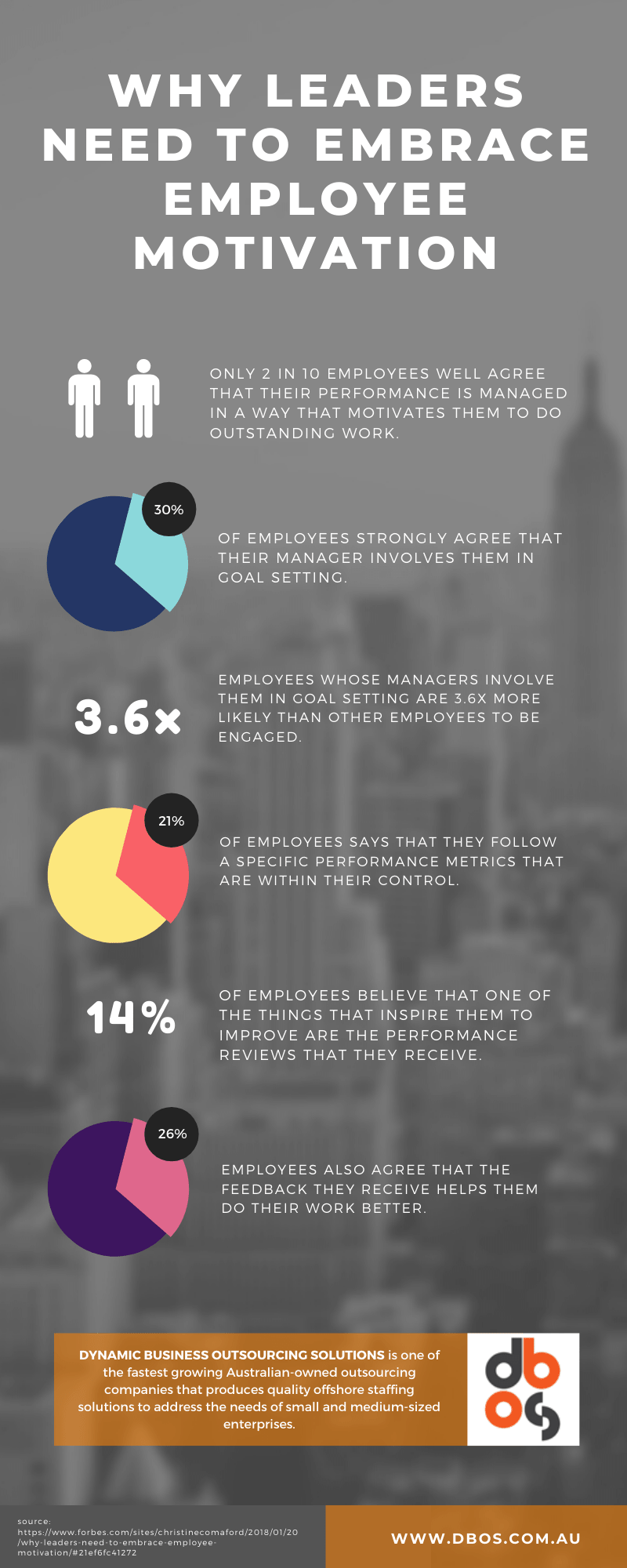
To help prevent the case of unmotivated employees, we created an infographic about a significant study as to why leaders need to promote employee motivation.

employee motivation

The Importance of Employee Motivation

Increased productivity, high-quality output, and meeting the company’s goals can be achieved through an employee’s hard work. With enough motivation and satisfaction, the employees will surely work towards the company’s best interest.

To further understand how crucial is employee motivation for a business, here are some reasons why:

Motivated people are always in action.
A company equipped with skilled employees are lucky, but a business with motivated people are luckier. Encouraged employees are without a doubt, the most willing to walk an extra mile for the company, if necessary. They are most likely to do what needs to be done regardless if they have to spend additional time at work.

Visible improvement on overall performance.
Motivated employees visibly aim to provide the best work performance for the company. In most instances, they display their ability to produce high-quality output and the willingness to go the extra mile to do the job well.

Leads to a stable workforce.
A stable workforce is a crucial key to a company’s success. When employees are motivated, they remain loyal to the company as they feel needed and valued. This will lead to a stable workforce that will also serve as a good image for the company which can also attract more qualified talents.

Enumerated above are just a few reasons why we can say that employee motivation is more than just a feeling.  It is a driving force that encourages people to do the best kind of work for the company that they provide their services to. Moreover, the effect it gives to an individual can never be compared.

Takeaway

Company leaders should realise that motivating their employees are as important as growing their businesses. Why? It’s because the employees are those who will work with them to achieve success. Now, it is not too late for company leaders to start promoting employee motivation in their businesses.

Just like how we do it here in DBOS! The secret of our successful 4 years in the offshore staffing industry in the Philippines lies in the hands of our employees. And it is the exact same reason why we make sure that their needs are always fairly met. Above that, we also promote employee engagement and self-development to the best of our ability.

Want to be a part of our growing family? Check out our job opportunities today! 

employee-engagement

Important Employee Engagement Stats

Employee engagement does not simply mean happiness nor satisfaction. An employee can be happy and satisfied at work but might not be willing to go the extra mile for the organisation and its goals.

According to a definition by Forbes, employee engagement is the level of commitment, passion, and loyalty a worker has toward their work and company. The more engaged an employee is, the more work they’ll put forth.

What do engaged employees mean for your business?

A business with engaged employees create lower risks of turnover, boost customer satisfaction, and produces high-quality output. They work hard not only for the paycheck but also to help achieve the company’s goals. They are committed, passionate, and loyal to their jobs. Those are the people who don’t mind going the extra mile to achieve the common goal.

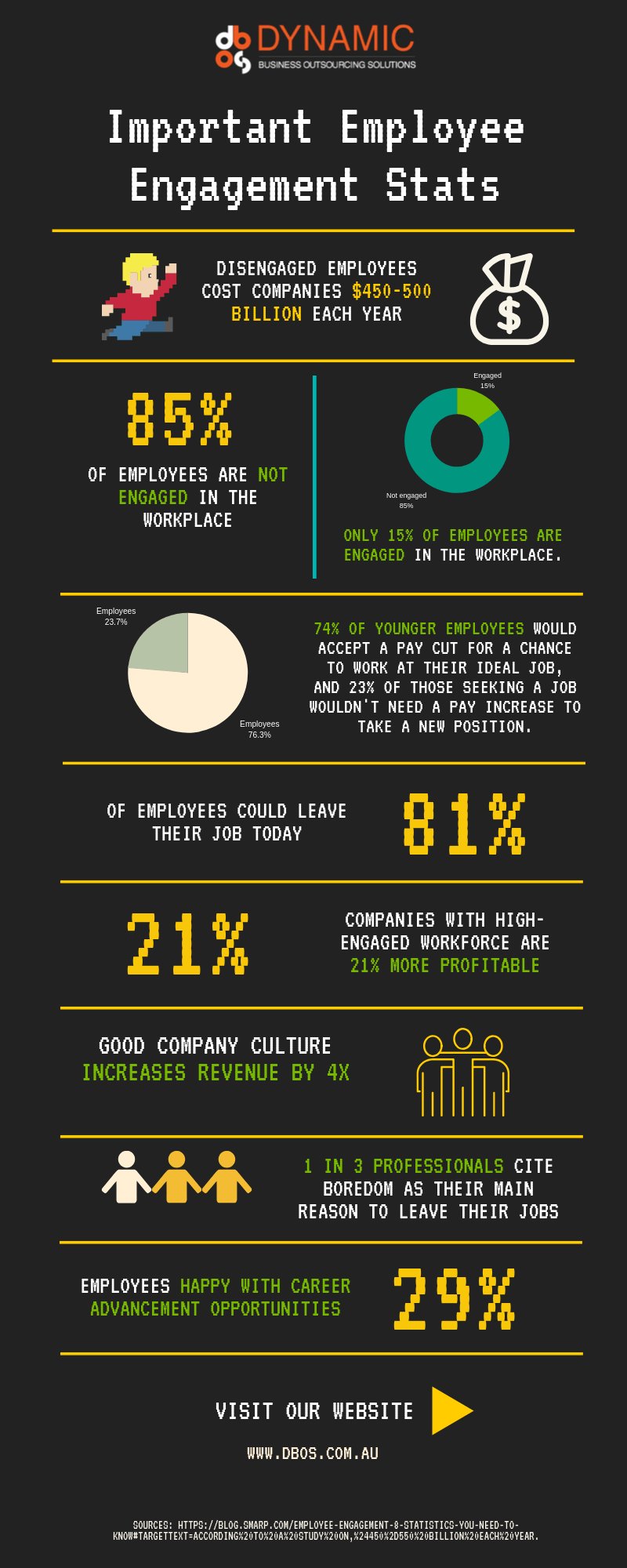
Check out some important employee engagement stats on the infographic below.

employee-engagement

It is rare to find highly-engaged employees nowadays because most of them work on a routine basis. They do their jobs excellently, beat their deadlines, go to work on time, but do not put extra effort to achieve the company’s goal.

That’s why we at DBOS continuously organise activities that aim to involve our employees with everything that goes within the company. We provide them with a healthy and comfortable working environment, as well as a support staff that they can always go-to for assistance.

We are an Australian-owned fast-growing offshore staffing company located in Manila, Philippines. We offer a wide range of offshore staffing services from non-voice to voice accounts! See our full list of offshore staffing services and get a free consultation with our CEO/Founder!