
Business

work-from-home

Impact of COVID-19 on Outsourced Services – Key Issues to Take Into Consideration

As we all now know too well, the coronavirus pandemic has forced many companies and their employees to shift operations to work from home (WFH) setup. This shift has had a great impact most especially on the outsourced services industry. An obvious example is the Philippines 30-day lockdown of its entire population, which creates immense logistical complexities for delivery centres across the country. 

A massive amount of focus is placed on logical layers of security to protect clients’ data. Fortunately for DBOS, clients have full control of all their data which allows a less complex transition of operations to the work from home environment. However, this sea of changes in service delivery also introduces other challenges and a lot of considerations for both providers and their customers, which in most cases demand swift decisions under enormous pressure.

Below are some of the key issues to take into consideration in the pressing term, while both clients and providers find the balance needed for the continuity of services against the restrictions and other realities of working remotely: 

Collaboration

Outsourced services providers and customers must work collaboratively and swiftly to come up with actionable decisions. Both must fully understand and not lose sight of their contractual rights and obligations while allowing at least a temporary deviation from contract norms. For example, many service providers and customers may be apt to look towards their force majeure clauses, but there may be conditions where mutually agreeable alternative arrangements could be more beneficial to both parties. 

In summary, while it is crucial to understand contractual rights and reliefs, in most cases, the WFH operations will mean that not all services can be fulfilled and not all service levels can be reached. With this in mind, customers should stay focused on their business and operational priorities and then work closely with providers to address them, rather than trying to hold firmly to all of the contractual requirements. Likewise, service providers should aim to address the customer’s most immediate needs and be transparent about what is attainable.

Documentation

Documentation is extremely critical. If the service provider is enquiring change of contractual obligations may it be performance related or otherwise or if a customer is demanding to re-prioritise services or extend the service provider’s liability due to increased performance or security risk, it is critical that: 

  • These changes are discussed and understood by both parties
  • Any contractual amendments and the degree of such amendments are documented clearly in writing that is contractually binding on both parties. 

Ideally, any documentation will follow the formal contract process and be explicit vis-à-vis the pre-existing contract terms. 

Internal Stakeholders Should All Participate

Customers should encourage all relevant departments within their companies, including representations from data security, legal, compliance and business operations to be proactive in identifying and documenting WFH set up with service providers. On the other hand, outsourced service providers are required to have a strengthened level of internal coordination within their companies.

Address External Concerns

Customers and outsourced service providers must try to fully understand and alleviate any impacts that WFH or working remotely might have outside the physical contract and services. For example, both parties must figure out if WFH jeopardises any liability insurance coverage on which its company may have been banking on. This also includes whether and how the WFH setup impacts corporate controls that are subject to reporting and audit. Lastly, it is critical to understand future impacts on any contracts with third-parties and all the necessary actions needed as a result of the WFH environment setup. 

No Unwarranted Delay

All parties must balance justified consideration with the requirement for action. Customers should acknowledge that the outsourced service provider’s resources may be limited. This includes internet, computers and other physical resources as well as manpower, such as legal, account management, contract administration and service delivery. On the service provider’s side, they must recognise that customers will have reasonable concerns and queries with the WFH setup. They will require immediate and continuous engagement with their outsourced service providers to understand and assess the ramifications. 

With all considerations in mind, customers and outsourced service providers should aim to work together closely and quickly to minimise any delays with making important decisions including reasonable negotiations. While not ideal, the current precedence requires more accurate documentation to follow the implementation and financial considerations or service level support be addressed. 

It is crucial during these unprecedented times that customers and outsourced service providers work closely, collaboratively, with urgency and with a proper sense of priorities. As crises evolve, the situation must be constantly monitored, keep close communication, and plan for further changes until a soon return to more normal operations is viable. 

small business owner

When and How to Outsource for your Small Business

Most entrepreneurs and small business owners have enormous talents but oftentimes they think they can do it all. This mindset can really hinder the growth of the business. Through outsourcing, they will have more time to focus on their core competencies to generate income. 

Business owners and entrepreneurs have long seen outsourcing as a strategy used by big businesses or large corporations, but technology has made this incredible resource more accessible to startups and other small businesses. For many startups, outsourcing has made a powerful impact not only on their growth but also on their efficiency, productivity and bottom lines. 

More and more businesses in the SME category are outsourcing or utilising offshore teams to do repetitive day-to-day back-office tasks because of technology. The advancing technology allowed professionals to be able to work from anywhere in the world. Couple that with the availability of extremely qualified and talented professionals. Whether it’s a virtual executive assistant, digital marketing professional, graphic designer, bookkeeper or web developer, there’s a large pool of these talents in countries like the Philippines. The utilisation of offshore staffing helps small businesses save on overhead costs. It removed the burden of paying overhead associated with payroll taxes and expenses such as health insurance and salary, as well as the office space constrictions that growing a company in-house can present.

When to outsource

Taking the first steps toward outsourcing can be a daunting task and extremely time-consuming. But figuring out how to build a more sustainable business with help from outside professionals can offer increased productivity, efficiency and economies of scale.  According to David Walsh, an entrepreneur and author of Source Control, “Progressive entrepreneurs realise the unstoppable power of outsourcing to handle aspects of their business that are essential but simply don’t make sense for them to deal with personally.”

The right time to outsource is different for every company. Some businesses have in-house employees to handle daily activities but may need outside help to tackle new projects that are beyond their capabilities and capacities. It’s when you and your current staff are unable to manage the daily business of your company and do it satisfactorily, it may be the right time to consider outsourcing. For entrepreneurs, the realisation may come when you had no time left in your day to pursue the growth of your business. If you want your business to thrive, you have to let go of some control and start delegating. 

According to Tonya Thomas, president of The Small Office Assistant, it’s recommended that startups and very small businesses start outsourcing from the very beginning. She suggested starting out with a virtual assistant and a bookkeeper and growing the team from there. 

What to outsource

Almost any task can be outsourced these days with many outsourcing and offshore staffing firms in countries like the Philippines offering access to a large pool of talented and qualified English-speaking professionals. But just because you can outsource a task or a project doesn’t mean you should. 

Business owners should take a hard look at their business and determine their strengths and values. Startups and small businesses especially must identify their core competencies and capabilities. 

Here are two general categories of the types of tasks that are best outsourced: 

  • Highly repetitive tasks. Some examples are data-entry, accounts payable, website tasks such as moderating comments, blog writing, content creation, SEO and social media tasks.
  • Specialised knowledge. An example is IT support for your network or accounting system. 

Related: Here are 4 tasks that entrepreneurs should consider outsourcing.

Finding the Right Outsourcing Provider

Although technology makes it a lot easier to find capable, reliable outsource providers, the selection process is still extremely important. There’s no better place to start than your own network; ask other entrepreneurs or your accountant, lawyer, or banker if they can recommend a provider that offers the services you need. Online networks like LinkedIn and Facebook make it easy to grow your personal networks and to ask for recommendations.

Others are also able to locate outsource providers through brokers like Outsource Accelerator. They are the leading Business Process Outsourcing (BPO) marketplace, advisory & operator for businesses across the globe. They connect startups, entrepreneurs and business owners of small-to-medium sized companies with the top outsourcing providers in the Philippines while helping them learn about, engage and integrate outsourcing into their businesses.

Whether you use a personal referral, a web-based broker or marketplace, or a consultant, the key to choosing the right provider is to know exactly what you’re business needs are.

Focusing on identifying your performance metrics for each task that you want to outsource is critical. There are some outsourcing providers that focus on speed at the expense of quality or vice versa. This is fine as long as there is a good match between what the small business wants and what the provider specialises in. In the Philippines, there are BPOs that specialise in customer service support for big companies like Slack, Google, AT&T, Skype to name a few who require a larger call centre operation. Others specialise in assisting the SME market like Dynamic Business Outsourcing Solutions (DBOS). DBOS’ business model allows full flexibility to scale up and down from 1 staff to 50+ which is perfect for startups and expanding businesses. Many small businesses don’t realise these massive differences among outsourcing providers and select the wrong ones. It’s essential to have an open and transparent conversation with potential partners regarding these key performance metrics.

Making it Work for your Small Business

Your work does not end yet once you’ve found a provider. You need to put in some extra time creating a specific contract that outlines exactly all the key performance indicators. You need to ensure that your provider focuses on what is most important to you rather than their own preferences or assumptions of what you want. 

Set your expectations and the steps included in the job as clearly as possible. Never assume that your provider is thinking what you’re thinking. And even when you clearly set your expectations, there will always be a learning curve on the provider’s side so just be patient. The provider will get better, and you will soon have the freedom to focus on more important tasks. 

Finally, your last responsibility to become a successful outsourcer is to relinquish some control and allow your new offshore team to do the job you’ve hired them to do. A measure of trust is required to be successful at outsourcing. Remember that the whole point of outsourcing is to save your valuable management time and attention. You also have to realise that removing yourself from low-level operations is the smartest investment you can make for the long-term success of your business.

Determining the Costs vs. the Benefits

The costs of allowing you to get away from the day-to-day tasks and build a better business depend on the type of work that you’re buying. You also have to consider the skill level of the employees you’re planning to hire and the location of your provider.

In the Philippines, outsourcing companies like DBOS offer a flat structure monthly fee which covers all the dedicated staffing solutions:

  • Staff’s salary package
  • Staff’s workstation
  • Electricity and internet access
  • HR support
  • IT support
  • Admin support
  • Orientation
  • Payroll processing
  • Benefits management
  • Performance monitoring and evaluation
  • Engagement and recognition programs
  • Meeting and boardroom access
  • Access to pantry and supplies

This type of fee structure allows businesses to save between $20,000 to $40,000 per employee annually. 

It cannot be any more true that you get what you pay for wherever you go in the world. Regardless of location, you always have to pay someone what they are worth. Leveraging the currency differences though can often work in your favour. 

Overcoming the Challenges

Outsourcing does not guarantee success every time. While it yields great advantages for a startup or small business, there are always challenges. 

  • Language and timezone barriers. Making sure that your own communication is clear can help overcome confusion for non-native English speakers. Time zones, on the other hand, create more opportunity than an inconvenience. You can extend your productive hours by assigning tasks over to your offshore team during your workday and wake up to find it complete and ready for you.
  • Security risks. There is always some level of security risks involved when handing over tasks to an outsourced provider. You need to ensure that you’re not risking any employee personal information and customer data. Choose a provider that allows clients to maintain their intellectual property and full process and data control. Or provide them with only the absolute minimum data necessary for them to do the job. Otherwise, for general sense, always review your provider’s security policy and practices.

Earning the Benefits of Small Business Outsourcing

Despite the risks, outsourcing offers small business owners great advantages. It’s an affordable and proven strategy for growing your business without letting it consume all your time. Outsourcing can bring back your focus on your core competencies and allows you to spend your time setting new goals and finding ways to fulfil them. 

customer service tips

Kick-Ass Customer Service Tips That Will Support Your Business in 2020

Providing high-quality customer service will continue to be a significant trend in 2020. Businesses that don’t pay attention to poor customer service will, later on, struggle in maintaining their reputation. Now, here are some kick-ass customer service tips and examples to help your business flourish in 2020 and beyond.

According to a relevant study, 77% of customers are fed up with bad customer service while a whopping 91% of consumers only buy from brands they trust. So we can conclude that poor customer service will most likely lead to lost customers and revenue. To avoid this, here are some call center tips to assist your business in 2020.

1. Customers come first, the service issue is just secondary.

Customers like it when the support agent is empathetic and nice. A gentle and accommodating voice on the other line that sounds genuinely concerned can ease the unsettling feeling of customers.

Do not take things personally

Unhappy customers are a little brazen and irritable. They might make abrasive remarks from time to time, but do not take it personally because they aren’t attacking you. It is the situation that they are mad about.

Never engage in an argument with a client

One of the 5 most important skills that make a good customer service representative is to be extra patient. Dealing with different customers every day could be exhausting, however, getting all worked up every single day could bring you serious stress. So practising effective breathing exercises will help clear your head and be more composed when talking to customers.

2. Personalisation when talking to clients.

Personalisation goes far beyond just using the client’s first name when addressing them. As much as possible, do not call them “Sir”, “Ma’am” or “Madam”. Putting on a personal touch when communicating is the best way to let them know that they are a priority. It is also important to show the value of their time and to not hold them off for far too long.

3. Maintain a positive language and reaction.

A good example of this is when a customer is looking for an item that has already been out of stock and then their attitude suddenly changed. Instead of saying, “I’m sorry we are out of stocks today”, it is better to put it this way: “It will be available next week. What is the best way to contact you once it arrives?”

Do you see the difference? The first response is dismissive and a bit negative, however, the second is hopeful and keen on setting the expectations straight. It would only take little time to rephrase your response from negative to positive, so make sure to do so.

4. Do not underestimate the power of quick replies.

A customer’s complaint might not be your priority, but for them, it definitely is. So make sure that you provide quick replies to customers. Waiting for their issues to be resolved before responding will only make them more furious than they already are. So if you want to impress your customers, make sure to set their expectations straight and provide clear KPIs for their reference.

Conclusion

As the call center industry in the Philippines continues to skyrocket, different advice, and guidelines are published everywhere. The list is endless, so we listed the four most important customer service tips that are believed to help your business thrive in 2020.

To further share some of the best strategies that will aid your business growth for this year and beyond, contact DBOS today and get a free consultation with our CEO/Founder.

manager

7 Steps How the Perfect Manager Delegate Tasks

A manager wears many hats. They are most known to handle all the planning, organising, leading, controlling, and execution of everything in their scope of work. Their role is very crucial to any kind of organisation and at most times, success relies on their hands.

Now, not many people acknowledge the importance of having good managers. As long as they can produce the output, the process doesn’t matter. Google also tried to prove something similar when they launched Project Oxygen in 2008. The goal is to also prove that managers don’t really have an impact on performance. However, after collecting all the data, they have come to a complete opposite of what they want to achieve – that good management can actually make a huge difference.

To achieve good management, a good manager is needed. But, you should remember that great employees don’t always make the best managers. Most great employees tend to want to focus only on their work and nothing else. They might have great technical skills, but it doesn’t mean that they’d make a great manager. On the other hand, a perfect manager is fully equipped with leadership skills that not every employee has.

Being a good manager is not as easy as it sounds because it requires numerous criteria. Specifically when managing an offshore team from all walks of life is a definite challenge.

perfect manager

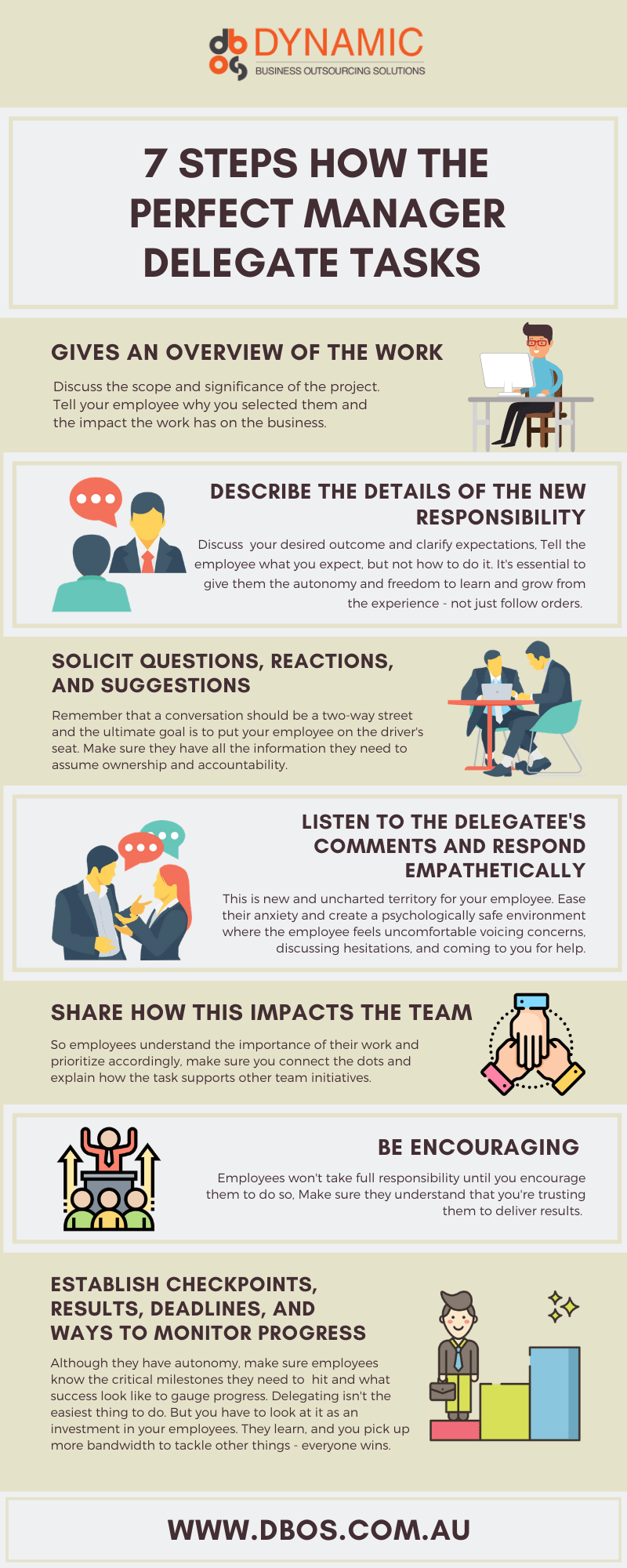
One of the best traits of perfect managers is their ability to delegate tasks properly. Here are 7 steps on how they do it.

1. Gives an overview of the work

It should be a prerogative to let the employee know why they were chosen for a specific task or work. Give them an overview of their supposed task and tell them the impact it has on the business.

2. Describe the details of the new responsibility

Talk to the employee to discuss your desired outcome and clarify expectations. Tell them what you expect as the project progress. Also, give them the autonomy and freedom to learn from that experience.

3. Solicit questions, reactions, and suggestions

Never forget that effective communication is a two-way street. Let them ask all the questions that they have and answer them as much as you can. You can also ask for their honest suggestions and reactions to make the process better. And make sure that they have all the information that they need before hitting the road.

4. Listen to the delegatee’s  comments and respond empathetically

As the manager, your people should feel safe and unjudged while voicing their concerns with you. Help them ease their anxiety by empathetically responding to their worries and regularly coming to you for help.

5. Share how this impacts the team

Brief your people on how each of their roles impacts the other members of the team. Teach them how to prioritise accordingly and make them understand the importance of their work.

6. Be encouraging

There is no better motivation for an employee but the encouragement of their boss. Make sure they understand that you’re trusting them to deliver results.

7. Establish checkpoints, results, deadlines, and ways to monitor progress

Although your people have the autonomy, make sure that they also know the targets and deadlines to hit. As the manager, it is on you to establish checkpoints and other ways to monitor your people’s progress.

Conclusion

A perfect manager knows the right ways on how to delegate tasks according to each person’s capability. Moreover, they help their people showcase the best of their abilities.

Meet some of these perfect managers in DBOS! As an Australian-owned offshore staffing company based in the Philippines, we aim to build high-quality output that benefits both the employee, client and the company. After establishing the head office in Araneta Center, Cubao 4 years ago, the company is now ready to expand the business and open another door in Eastwood City.

Anticipate the opening of our new office and help reduce your wages by up to 70% if you partner with us! Enquire now and get a free consultation with our very own CEO/Founder!

smart entrepreneurs

7 New Year Resolutions for the Smart Entrepreneurs

Before every year ends, smart entrepreneurs ensure that setting the goals for next year is already planned out. Without a detailed strategy laid out for the next year, it would be like travelling without a specific destination.

With 2020 just around the corner, smart entrepreneurs are starting to plot their business strategy for next year. Big plans like those should also be discussed with other think tanks in the company to get more insights and ideas for a more accurate action plan.

Moreover, fast-paced businesses like the offshoring industry in the Philippines and in other countries are taking their time picking the right resolutions. As important it is in choosing the resolutions, sticking with them is more crucial.

If you want to get an idea on how your resolutions as smart entrepreneurs should be, then check out our infographic below.

smart entrepreneurs

Manage cash effectively

For smart entrepreneurs, one of the major concerns that they usually ask about is how to effectively manage their business income.

For the next year, irregularities in cash flow should be addressed immediately.  Also, learn to consider alternatives to be able to cut back on the budget.

Improve your digital presence

Digital presence is highly important for businesses. Regular updates on your website, most especially on social media can create a huge effect on your digital presence.

Talk to your digital marketing team to come up with ways on how to ramp up your online visibility.

Pricing

Get a financial expert’s help with your pricing concerns. And if you think that your products and/or services are worth more than what you are getting paid for, then try to revamp your rates. But before doing so, you must ask an expert to help you strategise and implement the new rates.

Increase manpower

Believe it or not, you can’t actually wear all the hats in your business, especially if it’s slowing you down. Remember that there’s always a space to delegate it to others. So, when you are having a hard time juggling every part of your business, then maybe it is an indication that you should consider offshoring. Although it sounds scary at first, there is so much more to it than meets the eye. The only way is to address your offshoring fears and learn how to overcome them.

Better communication

Your success as a smart entrepreneur lies in the hands of your people. More than keeping better communication with them, make sure to also relay the exact message to your target audience.

Here are 4 types of communication to consider improving.

Challenge yourself

Set goals that challenge you mentally and not one that would challenge your business. Do not set goals just for the sake of goal-setting or one that you can complete easily for the sense of accomplishment. Make sure that the challenge for yourself will have a long-term effect on your business.

Give back

Do not ever forget to give back to the community especially when your business is doing well. Aside from the significant promotion that your business can get, the willingness to give back will go a long way.

Conclusion

The New Year prompts for a fresh start. And if you have made mistakes in the past year that makes you feel a bit regretful, the next year will bring you more time to correct all of those.

Let 2020 bring growth and new beginnings to you and your business. As for us here in DBOS, we will be opening another office in Eastwood to start the year right! And if you’re interested in growing your business too, let us help you reduce your wage costs up to 70% and get a free consultation with our very own CEO/Founder!


better business

Guide in Building a Better Business with Outsourcing

Tracing way back from the early days of outsourcing, businesses first doubted its effectivity. Later on, organisations started to see the potential and took the risk of utilising what the strategy offers to build a better business.

For a long time, entrepreneurs believed that outsourcing is only reserved for huge companies. That’s why small-medium businesses were intimidated for a long time and does not even consider outsourcing. But now, most small businesses are the biggest beneficiaries of this strategy. Thanks to technology for making it easier to outsource tasks and services all over the world.

Most business owners agree that what stalls a business from growing is the entrepreneur’s belief that they can do it all because of their talents.

While outsourcing remains to be a great business strategy, not everyone has fully understood what it means to outsource your services, what to outsource, and when? This blog was made to address all these concerns and a few guidelines on how to build a better business with outsourcing.

How do you know if it’s time to outsource?

The timeline for every business to outsource differs. They do not follow the same timeline nor set an identical process even for the same field. Normally, businesses maintain an in-house staff for their core services. But if they are planning to expand, outsourcing is a good strategy to make use of.

Here are the signs that you might need to consider outsourcing:

  • You’re spending all-day doing administrative tasks instead of your expertise.
  • You feel overwhelmed working on your business.
  • You have turned down an opportunity because you can’t keep up on the production.
  • Sales are declining.
  • Production time gets doubled.
  • You’ve been focusing on routinary tasks.

These are only just a few of the telltale signs that you should be looking out for if you want to know if its already time to outsource your tasks or services.

Knowing when to outsource your services is one thing, but identifying the benefits that you’ll get from outsourcing is another.

What tasks/services should you outsource?

Keep in mind to evaluate all your tasks and services using the outsourcing decision matrix before delegating anything. These days, almost any task can be outsourced with a huge pool of skilled professionals as freelancers or contractors. However, just because you can outsource doesn’t mean you should. Take a good look at your tasks and identify which are part of your core competencies and then keep them close to you.

The types of tasks that are best outsourced fall into these three general categories:

  • Highly skilled, or executive, expertise
  • Highly repetitive tasks
  • Specialised knowledge

The right outsourcing partner

Finding the right contractor is the most important part of outsourcing. Among the thousands of outsourcing companies that offer the same services, countries like India and the Philippines are at the top.

It won’t be easy to choose one, so you should examine these factors first before picking one from the pool of probable right outsourcing partner.

  • Company background – this includes past projects, client feedbacks, achievements, and experience
  • Pricing – think of the prices that will work best for you and your company’s budget
  • Employee retention – a great outsourcing company knows how to treat their employees well
  • Certified outsourcing partner –  pays their taxes on time and follows the rules required by the government
  • Location/office – visit the actual site and see the whole office set-up  

Conclusion

Outsourcing is a good business strategy that can provide actual results if professionally handled by an expert in the field. It can help increase your sales and make your business grow in the long run.

Know more about how outsourcing and offshore staffing in the Philippines work with DBOS! Ask about our services and get a free consultation with our very own CEO/Founder!