
Business

technology vs human experience

Why Technology Can’t Replace the Human Experience

There are growing concerns and fear that technological advancements like AI, robot machines, and more will replace the role of humans in the workplace. So, to prevent this, employees need to upskill and reskill to remain relevant in the market.

But will technology overcome humans? Technology may be good, but it is not going to replace human experience, values, and judgement any time soon, and here are some reasons why.

  1. Speed Is Not Intellect

One of the thought processes driving the belief that technology will overtake human intelligence comes from the visible and predicted increase in computing capabilities. However, speed does not necessarily equate to human intelligence and intuitiveness.

Humans created technology, which means human intelligence supersedes that of the products of its technology like robots. For example, advanced tech can decide things much faster than humans. Let’s say you want to fill a Google questionnaire, your answer will be recorded faster compared to if it was traditional checks. But this is where their processing ability stops. Only humans can take further process on the answer in your questionnaire.

Technology may provide the intelligence needed to make decisions based on knowledge against a set of objectives, however, it’s the desire and ability to choose those criteria based on a value set learned from experience and empathy that differentiates humans from technology.  

  1. Values Are Not Data But Experience

We make choices based on preferences. But with automation technology, choices are based on data and systems. It’s futile to describe the human world through a logical combination of data, programs, and atomic facts.

For example, a human being’s values may be contradictory. While you love eating meat, you don’t like the slaughtering part. This value system cannot be recreated through technology. Technology can only complement humans, but it cannot wholly replace the human value.

  1. Technology Lacks Understanding of Irrational Thought

Building on the last point, technology operates on mindless logic. While it is logical, humans don’t always work like that. So using a rational entity to do the work of an irrational one is asking for trouble.

For example, chatbots, which have become prevalent today. They are programmed to answer questions by following a set of pre-programmed clues. That’s good but when people interact with chatbots, sometimes they want that emotional understanding and connection over logical and rational answers. They want empathy, and understanding of their feelings and that they are justified to feel in a certain way.

The smartest AI is incapable of doing that, and even if they do, it is impossible to be so convincing as it can be with a human. From a customer satisfaction perspective, it may not be the best idea to completely replace humans with AI technology.

This is why many companies who want to establish tangible connections with customers but cannot provide in-house human customer service forgo chatbots and go the offshore customer support route and are better for it.

  1. Judgments Come From Values, Not Artificial Life

A wholly artificial company will provide artificial experiences, which creates artificial values. As earlier discussed, technology bases decisions on data and these decisions made are not the same with judgements.

On the contrary, human judgments are based on values and values come from our experiences. However, technology is yet to experience the life of a human and humanity. For example, humans have been suffering through the recent pandemic and economic recession. This made people to start improving on themselves and creating more business values.

AI tech, on the other hand, has no experience of the past or the present and cannot factor all of that into its decision-making process. If technology does produce robots and machines with human-like behaviours, this may endanger the human race, which once again points to the futility of such tech.

5. Technology Cannot Solve Problems Creatively

One of the special things about humans is the ability to think and provide creative solutions to problems. This imaginative capability is not something robots have, which means they are incapable of anything requiring creative thinking though. Of course, it can be argued that robots are fantastic at dull, repetitive tasks.

In fact, they are better at this than any human, since one of the most desired skills in mass production is machine-level consistency and the lack of feelings of tiredness or boredom. However, humans make up for this in creativity and this is not something that can be programmed into logic-based boards.

Technology advances relentlessly forward, and it would be unwise to argue otherwise. Some things remain significant, and people-to-people interaction and communication will continue to be one of them. Just because the tech is available and convenient, doesn’t mean it’s the best option in every situation.


outsourcing-trends-2021

Best Practices and Trends in Outsourcing for 2021

The year 2020 shook the business world to its foundations and showed how highly volatile the environment is with a change possible at any moment. However, preparing and coping with a global pandemic has taught us resilience, responsiveness, and most of all, adaptability.

One area that has been most impacted is the outsourcing industry. New trends are emerging and shaping how partnerships between clients and vendors exist. How can businesses thrive in the face of change? Let’s take a look at what’s in store in outsourcing in 2021.

Emerging Trends in Outsourcing for 2021

  1. Rise of KPO

Knowledge process outsourcing (KPO) deals with specialised knowledge and problem-solving outsourcing. Some KPO services include data analysis, financial consultancy, research and development, etc.

With the growing sophistication and adoption of advanced technology by various industries, KPO will become more valuable in outsourcing services. Companies seeking to fill the gap for highly-skilled professionals or expand use it to their requirements while ensuring costs are kept low.

  1. Robotic Process Automation

2021 will witness further incursion of Artificial Intelligence (AI) and other emerging technologies into outsourcing. Robotic process automation or intelligent automation is the novel technology that is already proving to offset workloads for outsourcing providers and boosting business services delivery.

  1. Social Media As a Customer Service

One trend that 2021 will see is growing social media adoption as a customer service channel. Due to the pandemic of 2020, social media apps and platforms have seen a skyrocket in global penetration rate. With more customers taking to social media platforms, this has created a better opportunity of interacting with clients where they are, boosting customer experience and raising satisfaction in general.

  1. Staff Upskilling

With menial and repetitive tasks taken over by automation, staff have to focus on more specialised knowledge. By upskilling, outsourcing staff can enhance knowledge and capabilities, which elevate and expand their service scope and delivery.

  1. Cloud Computing

A game-changer for many industries, cloud computing has provided greater storage access and increase processing power to users on-demand. Outsourcing providers can use a pay-per-usage model to offer their IT infrastructure to their clients ready to pay for a server, storage, and networking needs. Most businesses today are already using or considering using cloud services.

Outsourcing Best Practices For 2021

  1. Set Well-Defined Objectives And Goals For Outsourcing

Determine if you need to outsource your business, what aspects need outsourcing, and what best fits your needs and objectives. With well-defined expectations, both parties can ensure that the service rendered is according to the objectives stated.

  1. Strengthen Management Relations

How well a company and its outsourcing provider work together will help forge successful partnerships. Through mutual respect and commitment to terms agreed upon, project leaders and managers can improve their relationship. This healthy relationship can be the catalyst for business growth in the long run.

  1. Ensure Data Security And Regulatory Requirements Compliance

A huge priority will be keeping customer sensitive information safe, more so due to the involvement of a third-party. Businesses have to review all the data security requirements before committing to any agreements. Besides minimising the risk of data breaches, other things to consider are regulatory requirements and compliance with existing laws.

  1. Improve Conflict Management Processes

Conflict management processes should be created to effectively resolve disputes, which are expected when people work together. This will improve team relations and overall work performance. This conflict management process includes a hierarchy of escalation and principle negotiation for better representation.

To wrap up

The outsourcing industry like most industries is adapting its services to accommodate the rapid changes in technology and the evolving needs of businesses in 2021. With all of these exciting changes that will boost in-house staff communication and contribute to better services and growth, there has never been a better time for customer service outsourcing in the Philippines.

b2b-companies

DBOS Receives Award for Being One of the Top B2B Companies in Asia for 2020

The current state of voice is becoming more and more widespread as technology gets smarter. This year, we’re seeing more customer data analysis, real-time translation, and enterprise voice assistants.

Here at Dynamic Business Outsourcing Solutions, we’re always on top of the latest trends and practices so you don’t have to be. You can rest easy knowing we’re providing the latest and greatest for you. We’ve been at this for a while now, and our team has been providing world-class, personalized and affordable outsourcing services to businesses of all shapes and sizes.

Our greatest product is our staff. We offer different offshore staffing services such as call centre support, back-office functions, online marketing services, graphic designing, website, software and app development.

We can even customize solutions to each individual client’s request and requirements. With this, we cater to different industries such as car finance, car rental, insurance, marketing, IT, development, and a whole lot more. We locate experienced college graduates with the perfect skills to fit our client’s requirements for whatever industry it may be.

Over the years, we’ve had many successful engagements that have brought positive results to our clients.

client-review

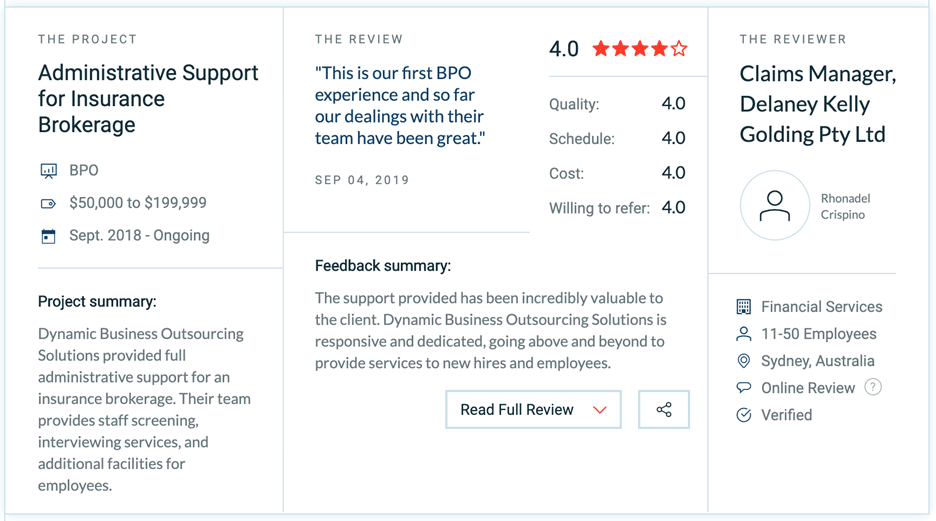
“Our dealings with their team have been great.” – Claims Manager, Delaney Kelly Golding Pty Ltd

Feedback such as this highlights our great customer service and the top quality of our deliverables. That’s why we’ve been recognized as a 2020 top collections service provider in the Philippines by Clutch. This award means we’re a top voice services company!

Jacqui Miller, our CEO and founder, had this to say about the achievement, “We aim to bring our customized outsourcing solutions to more SMEs not just in Australia and New Zealand but also in North America and Europe. Also, we want to provide more jobs and opportunities to well-rounded and talented Filipinos by opening more offices in key cities in the Philippines.”

We’re looking forward to what the future holds and always want to hear from you!

companies

Covid-19 is pushing more companies to look at outsourcing

Over the decades as globalisation has taken hold, the Philippines has become a major player in the outsourcing industry. In cities from Makati to Quezon City, more than 1.2 million people staff are employed by BPO companies, call centres, IT centres and all kinds of other outsourcing services to western businesses, including Australia and New Zealand. 

But the uncontrolled nature of the country’s coronavirus lockdown declared at four hours’ notice in March, left many outsourcers clambering to avoid operation interruptions as they shifted to remote working. This highlighted the risks of focusing on outsourced operations and work that has been kept in- house but transferred offshore in a singular place. 

The Philippines which is one of Asia’s biggest outsourcing and offshoring hub and one of the worlds top five is one of the outsourcing hotspots hoping to benefit.

For those businesses that were not considered outsourcing before, the pandemic will expedite it. They will look at the circumstance and say if we are global operating companies, we too have to have our workforce allocated more evenly. 

One hurdle for Philippines outsourcers in the switch to remote work or work-from-home was stern privacy rules on what can be taken out of the office. Next was the inadequacy of infrastructure, power interruptions, and staff often lack stable internet connections at home.

Many companies were not anticipating the scale of the impact. Most staff don’t have fast home broadband because it is too expensive so BPO companies have had to provide their staff with a prepaid sim card (with internet cash stipend) and laptops so they can work remotely. Some even let the staff take home their office desktop computers.

Since we transitioned our staff in DBOS to work from home, productivity continues to be higher. We have tools to track the productivity of every employee right now. There is a lockdown, so obviously, everybody is focused on work. We have to recognise how a grand-scale work from home stacks up in a non-lockdown environment. The second viewpoint is a lot of clients have comfortably accepted it because of the pandemic. 

The Philippines remain one of the most competitive and affordable in terms of labour costs among the top outsourcing providers. It continues to attract western companies, including Australian and New Zealand companies. As much of the country continues to be under “enhanced community quarantine”, the country’s BPO industry has adapted to new working practices and shifts in demand. With this, BPO companies executives hope that the way the industry handled the shift to work-from-home setup during the pandemic will be another factor in their favour.

Related article: A Quick Guide to Opening Your Business After the COVID-19 Lockdown is Over


outsourcing-center

Outsourcing Is More Relevant Than Ever After COVID-19

COVID-19 has hugely affected the outsourcing industry and there is no quick recovery in sight. However, once the recovery begins, the bounce-back will be racing, and the outsourcing industry will be more relevant and attractive than ever, especially to small and medium business owners. Here’s why:

The main challenges for the outsourcing industry

Around the world, outsourcing service providers are dealing with travel restrictions resulting in empty offices. Many companies in developing countries such as the Philippines provide outsourcing services to businesses in Australia and New Zealand. But, they do not have the infrastructures or management tools to execute a work-from-home (WFH) system for their staff. They are having great challenges in trying to deliver work.

With work and projects not getting done, many outsourcing partners have to take the work back in-house, which may result in them stopping outsourcing altogether. Even when the COVID-19 crisis is over, companies who can deliver will also have to deal with projects on a halt and limitation of incoming projects.  

Good news ahead for outsourcing providers

Australian companies are also experiencing the hurdles of staff working from home. They have to deal with processes they wished they had automated before all this happens and most of their staff had to work from home. These situations will be the deciding factor for many companies to open up towards automation and digitisation and of their work processes. This will reduce the threshold for outsourcing in the future. Companies may be more likely to outsource their business processes to other countries in the long run. There are understandings among companies from all over the world about this crisis that affects us all. 

Companies from all around the world have a great understanding of this crisis that affects us all. They have become more flexible when deadlines are not met and schedules have to be changed. The best advice is to maintain clear communication with your outsourcing partners. Transparency is key. You have to ensure that your clients see that you are doing the best you can to deliver optimum results despite the circumstances. 

Road to recovery

The fastest recovery is expected in strong European countries, especially countries in North- and Western Europe. But two economic powerhouses in the pacific, Australia and New Zealand are also expected to bounce back just as quickly. 

According to abc.net.au, Australia is unlikely to experience ‘post-war’ recovery after coronavirus. Their battle to contain the onslaught of the pandemic is working well and the economy is responding to the recent stimulus. Travel and entertainment industries may have suffered immensely but sectors like online retail, food delivery and subscription services are booming. These sectors have skyrocketed more than 60 per cent. Same with the demand for home improvement products which has soared 64 per cent. 

The biggest challenge for companies would be staying in business until the initial stage of the crisis is over. Once it is, the demand for outsourcing service will be bigger than ever. Most especially for industries like digital working environments, cloud services and security.  

How to stay informed on the situation?

There are many resources online that will help you stay informed on the situation in the outsourcing sector.

workplace-after-lockdown

A Quick Guide to Opening Your Business After the COVID-19 Lockdown is Over

It’s been four months since the outbreak of a mysterious virus that causes pneumonia-like symptoms, and today, much of the world as we know it has come to a halt. More than 4 billion people around the world are in some form of a lockdown due to the Coronavirus (COVID-19) pandemic. The lockdown will be over one day and time will come to go back out and rejoin the workplace, but given the nature of the pandemic, everything is about to shift. 

What will happen to the world when the lockdown gets lifted?

As countries like Australia, New Zealand and the Philippines slowly move toward the gradual removal of the lockdown for some sectors, the government doesn’t have any other choice other than to focus on saving lives and livelihoods. The greatest challenge businesses will face will be restarting their operations. Sectors like public transportation, etc., are likely to remain to be in lockdown and within the restrictions of what we are allowed to do, we’re going to have to ensure that businesses get back on track. 

Related article: Impact of COVID-19 on key Philippine economic sectors

What we can know for sure is that people are going to come back very different. It’s not going to be the same people you left before the lockdown and we’re going to see a very progressive opening up of the world. At the same time, we’re going to see very changed people who need to be managed very differently. Life would never be the same ever again. We have to remember how do we keep these things together, how we open our offices and keep social distancing while managing our costs. Accept that the same way you worked before has changed and made work from home a new norm. 

How does a business open its office once the lockdown is over?

Governments are going to allow the easing of the lockdown in a regulated manner. Companies are going to have to go through a series of actions to guarantee that they are complying with the government guidelines, but at the same time, assuring that people are safe, and can be active as well because, at the end of the day, we have to operate a business. The steps include:

  • Companies need to distinguish which employees need to come to work and which are to continue working from home. That clarity is essential.
  • Companies should secure transportation for their staff. At the offices where there are a series of checkpoints that employees have to go through before reaching the office, there should be holding areas to guarantee that a red flag can be raised if someone’s feeling unwell.
  • Companies have to make sure there is no crowding in office spaces, ensure that only 25 or 50% of the workspace is occupied.
  • Similar actions need to be done with support staff, including receptionists, security guards and cafeteria staff. Companies must ask if all of them need to come to work in the beginning or come in a staggered fashion.

All of these must be well planned out to ensure that while we open up our offices, we consider every step possible to reduce the impact on employees and ensure their well being and safety.

What parameters do small and medium-sized companies have to follow after the lockdown ends?

Several things are non-negotiable. Every organisation regardless of its size will have to do testing, workplace sanitation, and must have a physician available. There will be other parts that are easier for a smaller company but pose important challenges for a large company. This can include transportation which even for a large company can be very difficult to take control of. That will put significant financial pressure on a lot of organizations. So there will be a reduction in the pace of operations. The focus has to be on allowing work from home, wherever possible so that it’s just a proportion of the employees that are affected. 

Even when companies open up, not everyone will be allowed into the office at the same time. Rosters have to be created where teams come in at certain times during the day, complete their work, and leave. All of which will have to be brought into consideration and properly planned out.