
Offshoring in the Philippines

build-offshore-team

5 Practical Tips To Successfully Build An Offshore Team

Offshoring offers companies a myriad of benefits especially now that a pandemic has made it become a common practice compared to a few years back when many companies didn’t see the need for it.

Some of the benefits associated with it include access to a vast pool of talents, the ability to cover multiple time zones, and more operating capital funds.

With technological advancements in the internet and communication software, offshoring has never been easier than now. However, there is the ever-present challenge of what to do to build the right offshore team for your company. In this article, we will look at five great tips on how to successfully build a committed offshore team that guarantees growth.

1. Screen for Reputable Outsourcing Companies

The first step in getting the best hands in is by hiring from the right outsourcing company. This involves collecting all the necessary information about shortlisted companies. It would also be a good practice to request for sample CV’s of their current employees. This way you can check the quality of talents they can acquire for you. 

Doing this can help you make a more informed decision and eliminate inconveniences resulting from negligent hiring. This will also ensure that only suitable and sustainable team members are brought in.

Related article: Key Factors to Consider Before Choosing an Outsourcing Partner

2. Explore Business Models

It makes sense to keep in mind factors like the cost of building an offshore team in mind. However, the competitiveness in the offshore industry ensures that you can find companies that offer their services at reasonable rates. 

Cost-effectiveness is what matters most in the recruitment process. It is crucial to find professionals who are ready to provide the best job at a price that works for you. 

Before making a hiring decision, ask about things like hidden budgets, unforeseen costs, quotes, and timelines. There are different billing models you can consider, which include hourly, monthly or dedicated resource models.

3. Go From Smaller Engagement

It always makes sense to start projects with a small engagement with the offshore team. This helps candidates become more familiar with your company a well as other team members. 

Keep communication simple by using common and understandable language statements to ensure everyone irrespective of the country they come from are in tandem.

Doing this will help you understand better the quality of work done, the skill proficiency of the workers, professionalism, work ethics, and the attitude of team members.

4. Share Your Business and Product Vision

A common mistake made by many business owners is randomly assigning tasks to a team of professionals who don’t understand what the company’s vision is and how to achieve it. This can create a problem of people not working as a team towards a particular aim.

As you work with an offshore team, make sure that all the members of the team understand your goals and what you are looking to achieve with the product or service you sell. Help them see the whole picture of your vision. It is now on them to optimise their process and make smarter choices as the project progresses.

5. Use The Right Tools & Documentation

To successfully build an offshore team, consider using managing and controlling your projects with tools like Teams, Asana and Favro. This enables you to monitor, share, and create project ideas for your online team.

You can easily track team members and see what projects they are working on per time. Also, these tools help you manage team workload and schedules. You can discuss and comment on tasks in real-time as projects are being completed.

Conclusion

When hiring remote workers for your offshore team, ensure you follow the aforementioned offshore tips to get the right people. Choose people who have similar passion and enthusiasm for the work like you to prevent having challenges while working together.

To create a wonderful working environment for your team, ensure that you are flexible and adaptable to them. Give them autonomy, inspire them, and consider their opinions in making company decisions. 

Building an offshore team can be challenging, but if done right with patience and the right strategies, you can earn the rewards of business success.

outsourcing philippines

6 Frequently Asked Questions About Outsourcing Offshore

Every business seeks to be profitable while keeping expenses as low as possible. But with profit comes tax, upgrade of office equipment investments in real estate and other worthy ventures that ensure money goes back to the local economy and creates more jobs. 

However, when business owners refuse to adapt their models, profit dries up, tax and wages are no longer paid, and some even go into government benefits, which takes money out of the economy. And this is happening every day across Australia. Businesses that hold onto past models and misconceptions are bound to fail today. 

This article seeks to put an end to those misconceptions and wrong beliefs that hold people back. So let’s get started.

1. Are Jobs Being Taken Out of Australia?

Some people think that by outsourcing jobs overseas that they are stealing jobs in Australia. But this is not true. 

The truth is that everybody wins!

If a business gives a job to someone in another country, as the business grows and expands output and productivity, it can hire more hands among locals as not all jobs can be outsourced. 

Within a short while, more jobs have been created in Australia and the business pays tax and spends more money. The offshore professional wins, the business wins, and the local community wins.

2. What Can They Do?

There are endless tasks that offshore virtual staff can do. Businesses are only limited by their imagination. Here are some of the simple but time-consuming tasks that can be outsourced:

  • Deal with customer enquiries and clear out junk mail.
  • Contact people when emails bounce or return to the sender to ensure data is current.
  • Update website with content, optimise new pages for search engines and reply to blog comments.
  • Post to social media and monitoring of feedback.
  • Generate marketing reports on website analytics for smarter decision-making.
  • Typing minutes from meetings, creating presentation slides, doing research and sourcing images.

Related article: 4 Tasks That Entrepreneurs Should Consider Outsourcing

3. Is It Taking Advantage of Overseas Workers?

Overseas workers prefer working for Australian clients. Since the time difference between the Philippines and Australia is minimal, they can work during the day and get paid more, most of the time even more than working for clients that require workers to work at night. Working in day shift allows them to have a better work-life balance and spend more quality time with their families. 

The fact that they can earn more working for international clients motivates them greatly which increase their productivity and build loyalty to your business.

So again, this is providing a great employment opportunity at a higher rate than what is obtained working for a local employer.

4. Is It Possible To Find Good People?

Just like in every human endeavour, there are great people and there are bad ones. 

When it comes to finding the best people (And by the best people, we mean people who are highly skilled, have a degree or even double degree, speak excellent English and great work ethics), all it takes is some effort to search for the right outsourcing partner and the willingness to pay a little more than everyone else. 

Having said that, people are only as good as the system they follow, so it is crucial that new hires are trained and inducted properly into the company processes.

5. What About Business Data Security?

This may be a little tricky but it’s not any riskier than hiring local staff. All it takes here is following proper employee contact practice and if needed a non-disclosure agreement. However, this is more of an obstacle and not entirely a solution but is pure common sense. 

When it comes to the main work, they’ll only be granted access to the core folders and systems required for their job. Cloud-based file-sharing systems are the best bet and if they need access to special tools, password management tools like LastPass or RoboForm are great for this. With vital information, they can only be allowed to view them but not to delete or export data until they are tested and proven.

Given the importance of data security, a better option is to find an outsourcing partner that can help protect your data. This is why outsourcing companies like Dynamic Business Outsourcing Solutions (DBOS) have made a significant investment in infrastructure and connectivity as these are paramount in delivering a high-functioning offshore team.

DBOS placed high importance on privacy and security. Our facilities and systems are equipped with both logical and physical security. Most importantly, DBOS observes the provisions set out in the Privacy Act to protect our Client’s intellectual properties. 

6. Is Managing Offshore Staff Difficult?

Any serious business willing to make money must take staff management seriously and it is not any different when it comes to offshore staffing. It is important to have the right tools and maintain consistent communication as best practice.

Here are some great tools for offshore staff as well as in-house staff:

  • Gmail, Google Drive and other Google tools
  • Asana or Trello for project management
  • Skype or Zoom for face-to-face communication through video
  • Voxer for sending memos on the fly
  • TimeDoctor or Toggl for time tracking on projects

Conclusion

Outsourcing doesn’t have to be the way it has always been seen. Rather than thinking that it steals Australian jobs, businesses should see it as a great way to create more jobs in the country. Business people who are ready to join the shifting tide can take the plunge now or wait to be the last man standing, which might be an undesirable position to be in the future.

working-culture-remote-work

How To Maintain a Great Workplace Culture In a Remote Model

A company’s culture is the heart of any organisation. It isn’t built overnight, but instead, it involves the participation of employees, HR, and leadership. HR cultivate an environment of belonging that unites the entire team together wherever they may be around the globe and boosts productivity.

You don’t develop a productive and happy team culture by chance. If you’ve done a great job of building an amazing office-based culture you might be wondering how to keep it up even when everyone now works remotely.

In this article, you will learn how to continue growing a positive company culture with your remote team even when scattered around the globe.

Encourage Inclusivity

When people who use to work together now work separately, some will feel fine with it. They will still connect with their colleagues perfectly. But others won’t. New members on the team might not have had the chance to build a rapport as the old-timers have. Ensure you check in on everyone’s needs. Run surveys, ask questions. Introduce ideas that foster inclusiveness, implement them so everyone can feel they belong.

Welcome New Employees In Front Of The Entire Team

As a follow up to the last tip, help new employees blend in by welcoming them in front of the team just like you would when everyone was in an office setting. One way to do this is to ask the new hires questions about themselves, then circulate the answers to the team through email, along with a welcome message. 

Encourage new employees to have one on one meetings with the team members. This way, they can get to know one another and start building some rapport.

Encourage Open Communication And Feedback

Promote transparency by keeping communication channels clear and open. It encourages team connection which is vital to any organisation. Everyone should have a voice in the team, not just the loud extroverts. Reduce any formality or red tape that may keep some employees quiet. Depending on your team size, the more casual and laid-back you are with team communication channels, the more open and honest they typically are. 

Set Expectations On Communication Methods

Clearly defining what purposes each communication channel serves helps to make communication flow better. For example, you may want serious documentation by email, whereas casual team discussions by Skype or Slack.

You can provide a simple guide about where and what to post, so everyone is on the same page. And when new members come in, let them know right away the communication and collaboration tools you use, so they don’t have to email the team to find out.

Keep The ‘Water Cooler Effect’ Going

The ‘watercooler effect’ refers to a common phenomenon in the workplace when employees gather around the office water cooler to chat. It describes the gathering and connection building between people in a certain environment. Like a physical office, this should also be encouraged virtually. You can consider creating a channel for this on your company-wide text tool. You may have to lay ground rules on content, organisation language, humour, so no one gets offended.

Communicate Non-Stop

Great workplace culture is built on communication. Get it wrong, and the culture you seek won’t stick. 

Set aside specific and regular times weekly for an all-hands chat if possible. You can arrange two meetings if time zones prevent this. Go over what the team is working on. Provide details on decisions that might affect the team, and stress on feedback and free flow of communication. These kinds of meetings help disseminate news and get the team motivated.

With regards to the chat software, maintain an always-on policy, even if you may not be at the desk always, someone should be able to message you, so you can see it whenever you get back. Discourage round the clockwork, as this can lead to burnout and breed contempt.

Hold meetings through video conferencing, as this allows everyone to recognise each other, see facial expressions and reactions. Body language is very effective in communication. And finally, try to have regular (or at least) annual face to face meetings.

Related article: Why Leaders Need to Embrace Employee Motivation

Conclusion

Whether you are thinking of adding a new remote team by going the offshore staffing in Manila route or looking to transition your organisation from an on-ground team to a remote one. You need to be equipped with the knowledge on how to preserve the team culture to enable an environment of trust, transparency, and confidence that will keep moving your business forward.

smart entrepreneurs

7 New Year Resolutions for the Smart Entrepreneurs

Before every year ends, smart entrepreneurs ensure that setting the goals for next year is already planned out. Without a detailed strategy laid out for the next year, it would be like travelling without a specific destination.

With 2020 just around the corner, smart entrepreneurs are starting to plot their business strategy for next year. Big plans like those should also be discussed with other think tanks in the company to get more insights and ideas for a more accurate action plan.

Moreover, fast-paced businesses like the offshoring industry in the Philippines and in other countries are taking their time picking the right resolutions. As important it is in choosing the resolutions, sticking with them is more crucial.

If you want to get an idea on how your resolutions as smart entrepreneurs should be, then check out our infographic below.

smart entrepreneurs

Manage cash effectively

For smart entrepreneurs, one of the major concerns that they usually ask about is how to effectively manage their business income.

For the next year, irregularities in cash flow should be addressed immediately.  Also, learn to consider alternatives to be able to cut back on the budget.

Improve your digital presence

Digital presence is highly important for businesses. Regular updates on your website, most especially on social media can create a huge effect on your digital presence.

Talk to your digital marketing team to come up with ways on how to ramp up your online visibility.

Pricing

Get a financial expert’s help with your pricing concerns. And if you think that your products and/or services are worth more than what you are getting paid for, then try to revamp your rates. But before doing so, you must ask an expert to help you strategise and implement the new rates.

Increase manpower

Believe it or not, you can’t actually wear all the hats in your business, especially if it’s slowing you down. Remember that there’s always a space to delegate it to others. So, when you are having a hard time juggling every part of your business, then maybe it is an indication that you should consider offshoring. Although it sounds scary at first, there is so much more to it than meets the eye. The only way is to address your offshoring fears and learn how to overcome them.

Better communication

Your success as a smart entrepreneur lies in the hands of your people. More than keeping better communication with them, make sure to also relay the exact message to your target audience.

Here are 4 types of communication to consider improving.

Challenge yourself

Set goals that challenge you mentally and not one that would challenge your business. Do not set goals just for the sake of goal-setting or one that you can complete easily for the sense of accomplishment. Make sure that the challenge for yourself will have a long-term effect on your business.

Give back

Do not ever forget to give back to the community especially when your business is doing well. Aside from the significant promotion that your business can get, the willingness to give back will go a long way.

Conclusion

The New Year prompts for a fresh start. And if you have made mistakes in the past year that makes you feel a bit regretful, the next year will bring you more time to correct all of those.

Let 2020 bring growth and new beginnings to you and your business. As for us here in DBOS, we will be opening another office in Eastwood to start the year right! And if you’re interested in growing your business too, let us help you reduce your wage costs up to 70% and get a free consultation with our very own CEO/Founder!


offshore providers

5 Advantages of Offshore Staffing Providers with Multiple Offices

One to two offshore providers are being introduced to the public almost every single day. Hence, the growing competition in the offshoring industry. But despite all those, the market remains advantageous for companies with years of experience in the field rather than the newly established ones.

Generally, all businesses aim for growth and expansion. Achieving this two is a clear indication of ongoing success for any kind of business. Having multiple offices is an advantage that some does not fully utilise. It represents a significant outlay in finances, manpower, and a general commitment to driving towards a higher level of achievement.

Location is no small question for a company. When the time comes that they are finally ready to grow and evolve, they should not have to limit where their business operates. And today, it’s easier than ever to run a company without being centralised in a single place.

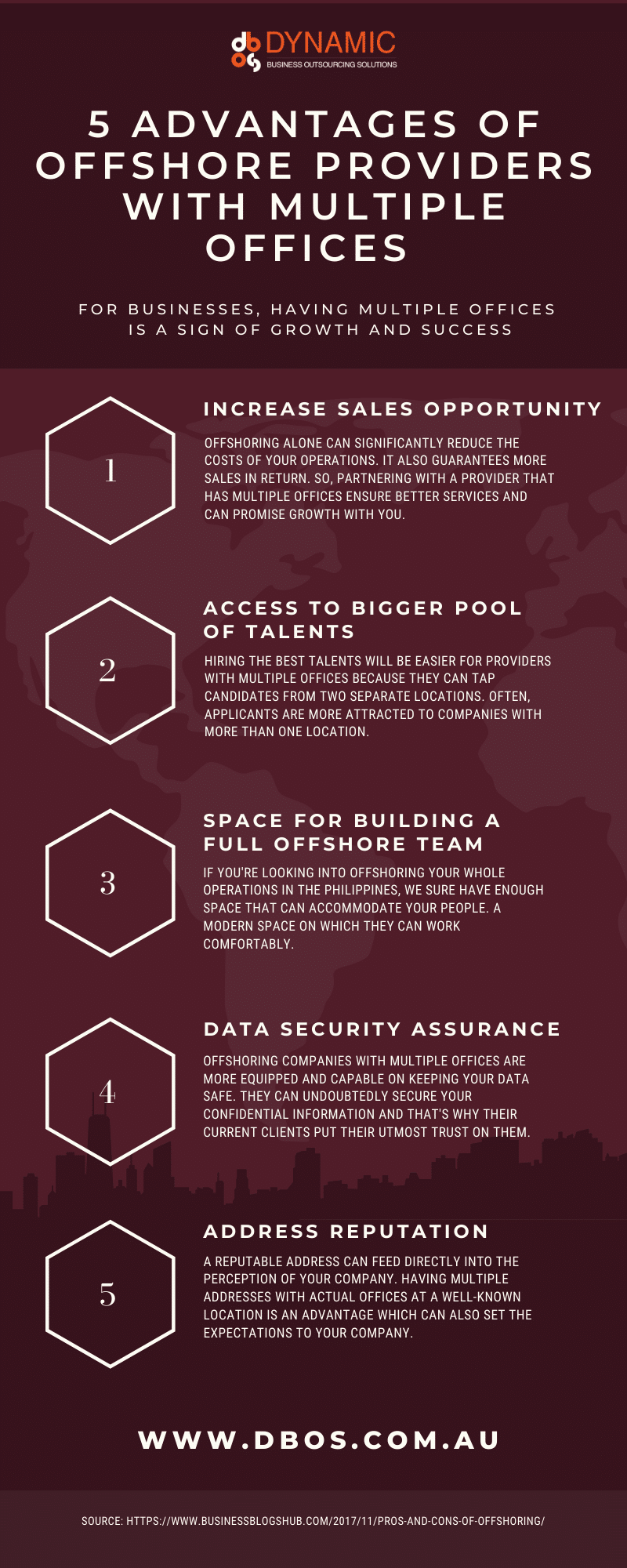
Know the reasons why and learn about the 5 advantages of offshore providers with multiple offices on our infographic below.

offshore providers

Increase sales opportunity

Offshoring companies with multiple offices can now accommodate more clients, thus the evident increase in sales. And because of reduced labour costs that offshoring allows, most clients have been expanding their services and offerings. Both opportunities to increase their sales is felt by the offshoring provider and the client.

Access to a bigger pool of talents

Employees are referred to as “talent” for a reason: When you’re hiring, you’re not looking for just anyone to fill a position. You’re looking for the right person to join the team. So for companies with multiple offices, it’ll be easier to pick from a huge number of choices. Also, a company with multiple offices appeal more to job seekers. Thus, tapping a bigger pool of talents from different locations.

Space for building a full offshore team

Most offshoring companies with multiple offices has more than enough space to accommodate a full offshore team. Especially, if a potential client is aiming to expand its operations on a different country like in the Philippines. And not just like any other space, but a modern and secured office that can handle the employees’ needs.

Data security assurance

More equipped and capable of keeping data safe, offshoring providers with multiple offices are experienced in this aspect. Their reputation and pride over the years came from the confidence of being able to protect their client’s data.

Address reputation

An address might seem like just an address. But that’s not the case for people outside of your company, especially for potential clients. So having an office in good locations can be one of your company’s greatest asset. Say for example, in the Philippines, there are five major business centres in the Metro. However, big factors like traffic and transportation problems made some of these business districts inaccessible to most. In the country, most BPO companies are aiming to build offices in Eastwood and Araneta Center as they are both convenient locations for commuting. Both are also near the borderline of all exit and entry points in the Metro which makes it the most strategic locations for growing businesses compared to Makati and Ortigas.

Conclusion

Offshoring providers with multiple offices that are both accessible for prospect clients and employees is a good find. In the Philippines, there are numerous offshoring companies that can cater to all sorts of services. However, only a few are successful enough to be able to expand and have multiple offices.

DBOS, an Australian-owned offshore staffing company based in the Philippines is one of the two. After establishing the head office in Araneta Center, Cubao 4 years ago, the company is now ready to expand the business and open another door in Eastwood City. Anticipate the opening of their new office and help reduce your wages by up to 70% if you partner with us! Enquire now and get a free consultation with our very own CEO/Founder!

business growth

5 Lessons About Outsourcing to Aid Your Business Growth

Ever since the significant shift in the global business trend, outsourcing has become a major player in the industry. Offering tempting benefits for all business fields, especially for startups, outsourcing has continuously dominated other business practices. Companies that are already utilising the strategy for years has reported exceptional improvements and remarkable business growth.

Up until this day, the outsourcing industry remains thriving. Businesses inclined with the practice either stays at the top of their game or are on their merry way to business growth. According to a recent report, some of the most popular companies that provide reliable outsourcing solutions are located in Asian countries.

To find out how you can measure your own business success, here are the top 4 indicators.

  • Profit

    If your business has been consistently making money that is enough to cover all expenses. Apart from that, leaving some extra for saving. Then that is a clear sign of your business doing well.

  • Growing network

    If you have the ability to retain your current clients while attracting more of them, then it is a clear sign of a growing network. Continued network growth shows that you are effectively reaching your target market.

  • Team satisfaction

    Inspire and motivate all your team members by rewarding their hard work and make them feel appreciated. By doing so, a progressive and productive workplace is highly guaranteed.

  • Business owner satisfaction

    The satisfaction of the business owner on how things are going around the company is one of the most accurate measures of success. It’s because the owner, among others, know exactly if their business is doing well or not.

In connection with these success indicators, implementing an effective business strategy should be the first priority. To help you get a headstart, we lay down 5 lessons about outsourcing that could aid your business growth in the long run.

business growth

When to outsource

Like in everything that we do, knowing the right timing is definitely important. Missing it or getting ahead of it might impact the business negatively. So before outsourcing, you should take a full stop to weigh down your options and think carefully. Doing so would significantly lessen the chances of getting it wrong.

When not to outsource

Although outsourcing is widely used around the world, some still get the wrong idea about it. And while outsourcing is supposed to help juggle limited resources, it does not always provide the solution for everything. The golden rule: never outsource your core business competencies.

Ideal tasks to outsource

In a world where everything can be easily outsourced to anyone, which tasks should it be? Well, it could be anything. Just don’t forget to keep your core tasks in-house and your non-core activities outsourced.

Weighing up the pros

Outsourcing should help increase a company’s productivity, help reduce the overhead costs, and provides an experienced workforce. But if you like you’re not getting any of these benefits, then go back to when is the right time to outsource.

Learning the cons

Despite the many benefits of outsourcing, going down this path without the full knowledge about it could pose a risk to the business. So, learning the potential drawbacks alongside its advantages is a good practice.

Considering offshoring? Check out DBOS – one of the fast-growing Australian-owned offshoring companies in the Philippines. Reduce your wage costs up to 70% when you partner with us and get a free consultation with our very own CEO/Founder.