
Employee Performance

positive work attitude

How a Positive Work Attitude Affects Your Job

A positive work attitude creates wonders on your mood and everyone else’s near you. It affects them unintentionally and impacts their perspective throughout the day. It is something that goes deeper beyond the surface cheer. Meanwhile, a negative attitude promotes the opposite of every positive there is. It ruins the atmosphere and harmony of the workplace.

So what would you be? The mood ruiner or the mood maker?

If you decided to be the latter, here are a few tips on how to sustain the positiveness radiating inside you.

How to maintain a positive work attitude?

A positive attitude amplifies a good working environment for you and your coworkers. It is not just about plastering a smile on one’s face and trying to think happy thoughts all day.

Studies have shown that having a positive attitude makes your life seem broad and full of possibilities. It can also create real value in your life and help you build skills that last much longer than a smile.

In a typical office setting, maintaining a positive work attitude might be hard because of numerous pressuring factors. So here’s how you can maintain a positive attitude at work:

Surround yourself with positive people.

Connect with people who love their job and is interested in lots of other things besides work. Talk with them on your free time and slowly, you’ll adapt their mindset. Just like how the saying goes, “birds of the same feather flock together”. However, you can’t pick your co-workers. So instead of avoiding the negative ones, why not try to be the bigger person and spread positivity?

Practice the attitude of gratitude.

Start from the moment you wake up in the morning. Be grateful for a new day. Appreciate the fact that you have a house, a comfortable bed to lie down, and a job to look forward every day. Learn to say “thank you” for the smallest of favours or when a coworker opens the door for you. Every day won’t be perfect, but focusing on what we are grateful for tends to wash away all the feelings of negativity.

Paul Mills, a Professor at the University of California School of Medicine conducted studies that looked at the role of gratitude on heart health.

Now, help yourself. Make expressing gratitude a habit and see where it brings you.

Control your language.

Restrain yourself from cursing. Using a foul language to insult your coworker will only cause misunderstandings and probably hidden grudges in the long run. So to avoid having bad blood with your colleagues, it is best to not use heavy languages that will only result in unnecessary arguments.

Be nice to people.

A significant study in the Journal of Social Psychology reveals that doing something kind for people has the same effect as trying new and exciting things when it comes to feeling happy. So, if you are nice to other people on a regular basis, it’ll become a cycle of generosity and happiness that will eventually go as far as it could. Remember the saying that says, “mind over matter”? Practice thinking positively every day and witness how your whole being responds.

Being nice and kind with colleagues is so much better than talking behind their backs and arguing for the most nonsensical reasons. Bear in mind that a peaceful and happy workplace eases the mind, increases productivity and lessen the stress.

We here at DBOS promotes a caring and happy environment that opens up new opportunities for self-growth and development.

Check out our careers and be a part of our growing family!

 

work performance

Useful Tips on How to Enhance your Work Performance

The best time to reflect on your lagging work performance should not only be when the annual evaluation arrives.

Sometimes, we got this feeling that everything is just doing fine at work. However, your superiors might not think the same way. Now if you don’t appreciate people criticizing your performance, then maybe its time to assess yourself. We listed a few useful tips on how to enhance your work performance, before matters got out of hand.

Learn to manage your priorities

Managing your priorities should be the first step in improving your work performance. The ability to handle things quite well is a talent but also a skill that can be learned through intensive discipline. So, how should you manage your priorities?

  • Firstly, organize your tasks wisely. You can either create a weekly to-do list or a calendar-type schedule to help you. Go for whichever you prefer.
  • After that, you should allocate a realistic duration (including date and time) of when you think you can finish each task.
  • Lastly, think of a strategic way on how you should execute each task.

If you don’t know how to manage an effective to-do list, try the 1-3-5 rule and see how much tasks you can actually get done.

Gracefully accept feedbacks and criticisms

It is no secret that most people don’t appreciate having their flaws pointed out to them. Sometimes, how the feedback is delivered and who delivered it creates a huge impact on how criticisms are perceived. Now, to avoid misunderstandings and grudges, here are a few ways on how to accept feedbacks and criticisms:

  • Do not take it personally. 
    Most often than not, we unintentionally got hurt when someone points out our error. It hurts our pride and confidence in the process. However, we must learn how to accept it level-headedly. Remember that professionals are those who turn criticisms into opportunities for improvement.
  • Ask for specifics.
    To further understand your fault and to not take it at heart, ask for specifics. Display a manner of humbleness and openness to accept feedbacks so they can specifically enumerate which matter should you enhance.
  • Seek for advice.
    To avoid doing the same mistake twice, sincerely ask for solicited advice and suggestions on how you could further improve your performance.

Acknowledging your mistakes and correcting it is the right way to deal with feedbacks. No matter how good you are at what you do, incidentally committing a small mistake once or twice only makes us human.

Crave for new knowledge

Remember what our teachers used to say when we are in school? Never stop learning. Our desire to learn new things and acquire new skills should not end when we finished schooling.

Realizing that there’s so much more to learn than what we already know could be a key point for your never-ending flight to success. Here are some tips to supply food for our brain:

  • Join training and workshops
    Since the rise of the internet, even training and workshops are now available online. Now you don’t even have to show up at bizarre and far-away places just to attend seminars and whatnot. Learning is just a click away. All you need to do is take the initiative to enrol yourself on various online training and workshops. Who knows? You might develop an important skill that could play an important role in your long-awaited promotion. DBOS, being the people-oriented company that we are, offers a special series of training available for all employees – for free!
  • Pursue additional courses
    Look for additional courses you can take to improve yourself at your job and don’t hesitate to discuss it with your boss. Even if it won’t be approved, take them anyway if it can really help you take a step forward towards career growth.
  • Ask for recommendations on what books to read
    Reading gradually enriches one’s learning when done regularly. Not only it enhances our vocabulary and comprehension, but also our imagination. Getting exposed on a broader range of intellect will eventually work its wonders either at work or daily life. Also, more often than not, bosses are often impressed with employees who always seek improvement.

Continuously learning for the sole purpose of gaining something new is an impressive feat. Since the world is full of endless possibilities, your newly acquired knowledge could take you a long way. Remember that you have so much to gain and nothing to lose when you invest in learning.

Make use of the tips above to improve your work performance and ace every evaluation!

Ready to pursue your dream today? Check out our careers and browse our quality offshore back office services available for a fraction of the cost!

Come and be a part of our growing family today!

coaching

Why Coaching is the Key to Successful Performance Management

Successful performance management is an integral part of every business. It can either make or break an organisation. Thankfully, there are various ways to achieve such a feat, one of them is coaching.

“The goal of coaching is the goal of good management: to make the most of an organisation’s valuable resources.”
– Harvard Business Review

Coaching in its best form plays a vital role in the company’s best asset – the employees. As they are the driving force of every business, their great contributions are a must. Skills, knowledge, and abilities all build up a great weapon.

However, skills, abilities, and knowledge are three different things. Acquired skills needed time to strengthen up, while abilities are natural-born talents and can do’s. On the other hand, knowledge is only an understanding. There is no guarantee that once you know a thing or two does mean that you can immediately do it.

Certain scenarios show that some employees were hired because their academic records are impressive but skills and abilities are lacking. This is why coaching is most needed.

What is coaching?

Coaching, according to Ed Batista is about connecting with people, inspiring them to do their best and helping them grow. It’s also about challenging people to come up with the answers they require on their own. Moreover, it is bringing out the best in people and broadening their horizons.

Most business outsourcing companies nowadays ditched the old leadership style and switched to a modern-day approach. Since the scary, cold, and authoritarian boss is no longer feared, more and more companies changed their strategy.

Several studies show that coaching, in order to be effective, requires mutual respect and trust from both parties. Others define it as healthy training.

Benefits of effective coaching:

  • Increased Productivity
    When you carefully select the right people and invest in their development as an individual, you are already planting seeds of productivity. A recent study shows that supporting and encouraging people increases their confidence and progress towards their goals. And before you know it, they are already actively contributing to the company’s growth.
  • Job Satisfaction
    All employees dream of a good working environment, including bosses who appreciate hard work. These are all associated with higher work morale, lower rates of absenteeism, burn-out, and bore-out. Close relationships with managers and colleagues also contribute to employee’s motivation to do better at work. In the long run, these factors would definitely bring success to both the staff and the company.
  • Adaptation to Innovation
    Effective coaching seeks to strengthen every employees’ level of independence. Thus, also being able to adapt to multiple changes in this highly competitive economy will help you survive in the end. This is equally accounted as to being proactive and always on the go.

Enumerated above are only a few benefits of effective coaching. On the other hand, there are a lot more advantages of coaching that drives to successful performance management.

Some people say that “there is no shortcut to success”, however true, there are tested and proven equations that work well on other companies. Even Google uses a simple framework to coach their employees and increase the percentage of effectiveness and knowledge.

Explore more about the hows and whys of effective coaching that drive companies to successful performance management.

Experience it yourself, contact us for a free consultation today!

work attendance

How to Effectively Improve Your Work Attendance

First impressions last. Now, do you want to be remembered as the most delinquent employee? Or do you prefer a deteriorating work attendance rather than a clean track record? Think again and decide.

It is a fact that getting up in the morning to prepare for work is tiresome. Everyone does. However, keeping your job is essentially important. We all know how hard it is to find a job, right? So might as well, change your habits now or lose your job soon.

Like it or not, attendance and tardiness add up to your work attendance. It doesn’t matter if you’re really good at what you do when you’re always late or missing-in-action (MIA).

Just as the saying goes, “skills can be taught but not attitude”.

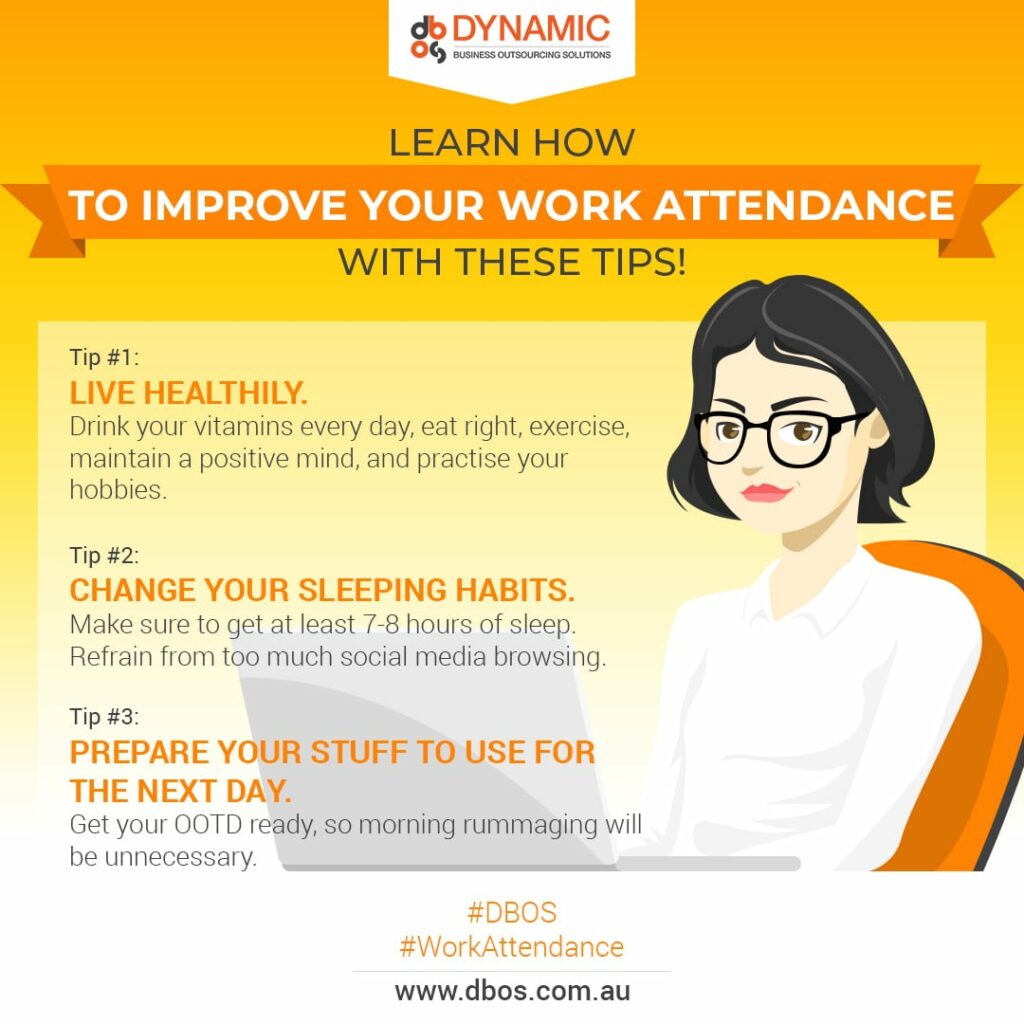
Here are a few tips to help you improve your work attendance:

work attendance

Healthy Living

One way to improve your punctuality and attendance is to live healthily. Eat right, exercise, take your vitamins, and other habitual routines that will help lessen your stress. Make sure to still practise your favourite hobbies and spend time with your loved ones. Doing so will help you balance your work and personal life. Also, maintain a healthy and positive mind.

Sleeping Habits

Practice at least 7 to 8 hours of sleep. But if you’re having trouble sleeping at night, try drinking any calming tea or milk, and do not drink coffee before going to bed. Refrain from too much social media browsing and playing mobile games until the wee of night. Also, avoid binge-watching your favourite TV series if you have work for the next day. You have the weekends to do that. Getting enough rest at night is important as it helps you regenerate your liveliness for the next day.

Preparation

Ready your office attire the night before, so you can save time from rummaging through your closet in the morning. Also, as traffic always gets bad especially during the morning rush hour, make it a point to allow another hour in case you get stuck on the jam. In addition, it is highly advisable to arrive 30 minutes before your scheduled time starts. And to be able to save more time, you can also prepare breakfast on the go instead of eating at home. Always remember that it is better to prepare earlier than be in a hurry the next day.

Listed above are just a few tips to help you get through the struggles of getting up in the morning and going at work. All of those mentioned are important,  however, the decision to improve your attitude towards work is on you.

In some companies, consecutive absences and tardiness can lead to immediate termination. Don’t let it happen to you. Don’t mess up your hard-earned career just because you’re bored or tired. Some people can’t even get a decent job so be appreciative and exert more effort.

Living in this fast-paced world is the only way to survive. So you should carry a positive mindset and a clear mind. And always remember that the most hardworking people are much needed for a successful dynamic business.

Check out our career openings and see which one fits you best!


business team meeting

Quick Tips to Hosting Better Team Meetings

Team meetings are important for catching up with your co-workers regarding your group’s weekly or monthly accomplishments and challenges. It strengthens the communication between employees and designated leaders within the workplace. Being in charge of a team meeting can be daunting to some, especially for those who are doing it for the first time. The following tips can help you get on track and start organising amazing meetings!

1. Enumerate objectives to set the tone

Before starting a meeting, list down your agenda for the whole session. You can dedicate a slide to this at the beginning of your PowerPoint presentation or write in on the board. This gives the participants an idea of what to discuss and which topics are to be prioritised. Anything outside the list of objectives can either be discussed in another meeting or if there’s time left. Having a prepared list also helps everyone stay on track in means of topic and time.

business team meeting
Discuss the agenda beforehand to inform every one of the meeting’s objectives.

Additionally, it’s better to have this agenda list crowdsourced beforehand: ask participating members in advance if they have core issues they want to share in the meeting that can be part of the objectives list. This way, you are giving them an everyone a fair chance of getting their voices heard.

2. Encourage participation

Always dedicate even just a small part of the meeting to hearing out everyone present in the room. Even quiet members can sometimes have great ideas and opinions to share. Keep a mindset of hosting meetings not just because you have something to say to everyone, but rather, making it a platform for everyone to be heard. You can also take the time to ask everyone about their weekend, share a piece of good news from their personal lives, or a short weekly update on their tasks. This can help liven up the meeting or serve as an icebreaker and help lighten up the mood.

3. Find solutions as a team

Though different tasks and challenges are delegated to each member, it’s important to also steer focus on working together to help each department lead or participating member who’s experiencing difficulty come up with action plans. Adopting this into practice further develops communication between employees and provides a fresh perspective in approaching different issues. It also builds a strong sense of camaraderie and increases the probability of having more successful interdepartmental collaborations.

business team meeting
Make every success a team effort.

4. Incorporate something new

Having weekly meetings can get monotonous especially when you keep following the same format. To spice things up, you can try adding something to break up the pattern: show a related Ted Talk, bring in snacks, ask everyone to dress the same colour or have the meeting at a different location. Introducing variety even in the smallest of ways can help make the meeting feel different every single time.


Mastering the art of leading an engaging meeting can be very tricky, but we hope that these steps will help turn your reporting into something your team members can look forward to every week.

How to Work Smarter and Quickly Avoid Burnout

As working adults, burnout is something we have felt at least once in our lives. It’s natural to get tired from constantly working hard day and night, after all, we’re only human. However, there’s a solution to help you avoid this so you don’t get sidetracked from reaching your goals. We’ve compiled a short list of tips to help you stay focused and refreshed.

1. Set clear boundaries between work and play

From the very second, you leave the office, set aside anything that’s work-related. Tomorrow’s tasks is tomorrow’s problem, and quit checking your emails outside your shift. You can choose between leaving your work phone behind or use apps like Cold Turkey or Focus Booster to help encourage you in keeping your mind off from work. The time you spend outside your job should be dedicated to your home life, other interests and self-care. My friend from Japan shared that her bosses advise her to turn down clients when they call her outside her shift. Even the mere act of answering their texts can give them the impression that her time isn’t as important as theirs.

multi tasking

2. Take things one at a time

Some people are born multitaskers, while the rest of us try in vain just to keep up with the demands of our job. There are ways to help you manage your time better, all of which you can easily adapt to your daily routine. Forcing yourself to do two different things at the same time might compromise the quality of your output and unnecessarily stress you out. Research has shown that when multitasking, your brain spends 40% more time to process switching between tasks. Additionally, a study by Stanford University discovered that even people who believe they are great at multitasking to tend to make more mistakes and took longer to complete tasks. The efficiency of multitasking is a common misconception and it’s better to focus on doing one task instead and then transition into another once it’s accomplished.


3. Don’t be afraid to ask for help

Outsourcing small tasks can do so much for time management. Apps like TaskRabbit allows you to hire people for specific tasks and you can always check out UpWork and Fiverr for freelancers. Not only will you save on time, you can also save on energy and materials to get things done. You can also opt for a personal virtual assistant to help you plan ahead and manage your schedule better. There are also other productivity apps like Indigo, Hound and EasilyDo that can serve as your personal assistant if you’re tight on budget.

stress

4. Mental health is just as important as physical health

Self-care must always include checking on your psychological health. However, not everyone can afford to go to a therapist regularly which makes it harder for people to get the proper help that they need. When things get tough, you can opt for cheap and virtual alternatives such as Talkspace and BetterHelp which connects you to a licensed professional and allows you to have counselling sessions without ever leaving your home.


Staying motivated may be hard, but it’s not impossible. It just takes the right approach to help make sure you are on the right track to success.