
BPO Industry

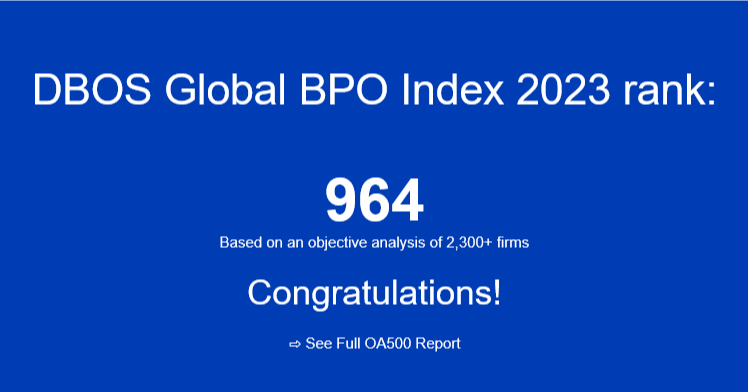
dbos global BPO index ranking 2023

DBOS ranked in The Global Outsourcing Firm (BPO) Index for 2023

16th of February, 2023, Outsource Accelerator, the world’s leading outsourcing marketplace and advisory, announced The Global Outsourcing Firm (BPO) Index.

The Global Outsourcing Firm (BPO) Index ranks BPO firms globally based on an objective and comprehensive analysis of 2,300+ firms.

What you need to know about the Global Outsourcing Firm (BPO) Index

  • The Global Outsourcing Firm (BPO) Index archives, analyses and compares all known outsourcing firms globally. The index delivers a great indicator of a company’s reputation and prominence.
  • Following 18 months of rigorous development, the methodology provides an efficient way to track companies’ headway, conduct cross-company comparisons, and establish a reliable ranking system.
  • The Global Outsourcing Firm (BPO) Index is a crucial tool to assist decision-makers with granular comparison and a broad but objective assessment of the industry as a whole.
  • Unlike the Time Doctor OA500 which focuses only on the world’s top 500 BPO firms, the Global Outsourcing Firm (BPO) Index gathers, sorts, and evaluates all known outsourcing firms globally.
  • The Global Outsourcing Firm (BPO) Index is an essential tool in assisting the BPO decision-making community with a broad but objective assessment of the industry at large.

The Global Outsourcing Firm (BPO) Index uses objective data to rank all outsourcing firms globally.

  1. Assessing and ranking BPOs

Through meticulous research, the Outsource Accelerator team carried months to develop a comprehensive and objective scoring methodology to rank these BPO firms by their prominence.

The team had to gather several metadata points that pertain to different facets of the company and piece them together to deliver an integrated analysis. 

The Global Outsourcing Firm (BPO) Index measures two primary categories: 

  • Footprint – Refers to the BPO’s online presence.
  • Quality – Determined through a series of metadata points, including, domain authority, website traffic, employee reviews, LinkedIn engagement, and third-party analysis.
  1. Company size and revenue

The size of an organisation doesn’t necessarily signify that it’s the perfect outsourcing partner for most firms, but it’s a strong indicator that still needs to be considered. Assessing a company’s size and revenue is the easiest way to assess its prominence.

  1. Online prominence and reputation

The company’s online prominence and reputation are other important factors to consider. While these are two different aspects, their metrics and indicators complement each other.

For the Global Outsourcing Firm (BPO) Index, some metrics that were used for the rankings include:

  • Domain Authority (DA)
  • Traffic analysis
  • Metadata from LinkedIn, Crunchbase, ZoomInfo, and Glassdoor – among others
  1. Employer brand and practices

Outsourcing is erroneously associated with negative labour practices, including unjust wages and subpar working conditions. One bad partnership with a BPO with a wretched track record can reflect badly on the outsourcer, which can even lead to legal and regulatory scrutiny.

In accordance with this, the Global Outsourcing Firm (BPO) Index highlights BPO providers with decent employer brands and good company cultures. Other indicators include Glassdoor rankings, community-centric portals and general media.

  1. Exclusion of variable subjective factors

The Global Outsourcing Firm (BPO) Index strives to provide an objective and comprehensive BPO evaluation. However, some variables need to be excluded, particularly in cases where the data is not universally available or is widely lacking in relevance and authenticity.

These variables include:

  • Geographical location
  • Access to particular languages

Source: https://www.outsourceaccelerator.com/oa500/ 

How to Choose the perfect bPO company in the Philippines

For Australian businesses, one of the best ways to scale is by outsourcing certain processes and tasks to a BPO company in the Philippines. However, with so many companies to choose from, it can be difficult to find the right one for your business. In this article, we will guide you in choosing the perfect BPO company in the Philippines that can help take your business to the next level! 

The Philippines is home to some world’s best BPO companies for hiring remote staff. And as the country recovers from months of lockdowns, the projections for the BPO industry remain positive. The IT-BPM, the country’s association of BPO companies, expects an upbeat outlook of 2.7% – 5% growth in the industry’s talent pool. This means Australian companies can definitely expect to find highly-skilled workers who can provide quality services at a fraction of the cost within the 1.4 million-strong Philippine BPO workforce. 

With such a huge industry, it can be difficult to find the companies with the best talent and services. So, to help you out, we’ve compiled a list of the factors you need to consider when hiring a BPO firm in the Philippines. 

Some BPO companies have specialities and may be good in certain processes but not in others. 

You want to ensure that the company you’re hiring has experience in your industry and can provide the services you need. For example, if you’re in the eCommerce industry, you’ll want to hire a company with experience with order fulfilment, customer service, and social media marketing. Some BPO companies have grown to become highly specialised and efficient at certain processes, so choose one that’s the best fit for your specific requirements. 

The company’s size, location, and culture can have a huge impact on its performance. 

The company’s size can also be a factor, as you’ll want to ensure they have the resources to meet your needs. Additionally, you should consider the company’s culture to see if it’s a good fit for your business. For example, if you’re a startup, you may want to hire a company that is young and dynamic, while a more established business may prefer a more mature and professional company. The company’s location is also something you should look at. If you’re looking for a company that can provide reliable service, one that’s located in Manila, Cebu, and other business hubs in the Philippines is a good option. 

Cybersecurity infrastructure matters especially if you’re going to give them access to critical company information. 

In today’s digital age, cybersecurity is more important than ever. Check the company’s cybersecurity infrastructure to ensure that your data will be safe and secure. Luckily, the Philippine government is highly supportive of the BPO industry and has put in place measures to ensure that all data is protected. The Data Privacy Act of 2012 requires all BPO companies to have comprehensive security measures in place, so you can be sure that your data will be safe. 

Related Article: 3 Ways To Strengthen Your Business Cybersecurity

Success in similar projects may indicate future performance. 

While young start-ups with little experience may have some advantages, Australian businesses should focus on working with BPO companies with a proven track record of success. This will ensure that the company can handle your project and deliver the desired results. 

A sound business plan and efficient systems can turn your business into a well-oiled machine 

Australian businesses should also ensure that the BPO company has a sound business plan and well-defined processes. This will ensure that the company is organised and efficient and can deliver the results you need on time. Having a solid business plan and systems also ensure you’ll have contingency plans in place in case of emergencies. 

These are just some of the factors Australian businesses need to consider when choosing a BPO company in the Philippines. With so many options available, it’s important to do your research and choose a company that’s the best fit for your business. We hope this guide has been helpful, and we wish you all the best in finding the perfect BPO partner for your Australian business. 

international-womens-day

International Women’s Day: Invigorating Women at Work

Women face many work and employment-related challenges. From unequal pay with male counterparts, discrimination to sexual harassment, and other workplace gender bias issues. Some of these gender-based issues have been identified and steps are being taken to mitigate them. However, most of these challenges still exist and are yet to be combated. One of such is the lack of women, particularly leaders in shared services.

Women’s Representation in Shared Services Jobs

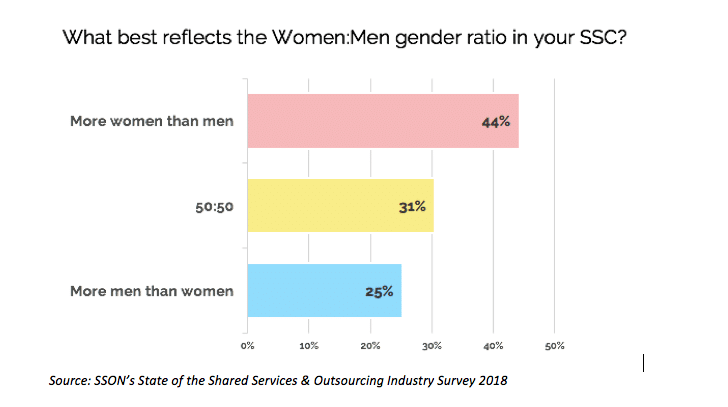
Research has given us an insight into the deficiency of female shared services leaders. A recent survey by the Shared Services and Outsourcing Network (SSON) on 620 shared services organisations indicated that 44% of such organisations employed more women than men while 33% employed an equal number of men and women. Despite the relatively high proportion of women in shared services, only a few women ever get to take up leadership positions.

shared-services

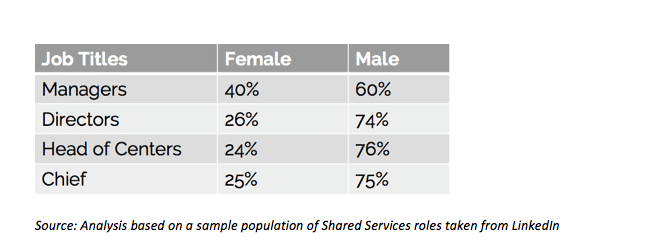
In an analysis made from shared services roles in LinkedIn, it was revealed that more men were in leadership positions than women. 60% of managers were men, 74% were directors and 76% were heads of centres. This shows a significant lack of female shared services leaders.

shared-services-roles

A lot of factors can be traced to this significant lack but the most influencing factor will be the perception of women as primarily domestic caretakers. This traditional perception sees women as those who are meant to take care of children and perform household chores. This has made many shared services organisations believe women will not be fit to take up leadership positions since their primary assignment is viewed as a domestic one. Again, this belief has made many women themselves unwilling to take up leadership roles.

Bearing this in mind, domestic responsibilities should not be automatically used to determine women’s capabilities for leadership positions. Rather, shared services organizations should be ready to support more females to take up leadership positions by enabling a healthy culture system in their workplace. Also, an organization should not assume a female not fit for a career role due to domestic responsibilities without first of all consulting her.

To power more women to take up leadership positions in shared services, every member of the workplace needs to be thoroughly educated to shun gender biases. All should embrace gender equality and each gender should be given equal opportunities to take up roles to encourage diversity. It should be understood that women possess certain skills such as team playing, empathy, and the ability to take up a challenge. When women are placed in leadership positions, these skills will serve as a complement to the unique skills and strengths men possess.

Furthermore, organisations should have flexible work schedules that will allow women to cope with domestic roles while they are still effective in the workplace. When shared services organisations have a flexible work schedule that is favourable, it will bring out full efficiency in women.

Even though there exist still many things to be done to fully empower women, these few processes if taken will surely be a step further at embracing gender equality and encouraging diversity in the workplace. The BPO Philippines industry is one of the leading sectors that is allowing more women to enter the workplace and levelling the playing field. According to the International Labor Organisation, young Filipino women dominate BPO jobs by up to 59.3 per cent and Grant Thornton’s International Business Report (IBR) showed that Philippine women hold 39% of all senior management positions, second only to Russia in the world despite a decline in women roles all over the world since 2009.

Conclusion

The importance of empowering women in the workplace cannot be overemphasised. While the BPO industry is leading in creating gender parity, there’s still more work to be done as many challenges stand in the way of equality in the workplace. This will not happen overnight but through deliberate and conscious effort. International Women’s Day is a time to acknowledge and remember these challenges and commit to fighting them.