
offshore staffing philippines

How to Spot a Scam BPO Service Provider in the Philippines: A Guide for Australian Businesses

Outsourcing to the Philippines remains a strategic move for Australian companies aiming to enhance efficiency, reduce operational costs, and access a skilled talent pool. However, recent events have highlighted the importance of due diligence when selecting a Business Process Outsourcing (BPO) partner.

A notable incident involved the shutdown of an alleged scam BPO operation in Cebu City IT Park. Authorities discovered that the company operated without proper business permits and abandoned its office following a viral exposé. The operation reportedly defrauded over 800 victims of a total of $44 million (roughly P2.5 billion in today’s rates).

This incident underscores the critical need for businesses to thoroughly vet potential BPO partners. Here’s how to identify red flags and ensure you’re partnering with a legitimate and ethical BPO provider.

Red Flags: Identifying a Scam BPO Provider

1. Unrealistically Low Pricing

Scam BPOs often lure clients with prices that seem too good to be true. While cost savings are a benefit of outsourcing, extremely low rates can indicate subpar services or fraudulent operations.

Tip: Compare pricing with industry standards and be wary of offers that significantly undercut the market.

2. Lack of Proper Business Registration

Legitimate BPOs are registered with the Philippine Securities and Exchange Commission (SEC) and have the necessary business permits. The Cebu incident revealed that the company operated without a valid business permit, leading to its closure by authorities.

Tip: Request and verify the company’s registration documents and business permits.

3. No Verifiable Client Portfolio

Reputable BPOs showcase their client successes and testimonials. Scam operations often lack a verifiable client list or present fake testimonials.

Tip: Ask for case studies and contact references to confirm the BPO’s track record.

4. Vague Contracts and Absence of SLAs

Scam BPOs may provide generic contracts lacking specific deliverables or Service Level Agreements (SLAs).

Tip: Ensure contracts detail performance metrics, data protection policies, and clear termination clauses.

5. No Physical Office or Untraceable Address

Some fraudulent BPOs operate from undisclosed locations or virtual offices. In the Cebu case, the office was found abandoned, with equipment left behind.

Tip: Request a virtual tour or visit the BPO’s office to confirm its physical presence.

6. Inconsistent Communication

Frequent changes in contact personnel, unprofessional communication, or reluctance to engage in video calls can be warning signs.

Tip: Establish clear communication channels and assess responsiveness during initial interactions.

7. Negative Online Presence

Search for news articles or online discussions about the BPO. The Cebu scam was exposed through social media and online platforms, highlighting the importance of online reputation. 

Tip: Conduct thorough online research to uncover any negative reports or discussions about the BPO.

Choosing a Trusted BPO Partner: What to Look For

When selecting a BPO provider, consider the following attributes:

  • Transparent Operations: Clear business registration, compliance with local laws, and open communication.
  • Proven Track Record: Documented success stories and positive client testimonials.
  • Robust Infrastructure: Secure IT systems and a physical office with modern facilities.
  • Cultural Alignment: Understanding of Australian business practices and communication styles.
  • Flexible Engagements: Customizable services and contract terms that suit your business needs.

Why Australian Businesses Trust Dynamic Business Outsourcing Solutions (DBOS)

Dynamic Business Outsourcing Solutions (DBOS) stands out as a reliable and ethical BPO partner for Australian companies. Here’s why:

Australian-Owned and Operated

DBOS is 100% Australian-owned, ensuring a deep understanding of Australian business requirements and cultural nuances.

Transparent and Compliant

DBOS maintains full compliance with Philippine business regulations, including SEC registration and tax compliance.

State-of-the-Art Facilities

Operating from a fully equipped office with robust IT security protocols, DBOS ensures data protection and operational efficiency.

Customised Solutions

DBOS offers tailored outsourcing solutions across various domains, including customer service, IT, finance, digital marketing, and back-office support.

No Lock-In Contracts

Believing in performance-based partnerships, DBOS offers flexible engagement terms without long-term commitments.


Take the Next Step with Confidence

The recent scam incident in Cebu City serves as a cautionary tale for businesses considering outsourcing. By partnering with a reputable and ethical provider like DBOS, you can leverage the benefits of outsourcing without compromising on integrity or quality.

Ready to explore outsourcing solutions tailored to your business needs?

Visit www.dbos.com.au to learn more and schedule a free discovery call.

cultural differences

Common Cultural Differences Between the Philippines and Australian Workplaces

Geographically separated by thousands of kilometres, the Philippines and Australia present distinct cultural nuances that significantly impact workplace dynamics. Understanding these differences is crucial for fostering effective cross-cultural collaboration.

Key Cultural Differences:

  1. Hierarchy vs. Equality:

    • Philippines: Hierarchical structure, with respect for authority and titles like “Sir,” “Ma’am,” and “Boss.”
    • Australia: The egalitarian approach emphasizes equality regardless of position.
  2. Self-Discipline vs. Laid-Back:

    • Philippines: Strong work ethic, often involving long hours and overtime.
    • Australia: Laid-back attitude, valuing work-life balance and the eight-hour workday.
  3. Results-Oriented vs. Relationships-Oriented:

    • Australia: Focus on deadlines, efficiency, and individual performance.
    • Philippines: Emphasis on building strong relationships and teamwork.
  4. Communication Styles:

    • Direct vs. Indirect: Australians tend to be more direct, while Filipinos may prefer a more indirect approach.
    • Verbal vs. Non-Verbal: Filipinos often rely on nonverbal cues, while Australians prioritise verbal communication.

Bridging the Gap:

To foster successful collaboration between Filipino and Australian teams, consider the following tips:

  • Open Communication: Encourage open and honest communication, respecting cultural differences.
  • Active Listening: Pay close attention to both verbal and nonverbal cues.
  • Cultural Sensitivity: Show empathy and understanding for different cultural perspectives.
  • Clear Expectations: Set clear expectations and deadlines to avoid misunderstandings.
  • Build Relationships: Invest time in building strong relationships with colleagues.

By understanding and appreciating these cultural differences, businesses can navigate the complexities of cross-cultural collaboration and achieve greater success.

Ready to tap into the power of offshore staffing?

Schedule a Free No-Obligation Discovery Call with DBOS today to explore how our expert team can help you scale your business at a more affordable cost.

Discover how offshore staffing can:

  • Enhance Productivity: Access a highly skilled workforce 24/7.
  • Reduce Costs: Lower operational expenses without compromising quality.
  • Scale Efficiently: Quickly adapt to changing business needs.

Don’t miss this opportunity to take your business to the next level.

Contact us now to schedule your free consultation.

Offshore Labour: Definition, Benefits and Drawbacks

The term “offshore labour” has gained significant public attention in today’s business landscape. And like most buzzwords, it’s easy to lose track of their meaning. Remote work, virtual staffing, and other terms, for example, have also become commonplace jargon that has similar yet not exactly the same meaning as offshore labour.  

What’s an Offshore Staff?

In its simplest form, offshore staffing is the practice of outsourcing everyday tasks and roles to workers living and working in another country. This can be done for various reasons, but the most common is to save on costs. Offshore staff are typically paid less than their counterparts in developed countries because the cost of living in their respective countries is often much less expensive.  

Offshore staffing is not a new concept; it has been around for a long time. Manufacturing, for example, has been outsourced for decades to countries like Vietnam, Bangladesh, and the Philippines. And as technology and skills advanced in these less developed countries, so did their ability to handle different types of outsourced work.  

These days offshore labour has spread to various industries, from manufacturing to back-office roles. Even critical tasks such as data analytics, engineering, and entire marketing departments are often outsourced to offshore labour.  

But, will hiring an offshore staff be good for your business? Let’s look at some key benefits and drawbacks to help you decide.  

Benefits of Hiring Offshore Labour  

Cost savings: One of the main reasons businesses choose to use offshore staff is cost savings. By hiring workers in a lower-cost location, companies can significantly reduce their overall labour costs.  

Access to skilled workers: In some cases, finding the skilled workers you need in your own country can be challenging because of the hard-nosed competition between companies. Offshore staffing provides access to a larger pool of talent. It allows you to hire the best workers for the job, regardless of location.  

Increased efficiency: Offshore staff can often work more efficiently as the teams are highly specialised and focused on a single task. In some cases, labour laws in their country may also allow them to work longer hours without much additional cost to the company. 

Drawbacks of Hiring Offshore Labour  

Language barriers: One of the challenges of offshore staffing is communication. A language barrier between you and your offshore staff can make it difficult to give clear instructions and get the results you need.  

Time differences: Another challenge of offshore staffing is time differences. If your offshore staff are in a different time zone, coordinating work hours and communicating in real-time can be difficult.   

Related article: Outsourcing To The Philippines: Managing The Timezone Differences

Cultural differences: Offshore staff may have different values and cultural norms than your own employees. This can lead to misunderstandings and conflict within your team.   

Final Thoughts: Is Offshore Labour for Your Business?  

The growth of the offshore outsourcing industry across the globe proves that it’s a sustainable way to scale businesses in developed countries. With an offshore staff, allocating resources to your most talented employees can be easier as more straightforward tasks can be outsourced to offshore labour. However, it’s essential to be wary of the cons, such as language and cultural barriers, as these can also lead to costly work disruptions.  

To be sure, before hiring an offshore team, try to get to know them first. A great way to do this is by conducting a video interview. This will give you a good sense of their language skills and whether or not they are a cultural fit for your company.   

Hopefully, we were able to help you in the decision-making process just by looking at the pros and cons we’ve laid out for you here. So, if you’re ready, then go ahead and give offshore staffing a try for your business. It may just be the boost you need to build momentum for your business this year! 

wellness

4 Employee Wellness Trends for 2020

Employee wellness is more important today than ever. Not only it affects employee productivity and performance, but also influences a person’s mental health. So, most companies today treat this matter with utmost cautiousness.

Businesses in different fields, as well as other organisations, implement various programs to help maintain their employee’s wellness or improve it if needed. This is aside from their usual benefits such as paid leaves, sick leaves, health care, and more.

According to a study by ResearchGate, effective corporate wellness programs create a remarkable impact on an employee’s health and overall well-being. Also, improved motivation, capability, and skills are other traits that show the enhanced result.

The brief history of workplace wellness 

Interestingly, workplace wellness did not just start abruptly. It has a long history that started in 1633 whereas, an Italian physician wrote about the effects of work exposure on workers. In 1810, a Welsh social reformer proposed a 10-hour workday to protect the well-being of the workforce. By 1817, he proposed a more aggressive measure – an 8-hour workday, where the phrase, “eight hours labour, eight hours recreation, eight hours rest” originated.

Jumping to 1950s, this is when companies began to offer wellness interventions which are primarily focused on mental health issues and alcoholism. And not until the mid-1970s, true workplace wellness programs did begin. During this timeframe, financial responsibility for health care from government to employer was developed. From that year onwards, occupational safety and health insurance, health promotions, and fitness programs for employees were pursued.

In modern-day, employee wellness is one of the most important aspects that employers pay attention to. More regulations are looked upon and restrictions on working hours are strictly implemented. But, on a survey of employees by Quantum Workplace, 71.1 per cent of them still wants their employers to provide stress relief breaks, including naps and massages.

Employee wellness trends in 2020

As time passes by, every employee’s needs and wants changes too. So whatever it is that might work for your employees last year could not be as effective this year. To be able to adjust according to the changing needs of your workforce composition this year, take note of these employee wellness trends:

1. Workplace wellness culture audits

To closely monitor the changes and keep pace with the workplace wellness culture, companies nowadays should implement regular HR reviews, turnover, productivity, error levels, and workplace health and safety standards.

This audits should be able to help keep your employees aligned with workplace well-being programs such as turnover, retention, stress levels, and mental health issues. The main goal is to immediately adjust the well-being programs even if changing technology, societal conditions, and satisfaction affects it.

2. Millennials will dominate the workforce in 2020

The workforce in 2020 is highly anticipated to be mostly dominated by millennials. This generation is known to have a strong standpoint against structural issues, most especially, workplace burnout. Millennials love maintaining their work-life balance, as well as their career satisfaction. So if they feel trapped in a place that doesn’t value much of their wellness, moving on is their next step.

According to a survey by Class pass, 75% of millennial professionals believe that it’s the employer’s responsibility to provide health and wellness benefits. More than half, states that they would’ve stayed in a company that provided fitness and wellness benefits.

3. Establishing wellness programs that create real behavioural change 

According to neuroscience research, habit change takes at least 60 days. But, engaging programs that continuously support employees at work and home helps create the change. In return, companies expect reduced turnover, absenteeism, stress levels, and improved retention.

Investing in people bears nothing but good results both for the individual and the company. It boosts morale which could, later on, progress to improved productivity that will directly impact the company.

4. Promoting healthy mental and psychological well-being

Psychological and mental health is as important as physical health. Nowadays, an increased number of people with mental health problems is arising. Younger generations, as well as the working-age individuals, are the usual victims of these mental health issues.

So this year, businesses are crafting wellness plans that address mental health. Some of which includes; free mental health checkups, coaching, encouragement with team members, team building activities, or anything that might work.

Conclusion

We, at DBOS, cares about our employee’s wellness as much as we do with their performance and productivity. Our human resources officer make sure to stay on track with employee reviews and concerns. Employee wellness programs such as monthly birthday and anniversary bash have been part of the culture. We also encourage our people to join several volunteering programs and donation drives that we continuously practice. Aside from those fun activities, we also motivate our people to learn new skills through constant training and study.

Know more about one of the fastest-growing offshore staffing companies in the Philippines and save up to 70% on your labour costs! Contact DBOS today and get a free consultation with our CEO/Founder.

offshore providers

5 Advantages of Offshore Staffing Providers with Multiple Offices

One to two offshore providers are being introduced to the public almost every single day. Hence, the growing competition in the offshoring industry. But despite all those, the market remains advantageous for companies with years of experience in the field rather than the newly established ones.

Generally, all businesses aim for growth and expansion. Achieving this two is a clear indication of ongoing success for any kind of business. Having multiple offices is an advantage that some does not fully utilise. It represents a significant outlay in finances, manpower, and a general commitment to driving towards a higher level of achievement.

Location is no small question for a company. When the time comes that they are finally ready to grow and evolve, they should not have to limit where their business operates. And today, it’s easier than ever to run a company without being centralised in a single place.

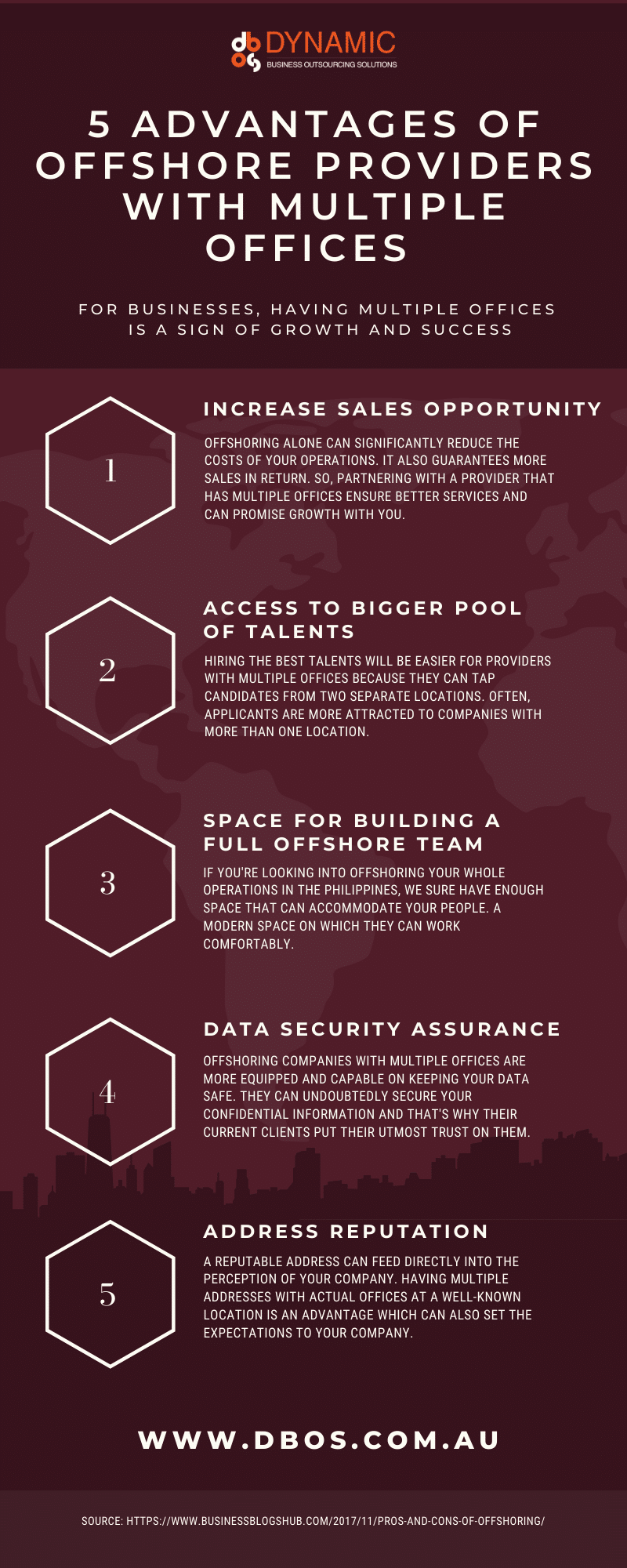
Know the reasons why and learn about the 5 advantages of offshore providers with multiple offices on our infographic below.

offshore providers

Increase sales opportunity

Offshoring companies with multiple offices can now accommodate more clients, thus the evident increase in sales. And because of reduced labour costs that offshoring allows, most clients have been expanding their services and offerings. Both opportunities to increase their sales is felt by the offshoring provider and the client.

Access to a bigger pool of talents

Employees are referred to as “talent” for a reason: When you’re hiring, you’re not looking for just anyone to fill a position. You’re looking for the right person to join the team. So for companies with multiple offices, it’ll be easier to pick from a huge number of choices. Also, a company with multiple offices appeal more to job seekers. Thus, tapping a bigger pool of talents from different locations.

Space for building a full offshore team

Most offshoring companies with multiple offices has more than enough space to accommodate a full offshore team. Especially, if a potential client is aiming to expand its operations on a different country like in the Philippines. And not just like any other space, but a modern and secured office that can handle the employees’ needs.

Data security assurance

More equipped and capable of keeping data safe, offshoring providers with multiple offices are experienced in this aspect. Their reputation and pride over the years came from the confidence of being able to protect their client’s data.

Address reputation

An address might seem like just an address. But that’s not the case for people outside of your company, especially for potential clients. So having an office in good locations can be one of your company’s greatest asset. Say for example, in the Philippines, there are five major business centres in the Metro. However, big factors like traffic and transportation problems made some of these business districts inaccessible to most. In the country, most BPO companies are aiming to build offices in Eastwood and Araneta Center as they are both convenient locations for commuting. Both are also near the borderline of all exit and entry points in the Metro which makes it the most strategic locations for growing businesses compared to Makati and Ortigas.

Conclusion

Offshoring providers with multiple offices that are both accessible for prospect clients and employees is a good find. In the Philippines, there are numerous offshoring companies that can cater to all sorts of services. However, only a few are successful enough to be able to expand and have multiple offices.

DBOS, an Australian-owned offshore staffing company based in the Philippines is one of the two. After establishing the head office in Araneta Center, Cubao 4 years ago, the company is now ready to expand the business and open another door in Eastwood City. Anticipate the opening of their new office and help reduce your wages by up to 70% if you partner with us! Enquire now and get a free consultation with our very own CEO/Founder!

website

11 Things You Can Do to Your Website to Prepare for 2020

As the end of 2019 is getting near, company owners and leaders are starting to lay down their strategic plans for 2020. One of their main focus is on marketing efforts. For successful marketing to take place, checking the health of your website is essential.

Few months before the end of 2019, companies from different industries are preparing their marketing plans for the next year. One of them is the offshoring industry which remains as one of the most competitive income-generating fields in this generation.

As a vital part of your marketing efforts, refreshing your website and preparing it for the next year should be a must. Now, to further understand what and which comes first, here are 11 things that you can do to your website to push it into 2020.

website

#1.  Implement chatbots and live chat

Advances in technology will only become more prominent as the years pass by. In 2020, think-tanks are aiming to achieve better communication with clients and customers. With this, conversational marketing is highly anticipated. Also to avoid clogged chat boxes and other modes of communication, implementing the use of chatbots and live chats are a probable solution. At the very least, chatbots can answer common questions, qualify leads, set meetings and so much more.

#2. Measure your marketing

It is important to set up the right tracking software/analytics to see how well your website is doing before making any changes. It will also provide a plus point to your marketing if you can integrate visitor tracking and marketing automation.

#3. Become a video expert

Watching videos is a fast and convenient way to learn about something. For businesses, videos keep the audience longer on their websites, enabling them to know the brand better. So learning how to edit basic videos or doing it like a pro is going to be a trend next year.

#4. Focus on buyer problems, not product features

Always remember that the main purpose of a business is to serve its consumers. So instead of focusing on how to improve this and that service or product, hear what your client has to say first.

#5. Become a content machine

More than the quantity of any content, quality should always come first. So in 2020, quality content will be an important determinant of on how your website would do well.

#6. Focus on user experience

Continuously improving the user experience of your website to help your visitors navigate seamlessly is going to create a huge impact in 2020. Reduce your website’s friction and make sure to find a happy medium to effectively communicate with your users.

#7. Optimise for mobile

When it comes to optimising the website for mobile, the navigation experience is far more important than the design. Also, make sure to get right to the point instead of filling it with countless marketing content.

#8. Test your conversion points

Find out where specifically on your website does the users can convert from visitor to known contact. Sometimes, this includes pop up forms, chatbots, general forms, CTAs, and a lot more.

#9. Implement social media

Ensure that your social media icons are easily found on your website and utilise it for joining conversations on topics about your industry.

#10. Optimise your Google My Business

Make sure to regularly use your listing on Google My Business in 2020. Doing so will improve your local SEO as you are sharing information to the world’s largest search engine.

#11. Focus on context

Putting context on your website will make visitors feel more welcome which will bring your 2020 marketing plan to a new level.

Getting ready for your business growth in 2020 but not exactly sure how and where to start? Contact DBOS – a fast-growing Australian-owned offshore staffing company based in the Philippines. Know more about our services and get a free consultation with our very own CEO and Founder!