
outsourcing Philippines

How to Be Professional at Work: Tips for Aussies Working with Filipinos

As an Australian business owner, building successful partnerships with offshore teams is not just about finding talent; it’s about knowing how to be professional at work across cultures. 

When working with Filipino professionals, understanding cultural values and workplace behaviours is crucial to creating strong communication, trust, and productivity.

Here are practical tips to help you work more effectively with Filipino teams while showing professionalism that builds lasting relationships.

1. Communicate Clearly and Respectfully

Australians are often known for being direct, while Filipinos may prefer a more diplomatic style of communication. A “yes” in the Filipino context might not always mean full agreement; it could mean “I’ll do my best” or “I understand.”

Actionable Tip: Check for clarity without being confrontational.

Instead of asking yes/no questions, use open-ended prompts like “How do you see this task being completed?” This encourages detailed answers and reduces the chance of misinterpretation. 

By communicating clearly yet respectfully, you show professionalism while making space for cultural differences.

2. Value Relationships as Part of Professionalism

For many Australians, professionalism often means efficiency and getting straight to business. For Filipinos, professionalism includes building strong relationships at work. Concepts like pakikisama (harmony) and teamwork are deeply valued, and strong relationships often translate to loyalty and commitment in the workplace.

Actionable Tip: Make time for small talk and team bonding.

Spend a few minutes in meetings to ask about your team’s day, family, or local events. Recognising milestones like birthdays or work anniversaries shows respect for your team’s culture and builds genuine connection. 

Professional behaviour, in this context, includes valuing relationships as part of work.

Recommended read: 17 Team-Building Activities for In-Person, Remote, and Hybrid Teams

3. Set Clear Expectations and Provide Guidance

Australian workers often thrive on autonomy, but Filipino professionals may prefer clear guidance and structured processes. This does not mean they lack initiative; rather, it reflects cultural respect for hierarchy and a desire to avoid mistakes that could reflect poorly on the team.

Actionable Tip: Outline roles and escalation paths from the start.

Be specific about responsibilities, deadlines, and decision-making authority. Provide clear instructions for when to act independently and when to escalate an issue. 

Doing so prevents hesitation, builds confidence, and helps everyone demonstrate professionalism at work.

4. Show Respect for Filipino Values

Filipino workplace culture is shaped by values such as hiya (maintaining respect and avoiding embarrassment) and kapwa (shared identity and community). These values influence how Filipinos collaborate, communicate, and view professional behaviour.

Actionable Tip: Be mindful of respect in everyday interactions.

Avoid direct criticism in public settings, as this may cause embarrassment. Instead, provide constructive feedback privately and frame it positively. 

Use polite greetings (such as “Sir” or “Ma’am” when appropriate) and acknowledge important cultural events. 

Small acts of respect go a long way in showing professionalism and building trust.

5. Lead with Civility and Cultural Awareness

Workplace civility is universal, but research shows that incivility has stronger negative effects in some cultures than others. 

Filipino professionals often place a high value on harmony, while Australians may not always realise when casual humour or blunt remarks come across as disrespectful. 

According to the study, incivility is strongly linked to job dissatisfaction and burnout.

Actionable Tip: Model professional respect in every interaction.

Be conscious of tone, avoid sarcasm that could be misinterpreted, and always acknowledge contributions. Encourage your team to listen actively and treat each other with kindness. 

Leading with civility shows professionalism and fosters a healthy, motivated team culture.


Final Thoughts

Learning how to be professional at work when collaborating with Filipinos goes beyond following business etiquette. It’s about bridging cultural differences, showing respect, and adapting your leadership style. 

By valuing relationships, clarifying expectations, and leading with civility, Australian business owners can create thriving partnerships with Filipino professionals.

Build Professional, Culturally-Smart Teams with Dynamic Business Outsourcing Solutions (DBOS)

Professionalism in cross-cultural settings means more than getting the work done; it’s about building understanding, respect, and strong connections. 

At DBOS, we help Australian businesses succeed by connecting them with skilled Filipino teams who bring both expertise and cultural depth to the table. 

With our support, you can bridge cultural differences and grow a resilient, high-performing workforce.

Discover how DBOS can help your business thrive → Book a Free Discovery Call Today!

The Shift Toward the Hybrid Offshore–Nearshore Staffing Model

As global workforce strategies continue to evolve, more companies are moving away from a single outsourcing approach and adopting a hybrid offshore–nearshore model. This setup combines the cost benefits of offshore teams (in countries like the Philippines or India) with the proximity and cultural familiarity of nearshore partners (such as Eastern Europe or Latin America). It’s a flexible model that offers better control, responsiveness, and performance across business functions.


What Is a Hybrid Offshore–Nearshore Model?

A hybrid staffing strategy distributes workloads across three primary locations:

  • Offshore teams: Usually based in more affordable labour markets and tasked with high-volume or process-heavy work.
  • Nearshore teams: Located in time zones closer to your home base, making collaboration and communication easier.
  • Onshore teams: Remaining in your country to manage leadership, compliance, and client-facing roles.

This model gives companies the best of all worlds—affordability, efficiency, and operational alignment.


Key Advantages

1. Significant Cost Savings Without Compromising Quality

By assigning technical or back-office tasks to offshore teams and client-centric roles to nearshore professionals, businesses can reduce labour costs without lowering service quality. This is particularly valuable in roles like IT support, finance, and customer service.

Related Article: Top Outsourced Roles in Australia and the Rise of the Philippines (2025)

2. Better Use of Time Zones

With offshore teams working while onshore staff are offline, projects keep moving. Nearshore teams also allow for real-time collaboration during business hours, reducing communication gaps.

3. Access to Skilled Professionals

The hybrid approach opens access to a wider range of talent. Companies are no longer limited to the local hiring pool and can match the right people with the right tasks, regardless of geography.

4. More Flexibility in Operations

Hybrid teams make it easier to ramp staffing up or down depending on demand. For example, customer support coverage can be extended without hiring additional local staff.

5. Improved Continuity Planning

Spreading teams across different regions protects operations against local disruptions like power outages, political unrest, or extreme weather events.

6. Smoother Communication and Collaboration

Nearshore teams offer cultural and language compatibility, which helps avoid miscommunication in fast-paced, client-facing environments.


How Companies Are Making Hybrid Work

Several leading companies have implemented hybrid staffing with strong results:

  • Slack has development teams offshore and relies on in-house and nearshore teams for design and customer engagement.
  • Spotify uses hybrid teams for software development, with coordination centres in Europe and support teams further afield.
  • Amazon leverages onshore leadership and customer-facing staff, supported by offshore service and logistics teams.

How to Get Started

To build a successful hybrid offshore–nearshore model, consider these steps:

  1. Define Job Roles Clearly
    Allocate tasks based on team strengths—routine tasks to offshore teams, real-time roles to nearshore staff, and strategy to local leads.
  2. Choose the Right Technology
    Ensure your teams use compatible tools for communication, project tracking, file sharing, and version control.
  3. Establish Strong Management Practices
    Regular check-ins, aligned goals, and transparent workflows help unify the team, regardless of location.
  4. Train for Cultural Awareness
    Support both offshore and nearshore staff with training that bridges language, etiquette, and work styles.
  5. Track Results and Be Flexible
    Use performance data to assess outcomes and make adjustments as needed. Keep an open mindset about changing roles or regions based on evolving needs.

Why the Australia–Philippines Model Is a Smart Choice

For Australian businesses, outsourcing to the Philippines as part of a hybrid model has specific advantages:

  • Minimal time difference (2–3 hours), which improves communication and coordination.
  • English proficiency and Western work culture, which reduces the risk of misunderstandings.
  • Highly educated and skilled workforce in areas like customer service, finance, and IT.
  • Strong government support for BPO operations, ensuring infrastructure and data security.

When combined with nearshore or in-house support, this model gives companies an edge in both performance and customer experience.

Conclusion

A hybrid offshore–nearshore strategy allows companies to work smarter by combining global talent, practical time zones, and cost-effective services. It’s no longer just about reducing expenses—it’s about building a more responsive and adaptable business.

Ready to Build a Smarter Team?

If you’re exploring hybrid staffing or looking to expand your offshore operations, Dynamic Business Outsourcing Solutions (DBOS) can help. With years of experience supporting Australian companies through skilled teams in the Philippines, DBOS can guide your business toward a more efficient and scalable setup.

Learn more about DBOS and how we can help you succeed → Book a Free Discovery Call

How to Spot a Scam BPO Service Provider in the Philippines: A Guide for Australian Businesses

Outsourcing to the Philippines remains a strategic move for Australian companies aiming to enhance efficiency, reduce operational costs, and access a skilled talent pool. However, recent events have highlighted the importance of due diligence when selecting a Business Process Outsourcing (BPO) partner.

A notable incident involved the shutdown of an alleged scam BPO operation in Cebu City IT Park. Authorities discovered that the company operated without proper business permits and abandoned its office following a viral exposé. The operation reportedly defrauded over 800 victims of a total of $44 million (roughly P2.5 billion in today’s rates).

This incident underscores the critical need for businesses to thoroughly vet potential BPO partners. Here’s how to identify red flags and ensure you’re partnering with a legitimate and ethical BPO provider.

Red Flags: Identifying a Scam BPO Provider

1. Unrealistically Low Pricing

Scam BPOs often lure clients with prices that seem too good to be true. While cost savings are a benefit of outsourcing, extremely low rates can indicate subpar services or fraudulent operations.

Tip: Compare pricing with industry standards and be wary of offers that significantly undercut the market.

2. Lack of Proper Business Registration

Legitimate BPOs are registered with the Philippine Securities and Exchange Commission (SEC) and have the necessary business permits. The Cebu incident revealed that the company operated without a valid business permit, leading to its closure by authorities.

Tip: Request and verify the company’s registration documents and business permits.

3. No Verifiable Client Portfolio

Reputable BPOs showcase their client successes and testimonials. Scam operations often lack a verifiable client list or present fake testimonials.

Tip: Ask for case studies and contact references to confirm the BPO’s track record.

4. Vague Contracts and Absence of SLAs

Scam BPOs may provide generic contracts lacking specific deliverables or Service Level Agreements (SLAs).

Tip: Ensure contracts detail performance metrics, data protection policies, and clear termination clauses.

5. No Physical Office or Untraceable Address

Some fraudulent BPOs operate from undisclosed locations or virtual offices. In the Cebu case, the office was found abandoned, with equipment left behind.

Tip: Request a virtual tour or visit the BPO’s office to confirm its physical presence.

6. Inconsistent Communication

Frequent changes in contact personnel, unprofessional communication, or reluctance to engage in video calls can be warning signs.

Tip: Establish clear communication channels and assess responsiveness during initial interactions.

7. Negative Online Presence

Search for news articles or online discussions about the BPO. The Cebu scam was exposed through social media and online platforms, highlighting the importance of online reputation. 

Tip: Conduct thorough online research to uncover any negative reports or discussions about the BPO.

Choosing a Trusted BPO Partner: What to Look For

When selecting a BPO provider, consider the following attributes:

  • Transparent Operations: Clear business registration, compliance with local laws, and open communication.
  • Proven Track Record: Documented success stories and positive client testimonials.
  • Robust Infrastructure: Secure IT systems and a physical office with modern facilities.
  • Cultural Alignment: Understanding of Australian business practices and communication styles.
  • Flexible Engagements: Customizable services and contract terms that suit your business needs.

Why Australian Businesses Trust Dynamic Business Outsourcing Solutions (DBOS)

Dynamic Business Outsourcing Solutions (DBOS) stands out as a reliable and ethical BPO partner for Australian companies. Here’s why:

Australian-Owned and Operated

DBOS is 100% Australian-owned, ensuring a deep understanding of Australian business requirements and cultural nuances.

Transparent and Compliant

DBOS maintains full compliance with Philippine business regulations, including SEC registration and tax compliance.

State-of-the-Art Facilities

Operating from a fully equipped office with robust IT security protocols, DBOS ensures data protection and operational efficiency.

Customised Solutions

DBOS offers tailored outsourcing solutions across various domains, including customer service, IT, finance, digital marketing, and back-office support.

No Lock-In Contracts

Believing in performance-based partnerships, DBOS offers flexible engagement terms without long-term commitments.


Take the Next Step with Confidence

The recent scam incident in Cebu City serves as a cautionary tale for businesses considering outsourcing. By partnering with a reputable and ethical provider like DBOS, you can leverage the benefits of outsourcing without compromising on integrity or quality.

Ready to explore outsourcing solutions tailored to your business needs?

Visit www.dbos.com.au to learn more and schedule a free discovery call.

timezone

Outsourcing to the Philippines: Managing the Timezone Differences

Majority of Philippine outsourcing companies offer to work almost the same office hours as their clients. They will work according to your timezone, whatever it may be. This is one of the many attractive propositions to clients located in Australia and New Zealand.

A normal and comfortable work shift in the Philippines would-be 7:00 AM to 4:00 PM. Without the dreaded Metro Manila traffic and with ample preparation, Filipino staff could comfortably come in as early as 6:00 AM and stay late until 5:00 PM. Sometimes, to avoid the rush hour, some employees choose to stay even a lot later. 

More and more Australian and New Zealand businesses choose to outsource to the Philippines, instead of other known outsourcing destinations. 

The timezone gap between the Philippines and these countries are minimal which allows a more real-time communication and interaction between the onshore manager and their Filipino staff. This is extremely important in building a good working relationship, better collaboration and making your Filipino staff feel like they are part of the team. 

Filipinos are also very family-oriented so working a day-shift allows them not only to live a healthier life but also spend more time with their families and friends.

But this doesn’t mean that companies in Europe and North America are in the disadvantage. Many of the BPO companies now have higher flexibility in providing services in different timezones. 

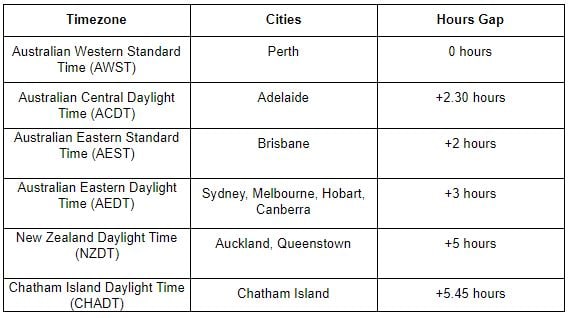
Here’s a quick overview of the time differences between the Philippines and some of the key cities in AU and NZ:

timezone-table

In Australia, New South Wales, Victoria, South Australia, Tasmania, and the Australian Capital Territory observe Daylight Saving Time (DST). Whilst Queensland, the Northern Territory and Western Australia do not observe DST.

Daylight Saving Time starts when the local standard time is about to reach Sunday, 4 October, 02:00:00. The clocks are turned forward 1 hour to Sunday, 4 October, 03:00:00 local daylight time instead. It ends when the local daylight time is about to reach Sunday, 5 April, 03:00:00. The clocks are turned backward 1 hour to Sunday, 5 April, 02:00:00 local standard time instead.

During DST, the clocks on the Chatham Islands are also turned forward 1 hour from UTC+12:45 to UTC+13:45. It starts on the last Sunday of September and ends the first Sunday of April, the same as mainland New Zealand.

Here at DBOS, not only that we personalise and make offshore staffing an affordable option for startups and expanding businesses, but we also make collaboration and communication with our Australian and New Zealand partners very simple. 

Our remote management system provides our clients with full control and visibility to their Philippine-based operations using their chosen tool and system. This addresses the pain points when working on a different timezone and with a geographically separated team. 

As labour costs in Australia and New Zealand continue to rise, startups and expanding companies find the low wages and minimal timezone gap in the Philippines attractive and practical. In fact, the Philippines has overtaken India as the leading call centre country. This subsector added around 10% in the country’s economy in 2015. The expansion of the BPO industry to other provincial regions such as Cebu and Davao was also a key factor for the country’s continuous growth. You can learn more about the best outsourcing locations in the Philippines on one of our previous blogs. 

bpo-marketplace

Back-Office Outsourcing: How to Remain on Top of a Competitive Marketplace

When a company wants to stay on top or improve their competitive position in a highly competitive market, they typically look to doing something internally to transform their position whether it’s learning a new technology, developing an innovative process, or even adopt a new business model.

These traditional strategies for enhancing competitiveness are sound but not the only option. More and more organisations turn to outsourcing to improve the competitive landscape, reposition their companies, or restore how they do business.

Thus, small and medium-sized enterprises (SMEs) are trying to find the most suitable offshore back-office provider that will help them achieve success.

With all the tasks available for outsourcing, and a lot of choices, finding the most equipped provider for your service is not as easy as it sounds. So, to keep up with the competition, most importantly with the industry giants, outsourcing providers have become very aggressive.

The demand for back-office outsourcing services

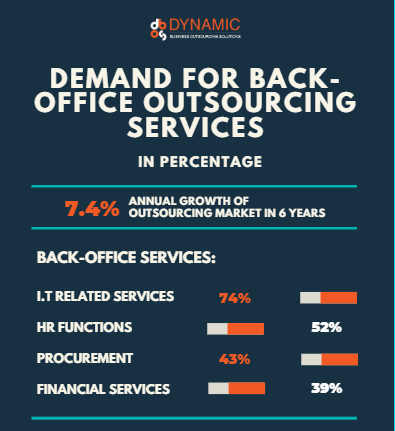
On a recent study, it is said that the outsourcing market is expected to see an annual growth rate of 7.4% in the next 6 years. Partially, this is because businesses are looking at becoming more global, complex, and digital to keep up with the trend. So, the initial step is to adopt the latest developments and work on better strategies to properly outsource.

marketplace

Along with the demand for call centre agents, other popular services today include back-office outsourcing services. Based on the latest data, 74% of companies outsource IT-related services, 52% on HR functions, 43% procurement, and 39% on financial services.

But first, how well do we know back-office outsourcing?

What is back-office outsourcing?

Back-office outsourcing is the process of delegating non-customer facing operations to a third-party supplier. The most common back-office services outsourced by companies are administrative tasks that require a certain level of skill.

Most startup entrepreneurs venture in fields that they are good at. However, to make the business running, there are other positions that must be occupied too. Some of which include; HR, payroll, accounting, marketing, and other support tasks.

Some companies try to do these tasks themselves but eventually didn’t get the results that they wanted. Most of the time, they ended using up all their time and fail in focusing on their core competency.

Why do businesses choose to outsource?

Both small and big companies have been outsourcing for a long time. Their number one reason remains to be for cost-savings. But, there are a lot more reasons to consider aside it. With outsourcing, businesses are not only expected to save a huge heap of money but also gain more time to focus on their main goal. Other entrepreneurs also take this time to make sure that they use their free hand in creating better strategies to expand their businesses.

Most of the time, there are telltale signs that prompt you to outsource, especially when you need it most, watch out for those.

Conclusion

Given the overwhelming advantages of outsourcing, back-office outsourcing is becoming increasingly strategic and even a game-changer.

Back-office outsourcing is changing how business is done. It is a powerful way to improve business focus, achieve better resource utilisation and allows the business to gain a competitive edge in the industry.

Now, we here at DBOS believes that if it is not your cream of the crop, then you should delegate it to the experts. And as an outsourcing company in the Philippines that holds a reputation for providing the best services to all our clients, we make sure to pick only the best talents. Our main goal, to help our clients grow their businesses while saving up to 70% on their labour costs.

Want to know more? Contact DBOS today and get a free consultation with our CEO/Founder.

locations

Top 4 Best Outsourcing Locations in the Philippines

Over the years, the Philippines continuously make headlines and breakthroughs in the world of outsourcing. In 2010, the country was then declared as the world’s BPO capital with 525,000 employees in call centres and $8.9 billion in revenue. After a year, numerous BPO companies started to open up their businesses in strategic locations inside and outside the Metro. That specific year started the progressively exciting year for the outsourcing industry.

With numerous contenders on the business processing outsourcing industry around the world, the Philippines soared high and has reached its peak in 2015. Formerly known as “the sick man of Asia”, the country immediately rose as the “tiger economy of Asia”, with outsourcing as its most income-generating industry.

However, not all foreign investors were impressed by this feat and some were even clouded by second thoughts. But then, a massive number of startup companies suddenly started to take risks and experience the perks of outsourcing their services to the Philippines.

PEZA special economic zones

Now, not just anywhere in the Philippines is a great location to outsource. There are strategic business districts in the country called PEZA Special Economic Zones. And out of all the industries under these economic zones, the BPO industry has benefited the most from it.

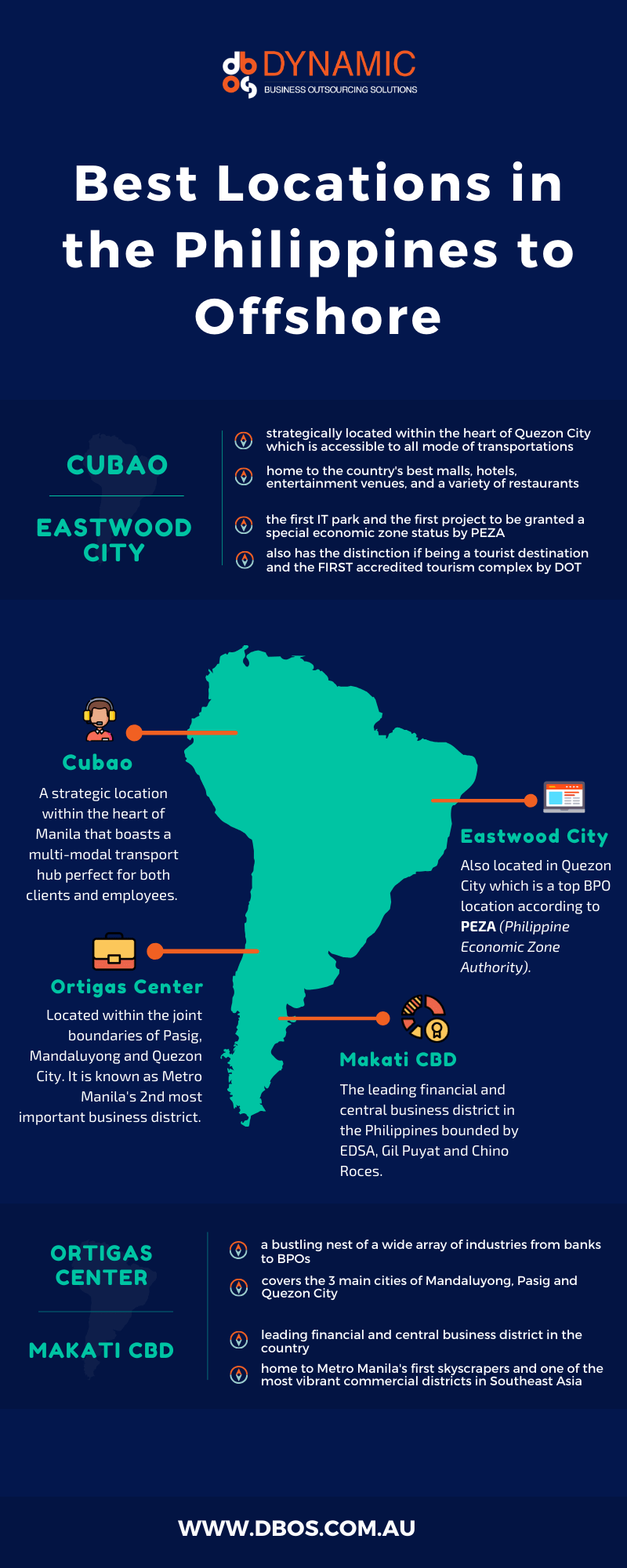
To date, there are 379 operating economic zones in the country which is mostly comprised of IT parks and centers. Most of them are located in Metro Manila, specifically in Eastwood, Cubao Quezon City, Makati, and Ortigas.

locations

To build more of these economic zones, currently, there are 139 under development, 99 of which are IT parks and centres.

If you would notice, the first PEZA economic zones are all strategically located in places most accessible to the general public. This is also because most career-driven individuals move into the Metro as there are better opportunities than in provinces on the country. However, as more people move to the capital, it has become highly congested. To veer away from the already overpopulated Manila, more IT parks and centres are being built outside the capital. This move attracts more companies to invest in the country while boosting the economy, as well as tourism.

4 Best Locations in the Philippines to Outsource

Aside from the numerous benefits that companies can get from starting their BPO businesses in the Philippines, there are PEZA incentives. But to get those privileges, entrepreneurs should be familiar with the strategically-located economic zones that PEZA approves. Here are some in the Metro:

Cubao, Quezon City

locations-cubao
Photo from ASYA Design.

Locations highly matter for businesses, especially for the BPO industry. Not only it is a great advantage for clients and customers, but also the employees.

Cubao has been a famous BPO hub since the peak of outsourcing because of its accessible location that entices great clients and talents. Since then, BPO companies in the area have been randomly popping up everywhere. And to continuously meet the ever-increasing demand of PEZA-accredited corporate offices, The Spark Place was built. Following the long line of BPO companies in the building, it also serves as home to DBOS for 5 years.

Nonetheless, there are only a few certified zones in the area. Some of which also includes the Araneta Center Cyberpark which has 2 towers with 33 floors of office space each.

Eastwood City

locations-eastwood

Eastwood City is a special case among all strategic locations for outsourcing in the Philippines. It is the first IT park and the first project to be granted special economic zone status by PEZA. Although technically, Eastwood City in Libis is still a part of Quezon City.

In addition to that, Eastwood is not just a business district, it is also a residential community that allows clients from keeping their home close to their business. With this, it has become a top dollar-earner in the Philippines over a couple of years. Accessibility wise, the ride from Eastwood to Cubao only takes a couple of minutes. If you live in Eastwood, there is a possibility that you might never move out because everything that you need is within its 18.5 hectares. High-end malls, entertainment complex, sports hub, and many more are provided in that location alone. These attractive features are the biggest reason why DBOS choose this location to build another office that will be launched this year.

Ortigas Center

locations-ortigas

Ortigas Center is located within the joint of Pasig, Mandaluyong and Quezon City. It is a central business area that is highly considered as the second most important business district that after Makati. Like other business districts in the Metro, it is home to many shopping malls, office spaces, and condominiums. Established for a very long time, Ortigas Center has been the headquarters for one of the largest and most diversified conglomerates in the country. It is also where one of the largest malls in the nation – SM Megamall is located.

The transportation to and from Ortigas Center is very easy as it is surrounded by the streets of Ortigas Avenue, EDSA, C-5 Road, and Shaw Boulevard. However, traffic is very bad in this area.

Makati CBD

locations-makati

As the leading financial district in the country, Makati is where the Manila skyscrapers are found. The country’s tallest office building is also in this area and is known as one of the most vibrant commercial districts in Southeast Asia. More than a hundred multinational companies listed in Forbes Global 2000 have also built their regional headquarters in the CBD.

Years ago, working in Makati was a prestigious achievement for job-hunting people. But as time changes, the Makati area has become one of the worst traffic-congested places, especially during rush hours. And although opportunities are there, talents are backing out because their travel time to and from work almost takes half a day.

Conclusion

If you choose to outsource in the Philippines, find a company that value things like travel time, locations-wise, accessibility to both clients and employees, as well as other factors that can affect on how your business will be impacted directly or indirectly.

With DBOS, you don’t have to worry about things like such. Our head office is strategically located in a PEZA-certified building – Spark Place Cubao and our upcoming office will open its doors in Eastwood – two of the most accessible business districts in the Metro. As we highly value the convenience of both our staff and clients, we only offer dayshift schedules. On top of that, we made sure to get the right talent as we help them save up to 70% on their labour costs.

Want to know more about our services? Contact DBOS today and get a free consultation with our CEO/Founder!