
BPO

More Than Just a Call Center: High-Paying BPO Jobs You Don’t Know About

The BPO industry has evolved significantly, offering a diverse landscape of career opportunities far beyond the traditional call center agent role. For ambitious professionals, this sector serves as a gateway to high-paying, specialized positions that offer competitive salaries and a clear path for career advancement.

More Than Just a Call Center: High-Paying BPO Jobs You Don’t Know About

When you hear “BPO,” the first image that comes to mind is often a bustling call center. While customer service is a core function, the business process outsourcing (BPO) sector has expanded into a powerhouse of specialized services, from finance and accounting to IT and healthcare. This evolution means that the opportunities for a rewarding career and high pay are now more accessible than ever.

Beyond the Phone: High-Paying BPO Roles You Should Know

The key to a lucrative career in BPO lies in moving from a generalist to a specialist. By developing technical and in-demand skills, you can unlock roles that offer a significantly higher salary and more professional growth.

Here are some of the high-paying BPO jobs that redefine the industry:

  • IT and Technical Support Specialists: This is one of the most lucrative areas in the BPO industry. Technical support roles go beyond basic troubleshooting. As a Technical Specialist, you might handle complex network issues, manage cloud-based systems, or provide support for enterprise-level software. The average monthly salary for a Technical Specialist in Metro Manila can range from PHP 44,000 to PHP 54,000, and experienced professionals with specialized skills can earn even more.
  • Finance and Accounting Professionals: Global companies are increasingly outsourcing their financial operations, creating a high demand for skilled accountants and finance professionals in the Philippines. Roles such as Procure-to-Pay (P2P) Analysts, Accounts Payable Officers, and Financial Analysts are crucial to a company’s financial health. A mid-career accountant can expect a monthly salary of PHP 40,000 to PHP 60,000, with senior managers earning upwards of PHP 100,000 per month.
  • Human Resources (HR) Specialists: The BPO industry requires a robust HR framework to manage its large workforce. High-paying HR roles include Senior Recruitment Specialists, HR Business Partners, and Payroll Officers. These professionals are not just involved in hiring and onboarding but also in strategic workforce planning and talent development.
  • Healthcare Information Management: The Philippines is a global leader in healthcare BPO. Jobs in this sector are highly specialized and require a strong understanding of medical terminology and processes. Roles like medical coders, claims analysts, and clinical research assistants are crucial. These positions often offer competitive salaries and a stable career path.
  • Digital Marketing Experts: As BPO firms expand their services, the need for digital marketing professionals has grown exponentially. Roles such as Search Engine Marketing (SEM) Specialists, Social Media Strategists, and Content Strategists are in high demand. An experienced digital marketer can earn a monthly salary between PHP 40,000 and PHP 60,000.

The Salary Perspective: A Technical Breakdown

While the average monthly salary for an entry-level call center agent ranges from PHP 20,000 to PHP 25,000, these specialized roles show how much more you can earn.

  • Entry-Level Professionals: Fresh graduates or those with minimal experience in specialized fields like IT or accounting can still command higher pay. For instance, a new graduate in a technical, high-demand IT role can expect a monthly salary of PHP 30,000 to PHP 40,000.
  • Mid-Level Professionals: With 3-5 years of experience, a professional can see their salary double or even triple. A mid-level BPO supervisor or team leader can earn PHP 40,000 to PHP 60,000 per month.
  • Senior-Level Professionals: Senior-level managers or technical specialists can earn a monthly salary of PHP 70,000 to PHP 150,000 or more, depending on their expertise and the company.

For a deeper dive into role-specific salary ranges, you can explore more detailed breakdowns on Payscale or Glassdoor.

How to Climb the Ladder

To secure one of these high-paying BPO jobs, you need to invest in your professional development.

  1. Gain Certifications: Certifications in IT, finance, project management (e.g., PMP), or digital marketing (e.g., Google Ads) can set you apart.

Check out: Hubspot Academy, Udemy, LinkedIn Learning

  1. Focus on Soft Skills: Strong communication, problem-solving, and leadership skills are non-negotiable for supervisory and managerial roles.

Recommended read: Top 4 Soft Skills Every BPO Job Seeker Needs Today

  1. Specialize: Instead of staying as a generalist, choose a niche within the BPO industry, such as technical support, finance, or healthcare, and become an expert in that area.

The BPO industry offers a dynamic and rewarding career path for Filipinos. It’s no longer just about taking calls; it’s about building a future in a highly skilled, high-paying sector.

Final Thoughts

The BPO industry in the Philippines has evolved far beyond its reputation as a call center hub. It now offers a wide array of high-paying, specialized career opportunities in fields like IT, finance, and digital marketing. 

By focusing on professional development and acquiring in-demand skills, you can unlock a fulfilling career with a competitive salary and a clear path for growth. The future of BPO is in specialized expertise, and the time to start your journey is now.

Ready to redefine your career? Start your journey in a specialized BPO role. Apply for rewarding positions on our careers page today!


Celebrating Pride: The Critical Importance of LGBTQ+ Representation at Work   

Diversity can’t just be a tagline in the workplace—it must be embedded in the culture. This Pride Month, we’re turning the spotlight toward something essential yet often overlooked: LGBTQ+ representation at work.

But what does real representation look like—especially for those considering careers in the BPO (Business Process Outsourcing) sector—and why is it so important?

Why LGBTQ+ Representation Matters

Representation isn’t just about having LGBTQ+ people on staff. It’s about creating a space where every identity is acknowledged and respected. When LGBTQ+ professionals are visible at every level—from frontline teams to executive roles—it sends a clear message: you belong here. 

In industries like BPO, where teams are inherently diverse and client-facing, embracing LGBTQ+ representation isn’t just ethical—it’s strategic. Inclusive teams tend to collaborate better, retain talent longer, and deliver stronger outcomes. 

When people feel safe to show up as their full selves, performance and morale rise across the board. 

Recommended read: How to find companies that value diversity & inclusion  

The State of LGBTQ+ Inclusion in the BPO Industry

The BPO sector employs millions and thrives on agility and cross-cultural collaboration. Encouragingly, many BPO companies are making visible strides toward LGBTQ+ inclusion, launching employee resource groups, celebrating Pride, and updating internal policies.

Still, in certain regions, conservative social norms persist. This can create friction for LGBTQ+ employees, making open dialogue difficult. That’s why visibility is so crucial—it helps normalise conversations and sets the tone for progress.

Benefits of Inclusive Workplaces for Job Seekers

Whether you identify as LGBTQ+ or simply value diversity in your workplace, looking for companies that prioritise LGBTQ+ representation can significantly impact your job satisfaction and long-term career success. Here’s how: 

1. Psychological Safety

Inclusive teams foster trust. You’re not walking on eggshells or filtering your identity—you’re just doing your job, confidently and authentically.

Read: What is psychological safety?

2. Professional Growth

When diversity is present at every level of a company, it shows that promotion is based on performance—not conformity. That visibility inspires ambition and unlocks mentorship.

3. Better Work-Life Integration

Workplaces that champion inclusion often lead the way in flexible schedules, mental health benefits, and progressive policies that respect personal lives as much as professional output.

4. Community and Belonging

Being part of a team that doesn’t just “tolerate” differences but actively celebrates them can make work feel like a community—not just a job.


DBOS: A Workplace That Honors Individuality 

At Dynamic Business Outsourcing Solutions (DBOS), inclusivity is a core value we uphold every day—not just during Pride Month. We are committed to creating an environment where everyone feels respected, supported, and empowered, no matter their gender identity, sexual orientation, or personal background. 


Our culture thrives on open-minded leadership, collaboration, and adaptability. Supporting LGBTQ+ inclusion isn’t a checkbox for us—it’s an essential part of who we are and a driving force behind our innovation and growth. 

Final Thoughts 

When you’re exploring job opportunities, finding a company that genuinely supports LGBTQ+ inclusion can significantly impact both your comfort at work and your career growth. This Pride Month, let’s focus on turning inclusive values into meaningful actions. 

No matter where you are on your professional journey, remember that the right employer will recognise your worth, uplift your identity, and invest in your development. 

🌈 Looking to advance your career?  

Discover exciting opportunities in the BPO industry with Dynamic Business Outsourcing Solutions (DBOS)

Head over to the DBOS Careers page to explore how you can move forward on your professional path. 

Projected Growth of the Philippines BPO Industry in 2024

The Philippines’ Business Process Outsourcing (BPO) industry has been a cornerstone of the country’s economy, showing consistent growth over the years. As we look forward to 2024, the industry is poised for further expansion, underpinned by various factors contributing to its anticipated growth.

Current State of the BPO Industry in the Philippines

The current landscape of the BPO sector in the Philippines exhibits robust growth, with an annual revenue that surpassed USD $26 billion in 2023. Dominated by sectors like contact centres, healthcare outsourcing, IT services, and more, the industry employs millions, contributing significantly to the nation’s GDP.

Factors Fueling Anticipated Growth in 2024

Anticipated growth in 2024 is propelled by several factors. Global trends, including the increasing reliance on digitalization and automation, are shaping the BPO landscape. The Philippines’ government initiatives, such as tax incentives and improved infrastructure, foster an attractive environment for foreign investments.

Furthermore, the integration of emerging technologies like AI, robotic process automation (RPA), and analytics is revolutionizing BPO services, enhancing efficiency and offering new service capabilities.

Related Article: Embracing Efficiency: AI And Automation In Outsourcing In The Philippines

Projected Growth and Key Projections

Industry analysts forecast continued growth in 2024, with revenue projected to exceed USD $30 billion. Employment opportunities are expected to rise, adding hundreds of thousands of new jobs across various sectors within the BPO industry. Expansion into non-voice and high-value services, such as finance and accounting, is also foreseen.

Source: Manila Standard

Challenges and Opportunities

Despite the promising outlook, increasing labour costs and global competition may pose hurdles. However, these challenges also present opportunities for innovation and upskilling the workforce. Embracing advanced technologies and diversifying service offerings can position the industry for sustained growth.

Conclusion:

The Philippines BPO industry’s projected growth in 2024 signifies its resilience and potential for further advancement. This growth contributes significantly to the national economy and opens doors for skill development and technological innovation. As the industry evolves, stakeholders must adapt, innovate, and collaborate to harness its full potential.

How to Choose the perfect bPO company in the Philippines

For Australian businesses, one of the best ways to scale is by outsourcing certain processes and tasks to a BPO company in the Philippines. However, with so many companies to choose from, it can be difficult to find the right one for your business. In this article, we will guide you in choosing the perfect BPO company in the Philippines that can help take your business to the next level! 

The Philippines is home to some world’s best BPO companies for hiring remote staff. And as the country recovers from months of lockdowns, the projections for the BPO industry remain positive. The IT-BPM, the country’s association of BPO companies, expects an upbeat outlook of 2.7% – 5% growth in the industry’s talent pool. This means Australian companies can definitely expect to find highly-skilled workers who can provide quality services at a fraction of the cost within the 1.4 million-strong Philippine BPO workforce. 

With such a huge industry, it can be difficult to find the companies with the best talent and services. So, to help you out, we’ve compiled a list of the factors you need to consider when hiring a BPO firm in the Philippines. 

Some BPO companies have specialities and may be good in certain processes but not in others. 

You want to ensure that the company you’re hiring has experience in your industry and can provide the services you need. For example, if you’re in the eCommerce industry, you’ll want to hire a company with experience with order fulfilment, customer service, and social media marketing. Some BPO companies have grown to become highly specialised and efficient at certain processes, so choose one that’s the best fit for your specific requirements. 

The company’s size, location, and culture can have a huge impact on its performance. 

The company’s size can also be a factor, as you’ll want to ensure they have the resources to meet your needs. Additionally, you should consider the company’s culture to see if it’s a good fit for your business. For example, if you’re a startup, you may want to hire a company that is young and dynamic, while a more established business may prefer a more mature and professional company. The company’s location is also something you should look at. If you’re looking for a company that can provide reliable service, one that’s located in Manila, Cebu, and other business hubs in the Philippines is a good option. 

Cybersecurity infrastructure matters especially if you’re going to give them access to critical company information. 

In today’s digital age, cybersecurity is more important than ever. Check the company’s cybersecurity infrastructure to ensure that your data will be safe and secure. Luckily, the Philippine government is highly supportive of the BPO industry and has put in place measures to ensure that all data is protected. The Data Privacy Act of 2012 requires all BPO companies to have comprehensive security measures in place, so you can be sure that your data will be safe. 

Related Article: 3 Ways To Strengthen Your Business Cybersecurity

Success in similar projects may indicate future performance. 

While young start-ups with little experience may have some advantages, Australian businesses should focus on working with BPO companies with a proven track record of success. This will ensure that the company can handle your project and deliver the desired results. 

A sound business plan and efficient systems can turn your business into a well-oiled machine 

Australian businesses should also ensure that the BPO company has a sound business plan and well-defined processes. This will ensure that the company is organised and efficient and can deliver the results you need on time. Having a solid business plan and systems also ensure you’ll have contingency plans in place in case of emergencies. 

These are just some of the factors Australian businesses need to consider when choosing a BPO company in the Philippines. With so many options available, it’s important to do your research and choose a company that’s the best fit for your business. We hope this guide has been helpful, and we wish you all the best in finding the perfect BPO partner for your Australian business. 

timezone

Outsourcing to the Philippines: Managing the Timezone Differences

Majority of Philippine outsourcing companies offer to work almost the same office hours as their clients. They will work according to your timezone, whatever it may be. This is one of the many attractive propositions to clients located in Australia and New Zealand.

A normal and comfortable work shift in the Philippines would-be 7:00 AM to 4:00 PM. Without the dreaded Metro Manila traffic and with ample preparation, Filipino staff could comfortably come in as early as 6:00 AM and stay late until 5:00 PM. Sometimes, to avoid the rush hour, some employees choose to stay even a lot later. 

More and more Australian and New Zealand businesses choose to outsource to the Philippines, instead of other known outsourcing destinations. 

The timezone gap between the Philippines and these countries are minimal which allows a more real-time communication and interaction between the onshore manager and their Filipino staff. This is extremely important in building a good working relationship, better collaboration and making your Filipino staff feel like they are part of the team. 

Filipinos are also very family-oriented so working a day-shift allows them not only to live a healthier life but also spend more time with their families and friends.

But this doesn’t mean that companies in Europe and North America are in the disadvantage. Many of the BPO companies now have higher flexibility in providing services in different timezones. 

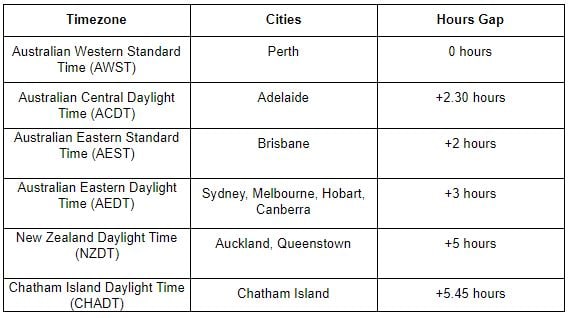
Here’s a quick overview of the time differences between the Philippines and some of the key cities in AU and NZ:

timezone-table

In Australia, New South Wales, Victoria, South Australia, Tasmania, and the Australian Capital Territory observe Daylight Saving Time (DST). Whilst Queensland, the Northern Territory and Western Australia do not observe DST.

Daylight Saving Time starts when the local standard time is about to reach Sunday, 4 October, 02:00:00. The clocks are turned forward 1 hour to Sunday, 4 October, 03:00:00 local daylight time instead. It ends when the local daylight time is about to reach Sunday, 5 April, 03:00:00. The clocks are turned backward 1 hour to Sunday, 5 April, 02:00:00 local standard time instead.

During DST, the clocks on the Chatham Islands are also turned forward 1 hour from UTC+12:45 to UTC+13:45. It starts on the last Sunday of September and ends the first Sunday of April, the same as mainland New Zealand.

Here at DBOS, not only that we personalise and make offshore staffing an affordable option for startups and expanding businesses, but we also make collaboration and communication with our Australian and New Zealand partners very simple. 

Our remote management system provides our clients with full control and visibility to their Philippine-based operations using their chosen tool and system. This addresses the pain points when working on a different timezone and with a geographically separated team. 

As labour costs in Australia and New Zealand continue to rise, startups and expanding companies find the low wages and minimal timezone gap in the Philippines attractive and practical. In fact, the Philippines has overtaken India as the leading call centre country. This subsector added around 10% in the country’s economy in 2015. The expansion of the BPO industry to other provincial regions such as Cebu and Davao was also a key factor for the country’s continuous growth. You can learn more about the best outsourcing locations in the Philippines on one of our previous blogs.