
human resources

How to Be Professional at Work: Tips for Aussies Working with Filipinos

As an Australian business owner, building successful partnerships with offshore teams is not just about finding talent; it’s about knowing how to be professional at work across cultures. 

When working with Filipino professionals, understanding cultural values and workplace behaviours is crucial to creating strong communication, trust, and productivity.

Here are practical tips to help you work more effectively with Filipino teams while showing professionalism that builds lasting relationships.

1. Communicate Clearly and Respectfully

Australians are often known for being direct, while Filipinos may prefer a more diplomatic style of communication. A “yes” in the Filipino context might not always mean full agreement; it could mean “I’ll do my best” or “I understand.”

Actionable Tip: Check for clarity without being confrontational.

Instead of asking yes/no questions, use open-ended prompts like “How do you see this task being completed?” This encourages detailed answers and reduces the chance of misinterpretation. 

By communicating clearly yet respectfully, you show professionalism while making space for cultural differences.

2. Value Relationships as Part of Professionalism

For many Australians, professionalism often means efficiency and getting straight to business. For Filipinos, professionalism includes building strong relationships at work. Concepts like pakikisama (harmony) and teamwork are deeply valued, and strong relationships often translate to loyalty and commitment in the workplace.

Actionable Tip: Make time for small talk and team bonding.

Spend a few minutes in meetings to ask about your team’s day, family, or local events. Recognising milestones like birthdays or work anniversaries shows respect for your team’s culture and builds genuine connection. 

Professional behaviour, in this context, includes valuing relationships as part of work.

Recommended read: 17 Team-Building Activities for In-Person, Remote, and Hybrid Teams

3. Set Clear Expectations and Provide Guidance

Australian workers often thrive on autonomy, but Filipino professionals may prefer clear guidance and structured processes. This does not mean they lack initiative; rather, it reflects cultural respect for hierarchy and a desire to avoid mistakes that could reflect poorly on the team.

Actionable Tip: Outline roles and escalation paths from the start.

Be specific about responsibilities, deadlines, and decision-making authority. Provide clear instructions for when to act independently and when to escalate an issue. 

Doing so prevents hesitation, builds confidence, and helps everyone demonstrate professionalism at work.

4. Show Respect for Filipino Values

Filipino workplace culture is shaped by values such as hiya (maintaining respect and avoiding embarrassment) and kapwa (shared identity and community). These values influence how Filipinos collaborate, communicate, and view professional behaviour.

Actionable Tip: Be mindful of respect in everyday interactions.

Avoid direct criticism in public settings, as this may cause embarrassment. Instead, provide constructive feedback privately and frame it positively. 

Use polite greetings (such as “Sir” or “Ma’am” when appropriate) and acknowledge important cultural events. 

Small acts of respect go a long way in showing professionalism and building trust.

5. Lead with Civility and Cultural Awareness

Workplace civility is universal, but research shows that incivility has stronger negative effects in some cultures than others. 

Filipino professionals often place a high value on harmony, while Australians may not always realise when casual humour or blunt remarks come across as disrespectful. 

According to the study, incivility is strongly linked to job dissatisfaction and burnout.

Actionable Tip: Model professional respect in every interaction.

Be conscious of tone, avoid sarcasm that could be misinterpreted, and always acknowledge contributions. Encourage your team to listen actively and treat each other with kindness. 

Leading with civility shows professionalism and fosters a healthy, motivated team culture.


Final Thoughts

Learning how to be professional at work when collaborating with Filipinos goes beyond following business etiquette. It’s about bridging cultural differences, showing respect, and adapting your leadership style. 

By valuing relationships, clarifying expectations, and leading with civility, Australian business owners can create thriving partnerships with Filipino professionals.

Build Professional, Culturally-Smart Teams with Dynamic Business Outsourcing Solutions (DBOS)

Professionalism in cross-cultural settings means more than getting the work done; it’s about building understanding, respect, and strong connections. 

At DBOS, we help Australian businesses succeed by connecting them with skilled Filipino teams who bring both expertise and cultural depth to the table. 

With our support, you can bridge cultural differences and grow a resilient, high-performing workforce.

Discover how DBOS can help your business thrive → Book a Free Discovery Call Today!

The Shift Toward the Hybrid Offshore–Nearshore Staffing Model

As global workforce strategies continue to evolve, more companies are moving away from a single outsourcing approach and adopting a hybrid offshore–nearshore model. This setup combines the cost benefits of offshore teams (in countries like the Philippines or India) with the proximity and cultural familiarity of nearshore partners (such as Eastern Europe or Latin America). It’s a flexible model that offers better control, responsiveness, and performance across business functions.


What Is a Hybrid Offshore–Nearshore Model?

A hybrid staffing strategy distributes workloads across three primary locations:

  • Offshore teams: Usually based in more affordable labour markets and tasked with high-volume or process-heavy work.
  • Nearshore teams: Located in time zones closer to your home base, making collaboration and communication easier.
  • Onshore teams: Remaining in your country to manage leadership, compliance, and client-facing roles.

This model gives companies the best of all worlds—affordability, efficiency, and operational alignment.


Key Advantages

1. Significant Cost Savings Without Compromising Quality

By assigning technical or back-office tasks to offshore teams and client-centric roles to nearshore professionals, businesses can reduce labour costs without lowering service quality. This is particularly valuable in roles like IT support, finance, and customer service.

Related Article: Top Outsourced Roles in Australia and the Rise of the Philippines (2025)

2. Better Use of Time Zones

With offshore teams working while onshore staff are offline, projects keep moving. Nearshore teams also allow for real-time collaboration during business hours, reducing communication gaps.

3. Access to Skilled Professionals

The hybrid approach opens access to a wider range of talent. Companies are no longer limited to the local hiring pool and can match the right people with the right tasks, regardless of geography.

4. More Flexibility in Operations

Hybrid teams make it easier to ramp staffing up or down depending on demand. For example, customer support coverage can be extended without hiring additional local staff.

5. Improved Continuity Planning

Spreading teams across different regions protects operations against local disruptions like power outages, political unrest, or extreme weather events.

6. Smoother Communication and Collaboration

Nearshore teams offer cultural and language compatibility, which helps avoid miscommunication in fast-paced, client-facing environments.


How Companies Are Making Hybrid Work

Several leading companies have implemented hybrid staffing with strong results:

  • Slack has development teams offshore and relies on in-house and nearshore teams for design and customer engagement.
  • Spotify uses hybrid teams for software development, with coordination centres in Europe and support teams further afield.
  • Amazon leverages onshore leadership and customer-facing staff, supported by offshore service and logistics teams.

How to Get Started

To build a successful hybrid offshore–nearshore model, consider these steps:

  1. Define Job Roles Clearly
    Allocate tasks based on team strengths—routine tasks to offshore teams, real-time roles to nearshore staff, and strategy to local leads.
  2. Choose the Right Technology
    Ensure your teams use compatible tools for communication, project tracking, file sharing, and version control.
  3. Establish Strong Management Practices
    Regular check-ins, aligned goals, and transparent workflows help unify the team, regardless of location.
  4. Train for Cultural Awareness
    Support both offshore and nearshore staff with training that bridges language, etiquette, and work styles.
  5. Track Results and Be Flexible
    Use performance data to assess outcomes and make adjustments as needed. Keep an open mindset about changing roles or regions based on evolving needs.

Why the Australia–Philippines Model Is a Smart Choice

For Australian businesses, outsourcing to the Philippines as part of a hybrid model has specific advantages:

  • Minimal time difference (2–3 hours), which improves communication and coordination.
  • English proficiency and Western work culture, which reduces the risk of misunderstandings.
  • Highly educated and skilled workforce in areas like customer service, finance, and IT.
  • Strong government support for BPO operations, ensuring infrastructure and data security.

When combined with nearshore or in-house support, this model gives companies an edge in both performance and customer experience.

Conclusion

A hybrid offshore–nearshore strategy allows companies to work smarter by combining global talent, practical time zones, and cost-effective services. It’s no longer just about reducing expenses—it’s about building a more responsive and adaptable business.

Ready to Build a Smarter Team?

If you’re exploring hybrid staffing or looking to expand your offshore operations, Dynamic Business Outsourcing Solutions (DBOS) can help. With years of experience supporting Australian companies through skilled teams in the Philippines, DBOS can guide your business toward a more efficient and scalable setup.

Learn more about DBOS and how we can help you succeed → Book a Free Discovery Call

wellness

4 Employee Wellness Trends for 2020

Employee wellness is more important today than ever. Not only it affects employee productivity and performance, but also influences a person’s mental health. So, most companies today treat this matter with utmost cautiousness.

Businesses in different fields, as well as other organisations, implement various programs to help maintain their employee’s wellness or improve it if needed. This is aside from their usual benefits such as paid leaves, sick leaves, health care, and more.

According to a study by ResearchGate, effective corporate wellness programs create a remarkable impact on an employee’s health and overall well-being. Also, improved motivation, capability, and skills are other traits that show the enhanced result.

The brief history of workplace wellness 

Interestingly, workplace wellness did not just start abruptly. It has a long history that started in 1633 whereas, an Italian physician wrote about the effects of work exposure on workers. In 1810, a Welsh social reformer proposed a 10-hour workday to protect the well-being of the workforce. By 1817, he proposed a more aggressive measure – an 8-hour workday, where the phrase, “eight hours labour, eight hours recreation, eight hours rest” originated.

Jumping to 1950s, this is when companies began to offer wellness interventions which are primarily focused on mental health issues and alcoholism. And not until the mid-1970s, true workplace wellness programs did begin. During this timeframe, financial responsibility for health care from government to employer was developed. From that year onwards, occupational safety and health insurance, health promotions, and fitness programs for employees were pursued.

In modern-day, employee wellness is one of the most important aspects that employers pay attention to. More regulations are looked upon and restrictions on working hours are strictly implemented. But, on a survey of employees by Quantum Workplace, 71.1 per cent of them still wants their employers to provide stress relief breaks, including naps and massages.

Employee wellness trends in 2020

As time passes by, every employee’s needs and wants changes too. So whatever it is that might work for your employees last year could not be as effective this year. To be able to adjust according to the changing needs of your workforce composition this year, take note of these employee wellness trends:

1. Workplace wellness culture audits

To closely monitor the changes and keep pace with the workplace wellness culture, companies nowadays should implement regular HR reviews, turnover, productivity, error levels, and workplace health and safety standards.

This audits should be able to help keep your employees aligned with workplace well-being programs such as turnover, retention, stress levels, and mental health issues. The main goal is to immediately adjust the well-being programs even if changing technology, societal conditions, and satisfaction affects it.

2. Millennials will dominate the workforce in 2020

The workforce in 2020 is highly anticipated to be mostly dominated by millennials. This generation is known to have a strong standpoint against structural issues, most especially, workplace burnout. Millennials love maintaining their work-life balance, as well as their career satisfaction. So if they feel trapped in a place that doesn’t value much of their wellness, moving on is their next step.

According to a survey by Class pass, 75% of millennial professionals believe that it’s the employer’s responsibility to provide health and wellness benefits. More than half, states that they would’ve stayed in a company that provided fitness and wellness benefits.

3. Establishing wellness programs that create real behavioural change 

According to neuroscience research, habit change takes at least 60 days. But, engaging programs that continuously support employees at work and home helps create the change. In return, companies expect reduced turnover, absenteeism, stress levels, and improved retention.

Investing in people bears nothing but good results both for the individual and the company. It boosts morale which could, later on, progress to improved productivity that will directly impact the company.

4. Promoting healthy mental and psychological well-being

Psychological and mental health is as important as physical health. Nowadays, an increased number of people with mental health problems is arising. Younger generations, as well as the working-age individuals, are the usual victims of these mental health issues.

So this year, businesses are crafting wellness plans that address mental health. Some of which includes; free mental health checkups, coaching, encouragement with team members, team building activities, or anything that might work.

Conclusion

We, at DBOS, cares about our employee’s wellness as much as we do with their performance and productivity. Our human resources officer make sure to stay on track with employee reviews and concerns. Employee wellness programs such as monthly birthday and anniversary bash have been part of the culture. We also encourage our people to join several volunteering programs and donation drives that we continuously practice. Aside from those fun activities, we also motivate our people to learn new skills through constant training and study.

Know more about one of the fastest-growing offshore staffing companies in the Philippines and save up to 70% on your labour costs! Contact DBOS today and get a free consultation with our CEO/Founder.

HR

8 Fundamental Benefits of Embracing Big Data in HR

The HR department in any organisation is pivotal. It plays one of the most important roles in a business because it handles strategic planning, company image, acquiring the right talents, and hiring. With all the tasks that HR personnel should do, the introduction of using big data has become a huge breakthrough in running the department.

What is Big Data?

According to SAS, the term “big data” refers to the data that is so large, fast or complex that it’s difficult to process using traditional methods. The idea was there for a very long time, but this concept gained momentum in the early 2000s.

Doug Laney, an industry analyst, enunciated the importance of big data as the three (3) V’s.

1. Volume: In businesses, data could be collected from a variety of sources including transactions, smart devices, videos, documents, and so much more. In previous years, storing big volume data takes up a lot of space on external hard drives and backups on other storage devices. Nowadays, there are affordable online platforms that could ensure security for any volume of data.

2. Velocity: The data streams that businesses acquire comes at an unprecedented speed and must be handled in a timely manner.

3. Variety: There are a huge variety of data. Whether structured or unstructured text documents, databases, emails, videos, audios, graphics, and others, the big data sure can handle it all.

Why is Big Data Important?

In today’s innovative world, using big data has become highly important. Initially, it doesn’t just focus on how much data you have, but what you can do with it. While all of those could be overwhelming to analyze and manage, big data enable cost reductions, time reductions, new product development, optimized offerings, and smart decision making.

While all those important aspects of acquiring big data alone is a huge feat, let us also find out what’s in it for the HR department.

HR

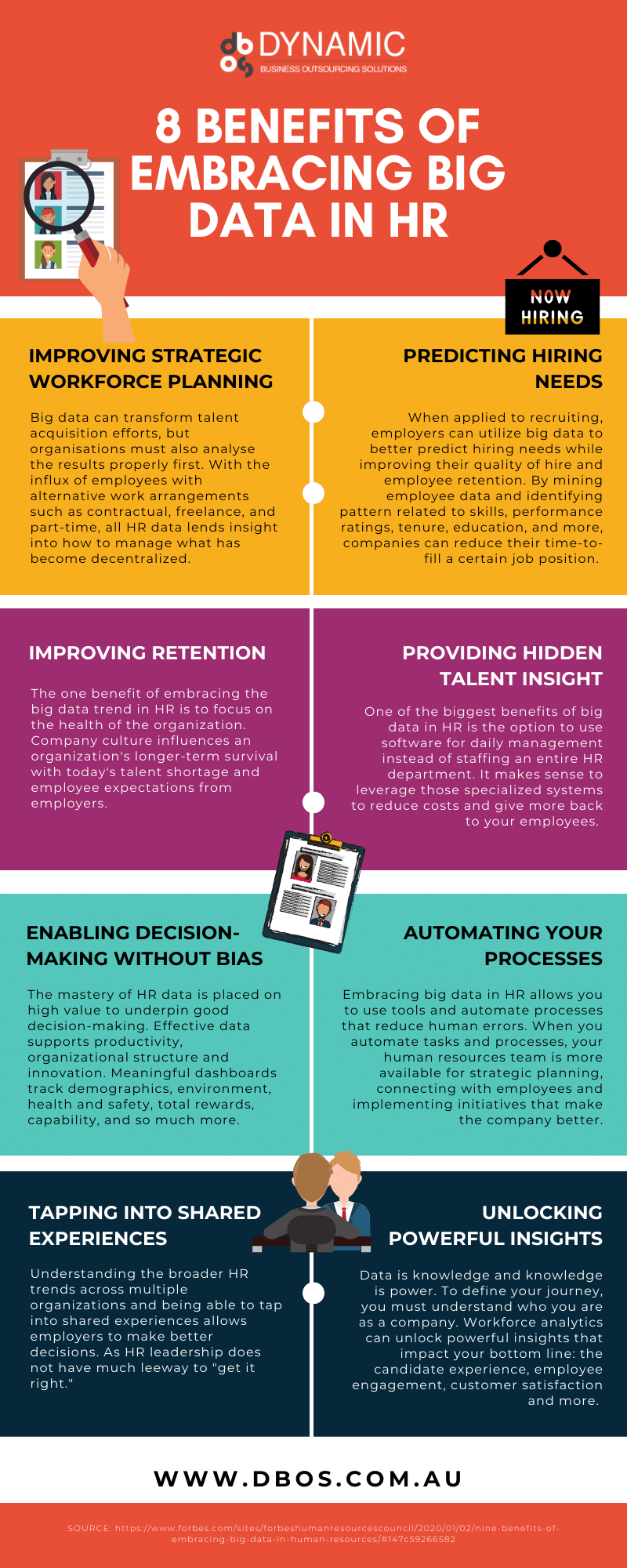
8 Benefits of Embracing Big Data in HR

Traditionally, the HR department is one of the busiest and most cluttered places in an office setting. Papers piled up on desks and file cabinets lined up everywhere are just normal during this time. Sorting all those files take up a lot of energy, manpower, and time. However, technological advances came fast and most businesses became reliant on outsourcing.

Moving forward, a lot of advanced years came by and the usage of online storage became a hit. Companies are suddenly going paperless and fewer people are needed to run a department while most are utilised for other roles.

Suddenly, HR outsourcing in the Philippines became famous and even the smallest entrepreneurs use this practice. To learn more about the usage of big data in human resources, check out these benefits:

1. Improving strategic workforce planning

Big data has the ability to sort all candidates by their specific skill sets, work arrangement options, work experience and other categories. This help businesses tap into a very precise talent pool and immediately exclude other candidates that do not pass the qualifications. By doing this, the HR department can save more time to look at a broader talent pool.

2. Predicting hiring needs

One very specific benefit of big data in HR is that it helps employers improve their quality of hire. It also strengthens employee retention and better predicts hiring needs. By mining employee data and identifying their pattern of skills, performance, education, professional experience, and more, then hiring the right talent would be so much easier.

3. Improving retention

According to a relevant HR study, the company culture hugely affects employee retention. With big data, HR can now immediately identify if a candidate and their personality align with the company values and goals. For an organisation’s long-term survival, employee retention is the key.

4. Providing hidden talent insight

The use of big data in HR lessens the actual number of staff needed in the department. So, instead of employing a whole HR department, the company can actually cut the number and have them do other things that will help with their career growth. Now, this is where hidden talents could be discovered.

5. Enabling decision-making without bias

By implementing big data in HR, decision-making would be quicker and simpler. There won’t be any issues of being biased, because all of it will be based on actual numbers. And so, the HR people will be able to accurately track the demographics and performance of each and every employee.

6. Automating your processes

Embracing the use of big data in HR allows you to use tools to automate your processes. On the other hand, your human resources team will be more available for strategic planning, reaching out to employees, and finding more ways to engage and support them.

7. Tapping into shared experiences

Being exposed to HR trends in other industries allows employers and their staff to get better ideas. It will also aid the HR leaders to create strategies that would best fit the organization they belong to. This drives new big data analytics and AI-powered solutions onto the market.

8. Unlocking powerful ideas

As analysing data can give you other points of view to focus on, it can also unravel more ideas that could later turn into an opportunity that will change the way companies handle their HR.

Conclusion

The implementation of big data in most companies is an advanced move that will help the business reach, understand, and target their supposed audience. On the other hand, the HR department is indeed a huge beneficiary of big data.

So if you’re thinking about working with an outsourcing provider who shares your goals and aspirations, check out DBOS and get to save up to 70% on your labour costs!

Contact us today and get a free consultation with our CEO/Founder.

destress

6 Simple Ways to De-Stress Your Work Day

At times, stress has its own way of overpowering our thinking. Well, it’s natural for work to leave you a little stressed. But if you’re not moving forward with your tasks for almost half a day, then you might need to breathe and de-stress a little.

Here are 6 simple ways to de-stress your work day:

#1. Get a head start

Wake up earlier than usual and leave home at least 30 minutes prior to your accustomed time. This would guarantee a little calmness as you’re not worried about being late.

Research proves that the less rushed you feel in the morning, the less stressed you’ll be for the rest of the day.

So try to start your day right to avoid stress the whole day!

#2. Pack some of your favourite snacks

Kickstart your day with your preferred coffee because it tastes best in the morning!

Also, make it a habit to pack some of your most favourite snacks at home and bring it with you. If you’re allowed to eat on your desks at work, go munch a little. But if you’re not, then take little breaks as you must.

There is no doubt that food alone can make our days lighter and brighter. However true, just make sure to not focus only on eating instead of doing some actual work.

#3.  Socialize with your colleagues

It is not prohibited to chat a little with your seatmate as long as you don’t interrupt each other’s business. So whenever you’re feeling a little queasy or you just wanted to take a break from staring at your computer for too long, do converse. Laugh a little, throw random jokes, smile more and do your job well.

Communicating even in the slightest way possible is all-important.

#4. Remember your goal

Whenever you’re feeling overwhelmed and a bit stressed, take some time to remind yourself why you are doing all that hard work. You can also display a little family photo or your pet’s portrait that inspires you. Reminisce each photo and go back to when it was taken. Ride down the memory lane and remember your happiest moments.

Every now and then, bravely going through life to achieve your goals and dreams is something that no one can stop you from doing.

To keep yourself motivated, carry your goals every day.

#5. Celebrate small wins

Arrived early at work? You deserve a full breakfast meal! Praised by your boss for a job well done? Then treat yourself some ice cream!

No matter how small your achievement might be, make sure to give yourself some credit. Doing so will give you a little push to do better so you can celebrate even more. But, do note that celebrations doesn’t have to be expensive.

Sometimes, the little things are what matters the most, so learn to appreciate it.

#6. Take short walks and just breathe

Whenever work feels like a little too much to handle, going out for 5 minutes to calm yourself would make a difference. Instead of getting aimlessly upset over the futile things about your job, learn to take short walks and breathe.

Breathing is a good practice to help calm the nerves and ease the irate feeling. Read this for the complete proper breathing exercise.

The truth is, at the end of the day, no matter how stressed you are, deadlines still won’t wait for you. So you have to pull off a little courage and get yourself out of that stress before your day ends. Follow these simple tips above to help you de-stress a little and then continue to do your job.

Here at DBOS, we promote a happy working environment so that stress won’t wear you off.

Join our growing family and check out our careers today to see what job fits you best!

positive work attitude

How a Positive Work Attitude Affects Your Job

A positive work attitude creates wonders on your mood and everyone else’s near you. It affects them unintentionally and impacts their perspective throughout the day. It is something that goes deeper beyond the surface cheer. Meanwhile, a negative attitude promotes the opposite of every positive there is. It ruins the atmosphere and harmony of the workplace.

So what would you be? The mood ruiner or the mood maker?

If you decided to be the latter, here are a few tips on how to sustain the positiveness radiating inside you.

How to maintain a positive work attitude?

A positive attitude amplifies a good working environment for you and your coworkers. It is not just about plastering a smile on one’s face and trying to think happy thoughts all day.

Studies have shown that having a positive attitude makes your life seem broad and full of possibilities. It can also create real value in your life and help you build skills that last much longer than a smile.

In a typical office setting, maintaining a positive work attitude might be hard because of numerous pressuring factors. So here’s how you can maintain a positive attitude at work:

Surround yourself with positive people.

Connect with people who love their job and is interested in lots of other things besides work. Talk with them on your free time and slowly, you’ll adapt their mindset. Just like how the saying goes, “birds of the same feather flock together”. However, you can’t pick your co-workers. So instead of avoiding the negative ones, why not try to be the bigger person and spread positivity?

Practice the attitude of gratitude.

Start from the moment you wake up in the morning. Be grateful for a new day. Appreciate the fact that you have a house, a comfortable bed to lie down, and a job to look forward every day. Learn to say “thank you” for the smallest of favours or when a coworker opens the door for you. Every day won’t be perfect, but focusing on what we are grateful for tends to wash away all the feelings of negativity.

Paul Mills, a Professor at the University of California School of Medicine conducted studies that looked at the role of gratitude on heart health.

Now, help yourself. Make expressing gratitude a habit and see where it brings you.

Control your language.

Restrain yourself from cursing. Using a foul language to insult your coworker will only cause misunderstandings and probably hidden grudges in the long run. So to avoid having bad blood with your colleagues, it is best to not use heavy languages that will only result in unnecessary arguments.

Be nice to people.

A significant study in the Journal of Social Psychology reveals that doing something kind for people has the same effect as trying new and exciting things when it comes to feeling happy. So, if you are nice to other people on a regular basis, it’ll become a cycle of generosity and happiness that will eventually go as far as it could. Remember the saying that says, “mind over matter”? Practice thinking positively every day and witness how your whole being responds.

Being nice and kind with colleagues is so much better than talking behind their backs and arguing for the most nonsensical reasons. Bear in mind that a peaceful and happy workplace eases the mind, increases productivity and lessen the stress.

We here at DBOS promotes a caring and happy environment that opens up new opportunities for self-growth and development.

Check out our careers and be a part of our growing family!