
Getting invited to a job interview is an exciting step, but it can also feel overwhelming. You might be wondering what questions the interviewer will ask, what to wear, how to explain your experience, or how to make a good impression.
The best way to manage interview nerves is to prepare with a clear plan. You don’t need to memorize every possible answer. Instead, focus on understanding the role, preparing relevant examples, and knowing how to communicate your strengths.
For Filipino jobseekers, preparation is especially important when applying for roles in outsourcing, business process outsourcing (BPO), remote teams, or companies that work with international clients. Employers want to know not only what you can do, but also how you approach responsibilities, solve problems, and work with others.
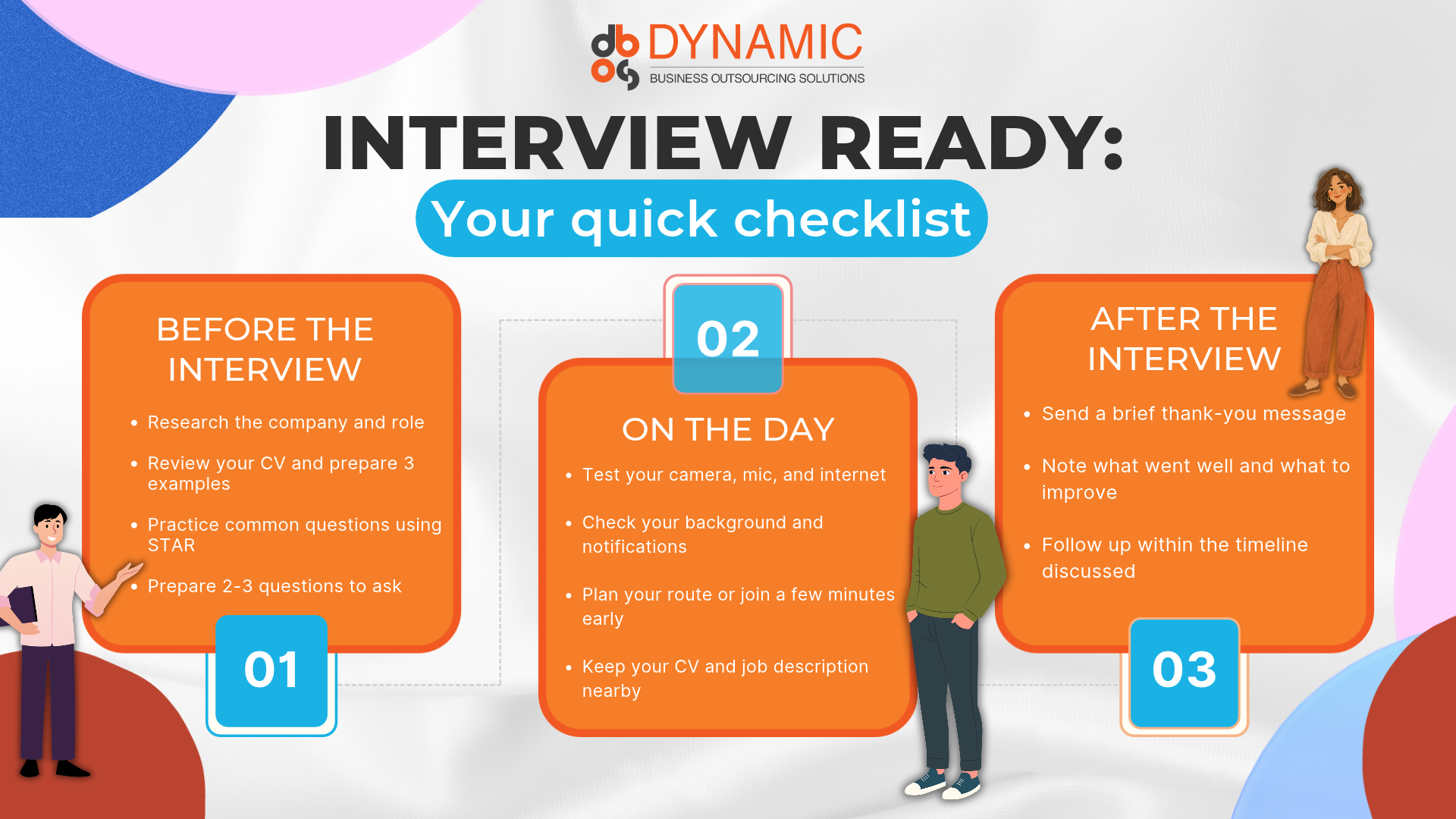
Use this practical interview preparation checklist to get ready before, during, and after your next interview.
Before preparing your answers, learn about the company and the position you’re applying for. This helps you understand what the employer needs and gives you useful context for your responses.
Your checklist:
Practical example: If you’re applying for a Virtual Assistant position, don’t just prepare to discuss administrative experience. Check whether the role involves calendar management, email correspondence, customer enquiries, research, or data entry. Prepare examples that match those responsibilities.
Look for repeated words in the job advertisement. If terms such as “accuracy”, “client communication” and “time management” appear several times, these are likely important priorities. Prepare an example for each rather than giving a general answer about being hardworking.
Interviewers may ask about anything you’ve included in your CV. Make sure you can confidently explain your experience, achievements, responsibilities, and career decisions.
Your checklist:
Practical example: If your CV says you improved a team’s response time, be ready to explain what you changed, how you measured the improvement, and what the result was. If you don’t have exact figures, explain the outcome honestly without inventing numbers.
A useful way to structure your answers is the STAR method:
Prepare examples from different situations, not just your most recent job. If you’re a fresh graduate, you can use examples from internships, university projects, volunteer activities, or part-time work. Employers are interested in how you approach situations, even if you haven’t held a full-time position before.
You don’t need a memorized script, but you should have a clear idea of how you’ll answer common interview questions.
Prepare responses to questions such as:
Practical example: If asked how you handle multiple deadlines, avoid simply saying, “I’m good at time management.” Explain your process: “I list my tasks, check their deadlines and business impact, then confirm priorities with my supervisor if several urgent requests come in at once.”
Practice speaking your answers aloud. This helps you notice whether your responses are too long, unclear, or overly rehearsed.
Related Article: 4 Questions to Ask in an Interview to Land Your Dream Job.
An interview is also your opportunity to decide whether the company and role are right for you. Asking thoughtful questions shows that you’re interested and have considered what the position involves.
Consider asking:
Easy-to-miss tip: Ask how performance will be measured. For example, a customer support role might assess response time, customer satisfaction, and quality scores. Understanding these expectations helps you decide whether the role matches your strengths and working style.
Avoid asking questions that are clearly answered on the company’s website or job advertisement. Use the interview to learn something you couldn’t easily find yourself.
Even strong answers can be affected by poor preparation on the day. Make sure your technology, location, and schedule are ready.
For an in-person interview:
For an online interview:
Check what appears behind you on camera. Remove personal information, distracting objects, or anything you wouldn’t want a potential employer to see. Also, test your audio using the same device and headset you’ll use during the interview.
If you’re applying for a remote position, make sure you can explain how you manage distractions, maintain communication, and stay productive while working from home.
Even strong answers can be affected by poor preparation on the day. Make sure your technology, location, and schedule are ready. If you need additional guidance, Harvard’s interview preparation guide offers useful advice on preparing for interviews, presenting yourself professionally, and making a positive impression.
Some employers may ask about your expected salary, notice period, or earliest possible start date. Think about these details before the interview so you can respond clearly.
Your checklist:
Practical example: Instead of giving an uncertain answer such as “Anything is fine”, you could say, “Based on the responsibilities and my experience, I’m looking for a salary within this range, but I’m open to discussing the overall package.”
For Filipino applicants working with overseas clients, also clarify the expected working hours, time zone, equipment arrangements, and communication expectations.
Your preparation shouldn’t end when the interview finishes. A brief, professional follow-up can reinforce your interest in the opportunity.
After the interview:
Practical example: If you discussed the company’s onboarding process, you could mention that you appreciated learning how new employees are supported during their first few months.
If you don’t receive an update immediately, allow the timeframe given by the recruiter before following up. If no timeframe was provided, a polite email after a few business days is generally reasonable.
A successful interview starts before you meet the interviewer. Research the company, understand the job description, review your CV, practice relevant examples, and prepare thoughtful questions. Don’t overlook the practical details, either: test your equipment, plan your travel, and know your salary expectations.
Most importantly, remember that an interview is a two-way conversation. It gives employers a chance to understand your capabilities and gives you an opportunity to decide whether the workplace is right for you.
If you’re ready to take the next step in your career, Dynamic Business Outsourcing Solutions (DBOS) offers opportunities across Virtual Assistance, Accounting, Sales, Quality Assurance, Claims, Collections, Digital Marketing, IT, and other back-office roles. Explore our current opportunities and discover where your skills could take you: Visit the DBOS Careers page.